

Understanding Search Engines
Search engines like Google, Bing, and Yahoo are gateways to the internet, helping users find relevant content quickly. They operate by crawling websites, indexing their content, and ranking pages based on factors such as relevance, quality, and user experience. Search engine algorithms are sophisticated and constantly evolving, incorporating signals like content quality, site speed, mobile-friendliness, and user engagement metrics.
Effective SEO content marketing requires staying updated with these algorithm changes and leveraging search data to optimize your content strategy. Conducting thorough keyword research helps identify the search queries your audience uses, the search volume for those queries, and the intent behind them. This insight guides the creation of content that aligns with what users are actively seeking, increasing your chances of ranking higher on the search engine results page (SERP).
Understanding how search engines work is the foundation for developing a successful content marketing strategy. Next, we’ll explore how content marketing integrates with SEO to drive online success.
Introduction to Content Marketing
This comprehensive guide covers the integration of SEO and content marketing—known as SEO content marketing—providing actionable strategies for marketers, business owners, and content creators. Mastering SEO content marketing is essential for online success because it ensures your content is discoverable, relevant, and engaging, ultimately driving more qualified traffic and conversions.
Scope: This article explores how to strategically combine SEO (Search Engine Optimization) and content marketing to maximize your website’s visibility and effectiveness.
Target Audience: Marketers, business owners, and content creators seeking to improve their online presence and achieve measurable results.
Importance: Mastering SEO content marketing is crucial for standing out in competitive digital landscapes, building brand authority, and achieving sustainable growth.
SEO content marketing is a strategic approach focused on creating and distributing valuable, relevant, and consistent content to attract and retain a clearly defined audience. Unlike traditional advertising, SEO content marketing aims to build trust and foster long-term relationships with potential and existing customers by providing information that addresses their needs and interests. This strategy drives profitable customer action by positioning your brand as a helpful resource.
In the digital age, content marketing plays a crucial role in overall digital marketing efforts. When combined with SEO, it enhances your online visibility, helping your valuable content reach the right audience at the right time. Understanding your target audience and their search intent—the reasons behind their queries—is fundamental to crafting content that resonates and performs well in search engine results.
To fully leverage content marketing, it's important to understand how search engines operate and what factors influence content visibility.
Defining SEO and Content Marketing
Before diving deeper, let’s clarify the definitions and relationship between SEO and content marketing:
-
SEO (Search Engine Optimization): SEO is the process of improving a website's visibility in search results from search engines. It focuses on making a website discoverable through search engines by optimizing technical elements, keywords, and site structure.
-
Content Marketing: Content marketing focuses on creating and distributing valuable content to attract and retain a defined audience. It is more strategic, aiming to build relationships and provide ongoing value.
-
Key Differences: The main difference between content marketing and SEO is that content marketing is more focused on the audience, while SEO is more focused on the search engines. Content marketing is more strategic, while SEO is more tactical.
-
Integration: Both content marketing and SEO work best when used together to achieve online goals. SEO ensures your content is found, while content marketing ensures it is valuable and engaging for your audience.
SEO and content marketing work best when integrated effectively to maximize visibility in search results.
Developing an SEO Strategy
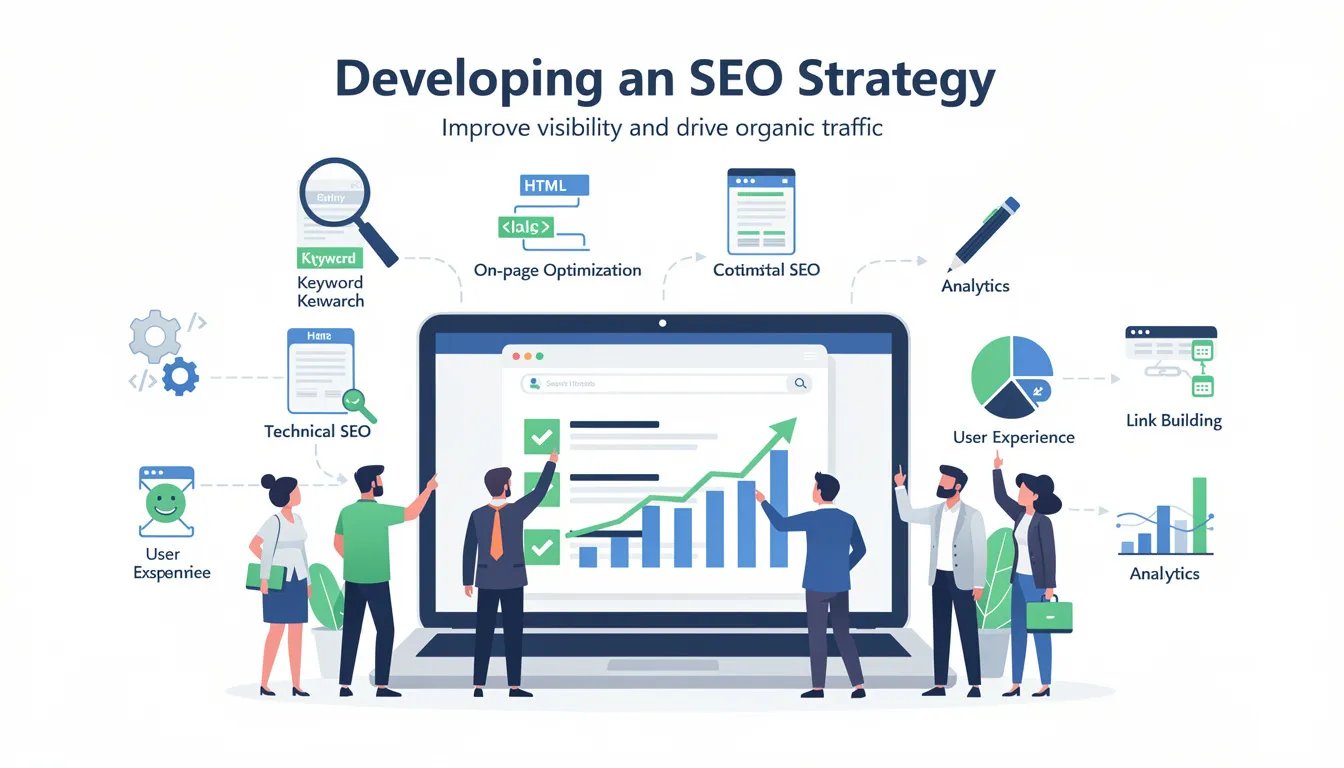
An SEO strategy is a comprehensive plan designed to improve your website’s visibility in search engine results and drive organic traffic. It encompasses several key components. Here are the essential steps:
Key Components of an SEO Strategy:
-
Keyword Research: Identify valuable keywords that your target audience uses and prioritize them based on relevance, search volume, and competition.
-
On-Page Optimization: Structure content with clear headings, meta descriptions, title tags, and naturally integrated keywords to help search engines understand your pages. Learn more about SEO for SMEs | On-Page, Technical & Local Growth.
-
Technical SEO: Ensure your website’s technical foundation supports SEO performance by optimizing site speed, mobile usability, crawlability, and fixing broken links. This also includes implementing schema markup, which helps search engines better understand the entities and context within your content, improving how your pages are indexed and displayed in search results.
-
Link Building: Acquire backlinks from authoritative sites to boost your content’s credibility and search rankings. Content marketing plays a vital role here by generating backlinks, attracting media attention, and providing a positive experience for your audience, all of which enhance your SEO efforts.
-
Author Credibility: Include detailed author bios with credentials on your content pages to enhance credibility and authority, signaling to search engines and users alike that your content is trustworthy and created by knowledgeable subject matter experts.
A well-executed SEO strategy not only increases your online visibility but also enhances user experience, driving more qualified traffic and boosting conversions. It requires continuous monitoring and adaptation as search engine algorithms and user behaviors evolve. Tracking engagement metrics, conversions, and visibility across various search features is essential to measure the effectiveness of your SEO and content marketing efforts and to inform ongoing strategy improvements.
With a solid SEO strategy in place, the next step is to focus on creating high-quality content that meets both user needs and search engine requirements.
Creating High-Quality Content

High-quality content is the cornerstone of successful SEO content marketing. To stand out and rank well, your content must excel in several areas.
Key Attributes of High-Quality Content
-
Relevant: Address the specific needs and interests of your target audience.
-
Valuable: Provide unique insights, actionable information, or solutions that users cannot easily find elsewhere.
-
Engaging: Write in a clear, compelling style that encourages users to read, share, and interact.
Optimizing Content Formats for Engagement
To improve search engine visibility and user engagement:
-
Incorporate relevant keywords naturally throughout your content, including in headings, paragraphs, and meta elements, to improve search engine visibility without keyword stuffing.
-
Diversify content formats by including blog posts, guides, videos, infographics, and interactive tools to cater to different user preferences and enhance engagement.
By focusing on these attributes and formats, you can create content that not only ranks well but also resonates with your audience.
Next, let’s explore how to optimize content quality specifically for search engine performance.
Content Quality and Search Engine Optimization
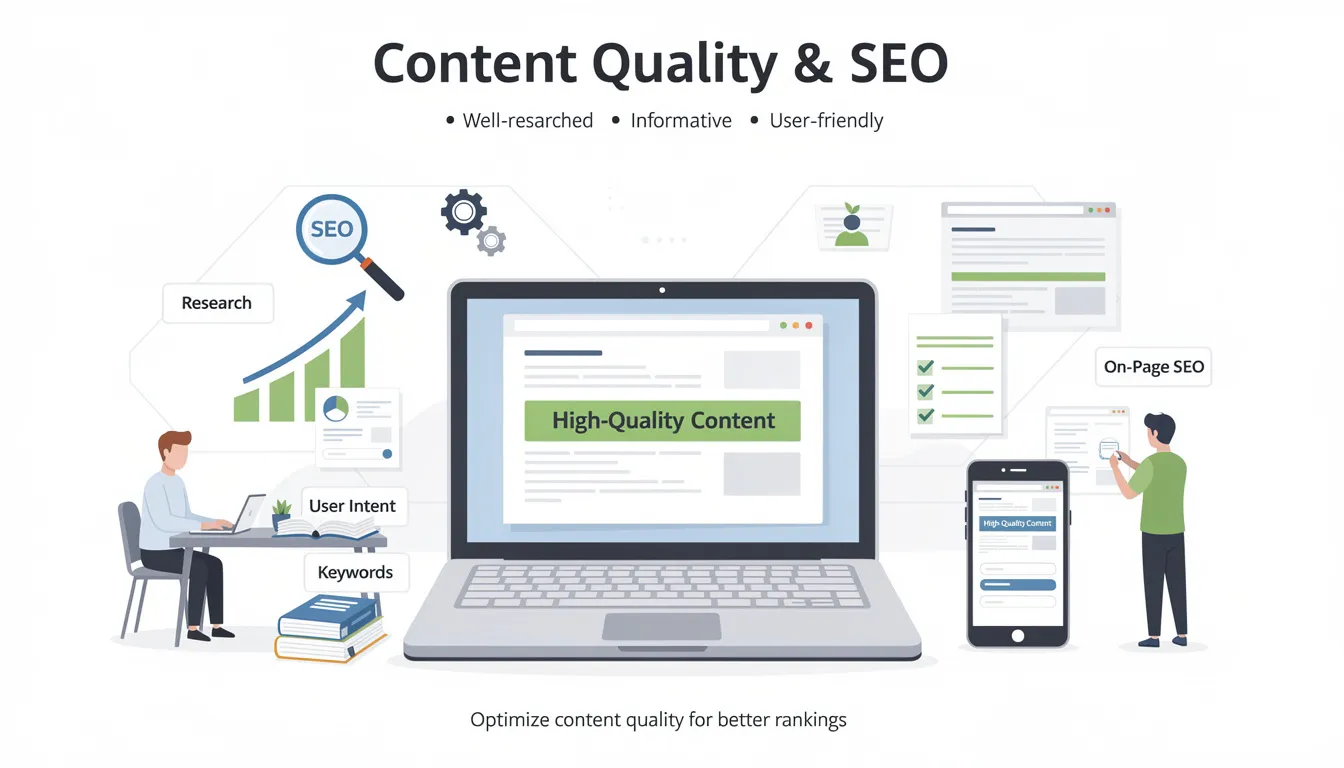
Content quality and SEO are deeply interconnected. Search engines prioritize content that is well-researched, informative, and user-friendly. Here’s how to optimize your content for SEO:
Optimizing for User Intent
-
Use primary and related keywords strategically to signal topic relevance.
-
Ensure your content aligns with user intent, answering the questions or solving the problems behind search queries.
Structuring Content for SEO
-
Optimize meta descriptions and title tags to improve click-through rates from search results.
-
Maintain a logical structure with clear headings and subheadings to enhance readability and accessibility.
-
Incorporate internal links to related pages within your website to improve navigation and distribute link equity.
Updating Content for Relevance
-
Regularly update existing content to keep it fresh and relevant.
Implementing these practices helps your content perform better in search engine rankings while providing a positive user experience.
Understanding the role of search engines in content marketing is the next step in building a comprehensive strategy.
The Role of Search Engines in Content Marketing
Search engines are vital partners in content marketing. They connect your valuable content with users actively seeking information. Optimizing content for search engines increases your brand’s online visibility, driving organic traffic that is more likely to convert.
By understanding how search engines evaluate content, marketers can tailor their content marketing strategies to meet both user needs and SEO requirements. Using tools like Google Search Console and Google Analytics allows you to monitor how your content performs in search results, identify opportunities for improvement, and track key metrics such as impressions, clicks, and bounce rates.
With this knowledge, you can better align your SEO efforts and content marketing for maximum impact.
SEO Efforts and Content Marketing
SEO and content marketing are complementary disciplines that, when combined, amplify each other’s effectiveness. SEO ensures your content is discoverable by search engines, while content marketing focuses on creating content that attracts and retains your audience.
Together, they help build brand authority, increase online visibility, and drive profitable customer actions. Understanding search intent and continuously optimizing content to meet evolving user expectations are essential for maximizing the synergy between SEO efforts and content marketing.
The next section will show how to optimize your content creation process using collaborative tools.
Optimizing Content with Google Docs
Google Docs is a versatile tool that supports the content creation process by enabling real-time collaboration, editing, and optimization. It allows teams to draft, review, and refine content while integrating SEO best practices such as keyword placement, meta description drafting, and readability checks.
Using Google Docs effectively can streamline your content creation workflow, improve content quality, and ensure alignment with SEO goals before publishing.
Now, let’s look at how understanding search results can further refine your SEO content marketing strategy.
Understanding Search Results
Search results pages are where your content competes for user attention. Understanding the different types of search results—including organic listings, featured snippets, local packs, and paid ads—helps you tailor your SEO content marketing strategy.
Analyzing search results for your target keywords can reveal content formats that perform well, user intent, and gaps in existing content. This insight guides the creation of content that stands out and ranks higher, driving more traffic and engagement.
With this understanding, you’re ready to build a successful content marketing campaign.
Building a Successful Content Marketing Campaign
A successful content marketing campaign integrates high-quality content creation, SEO optimization, and targeted promotion. Here are the key steps, each with a specific focus:
Defining Your Audience
-
Clearly define your target audience and understand their search intent.
Conducting Keyword Research
-
Perform keyword research to identify valuable keywords that align with your audience’s needs.
Content Creation and Optimization
-
The Essential Guide to Becoming a Successful UGC Creator, Create relevant, engaging content optimized for SEO, ensuring it addresses user intent and incorporates best practices.
Promotion Strategies
-
Promote content through social media, email marketing, CTV and streaming audio, digital agencies, and partnerships with other websites to expand reach and attract backlinks.
Performance Analysis
-
Analyze performance metrics to refine your strategy continuously, using data to identify what works and where improvements are needed.
Consistent execution of these steps builds brand authority, drives organic traffic, and supports long-term business growth.
Measuring and analyzing your results is essential for ongoing improvement.
Measuring and Analyzing Performance
Measuring the effectiveness of your SEO content marketing efforts is critical. Use tools like Google Analytics and Google Search Console to track key performance indicators. If you're also running performance media campaigns on Google and Meta, monitoring these metrics becomes even more important to assess your ROAS and lead generation. Here are the main metrics to monitor:
-
Organic traffic volume
-
Keyword rankings
-
Bounce rate and time on page
-
Conversion rates
-
Backlink profiles
Regularly analyzing these metrics helps identify what’s working, uncover content gaps, and optimize your strategy for better SEO performance and audience engagement.
Avoiding common mistakes is also crucial for maintaining strong search engine rankings.
Common Mistakes to Avoid in SEO
Avoiding common SEO pitfalls is essential to maintaining strong search engine rankings. Here are some frequent mistakes and how to recognize them:
-
Keyword Stuffing: Overusing keywords in a way that reduces readability and may lead to penalties.
-
Duplicate Content: Publishing the same or very similar content across multiple pages, which confuses search engines.
-
Broken Links: Links that lead to non-existent pages harm user experience and SEO.
-
Ignoring User Intent: Creating content that doesn’t align with what users are searching for.
-
Neglecting Technical SEO: Overlooking site speed, mobile usability, and crawl errors.
By steering clear of these errors and focusing on quality, relevance, and technical soundness, you can build a robust SEO content marketing foundation.
FAQs About SEO Content Marketing
Before diving into the most common questions, let’s clarify the relationship between SEO and content marketing:
-
SEO (Search Engine Optimization): SEO is the process of improving a website's visibility in search results from search engines. It is more tactical, focusing on technical optimization and discoverability.
-
Content Marketing: Content marketing focuses on creating and distributing valuable content to attract and retain a defined audience. It is more strategic, emphasizing audience engagement and long-term value.
-
Key Difference: Content marketing is more focused on the audience, while SEO is more focused on the search engines.
-
Integration: SEO focuses on making a website discoverable through search engines, while content marketing attracts and retains the target audience. Both work best when used together to achieve online goals.
Q1: What is the difference between SEO and content marketing?
SEO focuses on optimizing your website and content to rank higher in search engine results, while content marketing is about creating and distributing valuable content to attract and engage your target audience. Together, they work synergistically to increase visibility and drive profitable customer actions.
Q2: How do I identify the right keywords for my content?
Conduct keyword research using tools like Google Keyword Planner, SEMrush, or Ahrefs. Focus on keywords that have good search volume, align with your audience’s intent, and are relevant to your business goals. Prioritize long-tail keywords and conversational phrases for more specific targeting, lower competition, and to better match natural search behavior.
Q3: Why is user intent important in SEO content marketing?
Aligning content with search intent ensures that each piece answers the specific questions behind a user's query. This improves engagement, satisfies user needs, and boosts search rankings by providing helpful content that matches what users are actually looking for.
Q4: What types of content are most effective for SEO?
Effective content types include expert-led blog posts, short-form videos, interactive tools, and original research reports. These formats not only address diverse user preferences but also demonstrate human expertise—a major ranking factor as AI-generated content becomes more common.
Q5: How should I organize my website’s content for SEO?
Establishing a logical site architecture by organizing content into topic clusters helps both users and search engines understand your site hierarchy. This improves navigation, distributes link equity through internal links, and signals topical authority to search engines.
Q6: How important are backlinks for SEO?
Building high-quality backlinks from authoritative and relevant websites is vital for SEO. Creating linkable assets such as unique research, comprehensive guides, or guest blogging opportunities can attract valuable backlinks, significantly improving your search engine rankings and referral traffic.
Q7: Is content marketing cost-effective compared to traditional marketing?
Yes, content marketing is roughly 62% more cost-effective than traditional outbound marketing. It provides long-term visibility, especially since organic search accounts for over 53% of all website traffic, making it a sustainable strategy for growth.
Q8: How is search evolving, and how does that affect SEO?
Search is evolving beyond traditional text-based queries with the rise of smart assistants, voice search, and visual tools. This requires adapting SEO strategies to include conversational keywords and optimizing for multiple content formats to meet changing user behaviors.
Q9: What technical SEO factors should I prioritize?
Prioritize maintaining a fast-loading, mobile-friendly, and secure website. Meeting Core Web Vitals standards ensures your site has the technical foundation needed for SEO success, improving user experience and search engine rankings.
Q10: Can user-generated content help with SEO?
Encouraging user-generated content and community discussions adds authentic insights and fresh perspectives, which can favorably influence search rankings. It also enhances engagement and helps build a loyal audience.
Q11: How often should I update my content?
Regularly audit and update your content every 6 to 12 months to keep it accurate, relevant, and aligned with current search intent. This signals to search engines that your site is active and maintains SEO performance.
Q12: Can AI-generated content be used for SEO?
AI-generated content can assist in the content creation process by providing drafts or ideas. However, it must be reviewed and refined by human experts to ensure originality, accuracy, and alignment with your brand voice. Human expertise remains crucial as a ranking factor in SEO.
Conclusion
SEO content marketing strategically combines search engine optimization with content marketing to rank high in search results. Effective SEO content marketing combines technical optimization, high-quality content creation, and strategic promotion. SEO and content marketing work best when integrated effectively to maximize visibility in search results.
With a well-rounded SEO content marketing strategy that integrates keyword research, high-quality content creation, technical optimization, and ongoing performance analysis, your online business can achieve sustainable growth and increased visibility in search engine results. Prioritizing content marketing within your digital strategy ensures that your brand not only attracts visitors but also builds lasting relationships with your audience.

0 comments