

Introduction: Who This Guide Is For and Why It Matters
This guide is for leaders, managers, aspiring coaches, parents, and anyone interested in fostering growth and collaboration in themselves and others. Understanding the coach mindset is crucial in 2025’s rapidly changing workplace and personal environments. As hybrid teams, AI-driven tools, and constant change reshape how we work and live, the ability to think, act, and lead like a coach is no longer optional—it’s a core skill for anyone who wants to empower others, build resilient teams, and create meaningful impact.
Key Takeaways on Coach Mindset and Mindset Coach Practices
-
A coach mindset means seeing others as capable, asking more than telling, and focusing on growth rather than control—it’s about who you’re being, not just what you’re doing.
-
The coaching mindset is built on clear philosophical assumptions about people, knowledge, and values, not just on skills like listening or asking open ended questions.
-
In a 2025 workplace shaped by hybrid teams, AI tools, and constant change, a coach mindset is now a core leadership and career skill—not a “nice-to-have.”
-
Anyone—manager, entrepreneur, parent, freelancer—can develop this mindset through daily practices: self reflection, better questions, and growth-oriented constructive feedback.
-
The sections below provide concrete examples, step-by-step strategies, and answers to real-world challenges like time pressure and working with people who seem unmotivated.
What Is a Coach Mindset? A Transformative Approach to Personal Development
A coach mindset is a way of seeing and relating to people that prioritizes curiosity, partnership, and personal growth over control, advice-giving, or rescuing. It’s the difference between approaching a conversation thinking “How can I fix this person?” versus “How can I help this person think better about this?”
Explicit Definition and Philosophical Core:
A coaching mindset represents a specific approach to dialogue, personal change, leadership, and collaboration. At its core, the coaching mindset is about fostering an empowering, non-judgmental, and collaborative relationship that facilitates personal growth, learning, and transformation. It recognizes the client’s autonomy, respects their individuality, and believes in their capacity to construct their own reality and achieve their potential. The coaching mindset assumes that the client is the expert in their life and work, not the coach. This approach is anchored in constructivist, social constructionist, and humanistic assumptions, emphasizing that people learn best through their own insights and experiences. By fostering an empowering, non-judgmental, and collaborative relationship, the coaching mindset creates the conditions for meaningful and sustainable change.
When you operate from a coach mindset, you believe that the person in front of you is resourceful and capable of finding their own solutions. Your role shifts from expert who provides answers to thinking partner who helps them develop understanding of their situation, explore different perspectives, and choose their path forward. This mindset transformation doesn’t require a certification—it requires a deliberate shift in how you show up.
The International Coaching Federation (ICF) formalized this concept in 2021 when they added “Embodies a Coaching Mindset” as a core competency. They define it as developing and maintaining a mindset that is open, curious, flexible, and client-centered. These four words capture the essence of the stance.
What is the mindset of a coach?
The mindset of a coach is characterized by curiosity, empathy, and a belief in the potential of others. It involves seeing clients as whole, resourceful individuals capable of growth and change. A coach maintains a positive outlook, fosters psychological safety, and creates space for clients to explore their own journey. This mindset encourages active listening, asking powerful open-ended questions, and providing constructive feedback that supports personal and professional growth.
Coach Mindset vs. Expert Mindset: Key Mindset Shift for Effective Leadership
|
Expert/Control Mindset |
Coach Mindset |
|---|---|
|
“I know what you should do” |
“What do you think could work?” |
|
Provides the answer immediately |
Creates space for the other person to think |
|
Sees the person as a problem to fix |
Sees the person as resourceful and whole |
|
Focuses on efficiency and speed |
Focuses on learning and long-term growth |
|
Owns the solution |
Helps the other person own their journey |
Concrete Behaviors That Signal a Coach Mindset in Life Coaching and Beyond
In daily work, a coach mindset shows up through specific actions:
-
Asking open questions in 1:1s rather than immediately offering your perspective
-
Pausing before giving advice, even when you’re confident you know the answer
-
Reflecting back what you heard to confirm understanding
-
Co-creating next steps instead of assigning tasks
-
Checking what the other person wants from the conversation before diving in
A 2025 Workplace Scenario: Applying a Coach Mindset to Future Goals
Imagine you’re a hybrid team lead based in London. One of your direct reports, working remotely from Manchester, missed a critical project deadline in February 2025. The old approach might be to immediately identify the cause, explain what went wrong, and prescribe a solution.
With a coach mindset, the conversation looks different:
“I noticed the deadline was missed. Before I share any thoughts, I’m curious—what happened from your perspective?”
You listen. You ask follow-up questions. You explore what got in the way and what the person learned. You might ask, “If you could approach this again, what would you do differently?” Only after they’ve done their own thinking do you add your observations—if they’re even needed.
This approach takes roughly the same amount of time, but the outcomes differ: the person develops self awareness, feels trusted, and is more likely to prevent the same issue in the future.
A coach mindset isn’t limited to professional coaches. Leaders, HR professionals, teachers, parents, and peers can all adopt this stance. It’s broader than certification—it’s a way of being in relationship with others.

The Philosophical Foundations of a Coach Mindset: A Transformative Approach
Coaching isn’t just a collection of tools and techniques. It rests on assumptions about how people learn, grow, and change. Understanding these foundations helps you apply the mindset more authentically—and avoid the trap of using coaching skills without the underlying beliefs that make them work.
Think of it this way: coaching skills are like musical instruments, and the coach mindset is the musician’s understanding of music itself. Without that deeper understanding, the instruments produce noise, not music.
The philosophical foundations can be grouped into three areas: how we view knowledge, how we view people, and what values guide our actions.
How a Coach Thinks About Knowledge and Learning in Personal Development
Coaches assume people learn best by making sense of their own experience. This is sometimes called a constructivist view—the idea that we build our own understanding rather than passively receiving information from experts.
In practice, this means:
-
Asking reflective questions about actual situations—a failed pitch in March 2025, a tough performance review last quarter—rather than abstract hypotheticals
-
Expecting multiple valid perspectives: the manager’s view, the client’s view, the co-worker’s view, and helping the person explore all of them
-
Trusting that insight created by the person will stick longer than advice imposed from outside
-
Focusing on the process of thinking, not just the content of what’s discussed
For example, after a team member receives difficult constructive feedback from a client, a coach-minded leader might ask: “What stood out to you about that feedback? What part, if any, do you think is accurate? What would you want to do with this?”
This approach builds the person’s capacity to learn from future situations—not just solve the current one.
How a Coach Sees People and Values in Life Coaching and Mindset Transformation
A coach mindset rests on a positive, yet realistic, view of human nature. It assumes people are not problems to fix but individuals capable of growth, choice, and change. This doesn’t mean ignoring performance issues or pretending everyone is perfect. It means believing that behavior is changeable and that a person’s identity is richer than any label—“underperformer,” “difficult,” or even “high-potential.”
Key beliefs include:
-
People are inherently resourceful and can develop the abilities they need
-
Everyone is responsible for their own choices and outcomes
-
Context matters—culture, systems, and circumstances shape what people do
-
Change happens best when people feel respected, not judged
The values that guide coach-like behavior are dignity, autonomy, and confidentiality. These show up practically:
-
Asking permission before giving feedback: “Would it be helpful if I shared an observation?”
-
Respecting “no” when someone isn’t ready to explore a topic
-
Keeping commitments about privacy in 1:1 conversations
Consider a manager in April 2025 whose team member is experiencing burnout and layoff anxiety. A coach mindset doesn’t mean pretending everything is fine or offering false reassurance. It means acknowledging the difficulty, asking what support would help, and respecting the person’s agency in navigating their own situation—while being clear about what you can and can’t control as their manager.
What a Coach Mindset Looks Like in Practice: Mindset Shift for Effective Leadership and Personal Development
Theory matters, but daily behavior is where the coach mindset becomes real. This section shifts from philosophy to action—what you actually do in meetings, emails, Slack messages, and corridor conversations.
A skilled coach doesn’t just know the right things to believe; they translate those beliefs into observable actions. And the good news is that these actions can be learned and practiced by anyone.
Hallmark Attitudes of a Mindset Coach
The attitudes behind a coach mindset include:
-
Curiosity: Genuine interest in the other person’s experience and perspective
-
Non-judgment: Suspending premature conclusions about what’s happening or what should happen
-
Belief in potential: Assuming the person can grow and learn, even when current performance is poor
-
Patience: Comfort with the other person’s learning curve, even when it’s slower than you’d like
-
Comfort with not knowing: Being okay without having the “right” answer
-
Presence: Showing up fully, not distracted by your phone, your next meeting, or your own agenda
What are the 5 C's of coaching?
The 5 C's of coaching provide a framework for effective coaching relationships and practices:
-
Curiosity – Maintaining an open and inquisitive mindset to explore the client’s experience.
-
Connection – Building trust and rapport to create a safe space for honest dialogue.
-
Clarity – Helping clients gain clear understanding of their goals, challenges, and options.
-
Commitment – Supporting clients to take ownership and follow through on their actions.
-
Compassion – Approaching clients with empathy and non-judgment, honoring their journey.
What are the 7 pillars of coaching?
The 7 pillars of coaching represent foundational elements that contribute to successful coaching:
-
Trust and Safety – Creating a confidential and supportive environment.
-
Active Listening – Fully attending to the client’s words, emotions, and nonverbal cues.
-
Powerful Questioning – Using open-ended, thought-provoking questions to stimulate insight.
-
Goal Setting – Facilitating clear, achievable personal and professional goals.
-
Accountability – Encouraging responsibility for actions and progress.
-
Feedback – Providing constructive and balanced feedback to foster growth.
-
Continuous Learning – Embracing ongoing development for both coach and client.
What are the 3 C's of coaching?
The 3 C's of coaching focus on core coaching principles:
-
Competence – The coach’s skills and knowledge to facilitate effective coaching.
-
Commitment – The dedication of both coach and client to the coaching process.
-
Collaboration – The partnership between coach and client working toward shared objectives.
What is a mind coach?
A mind coach specializes in helping individuals identify and overcome limiting beliefs, mental blocks, and unhelpful thought patterns. They use techniques from psychology, neuro linguistic programming, mindfulness, and mindset coaching to facilitate mindset transformation. Mind coaches support clients in building resilience, self confidence, and a positive outlook to achieve personal and professional goals.
How much does mindset coaching cost?
The cost of mindset coaching varies widely depending on factors such as coach experience, session length, and format (individual or group). On average, mindset coaching sessions can range from $100 to $300 per hour. Some coaches offer packages or programs that may cost several thousand dollars, providing ongoing support and structured development. Investing in mindset coaching is considered a powerful tool for personal growth and overcoming challenges.
How to become a mind coach?
Becoming a mind coach involves developing coaching skills, gaining knowledge in psychology and mindset techniques, and building practical experience. While certification is not always mandatory, completing reputable training programs—such as those aligned with the International Coach Federation or specialized mindset coaching academies—can enhance credibility. Aspiring mind coaches often start by coaching friends or clients at reduced rates to gain experience, then gradually build a coaching business focused on mindset transformation.
What is a coaching mindset?
A coaching mindset is an empowering approach characterized by openness, curiosity, empathy, and a focus on enabling others to find their own solutions. It involves fostering personal growth, continuous learning, and resilience. The coaching mindset values the client’s autonomy, respects their individuality, and supports them in breaking free from limiting beliefs to pursue their personal and professional goals.
What is the difference between a life coach and a mindset coach?
While both life coaches and mindset coaches support personal development, their focus differs. Life coaching typically addresses broader life areas such as career, relationships, and health, helping clients set and achieve goals. Mindset coaching specifically targets the client’s thought patterns, beliefs, and mental blocks, aiming to shift limiting beliefs and foster a positive mindset that underpins success in various life domains. Mindset coaching often involves techniques from psychology and neuro linguistic programming to facilitate deep mindset transformation.
What are the activities of mindset coaching?
Mindset coaching activities include:
-
Guiding clients through mindset journaling to increase self awareness.
-
Facilitating visualization exercises to help clients envision success.
-
Challenging limiting beliefs through cognitive restructuring.
-
Teaching positive affirmations to nurture self confidence.
-
Using powerful questioning to explore thoughts and emotions.
-
Supporting clients in setting actionable goals aligned with a growth mindset.
-
Providing constructive feedback to reinforce progress.
What is meant by mind coaching?
Mind coaching refers to the process of helping individuals develop a positive mindset, overcome mental barriers, and build mental resilience. It involves techniques that promote mindset transformation, enabling clients to break free from limiting beliefs and adopt empowering perspectives. Mind coaching supports personal and professional growth by fostering emotional well being, self confidence, and a solution focused approach to challenges.
Benefits of Adopting a Coach Mindset in 2025: A Transformative Approach to Personal and Professional Growth
The business world in 2025 looks different from five years ago. Hybrid work is standard. AI tools are reshaping roles. Labor markets remain competitive. People expect more from their leaders than task assignment and annual reviews.
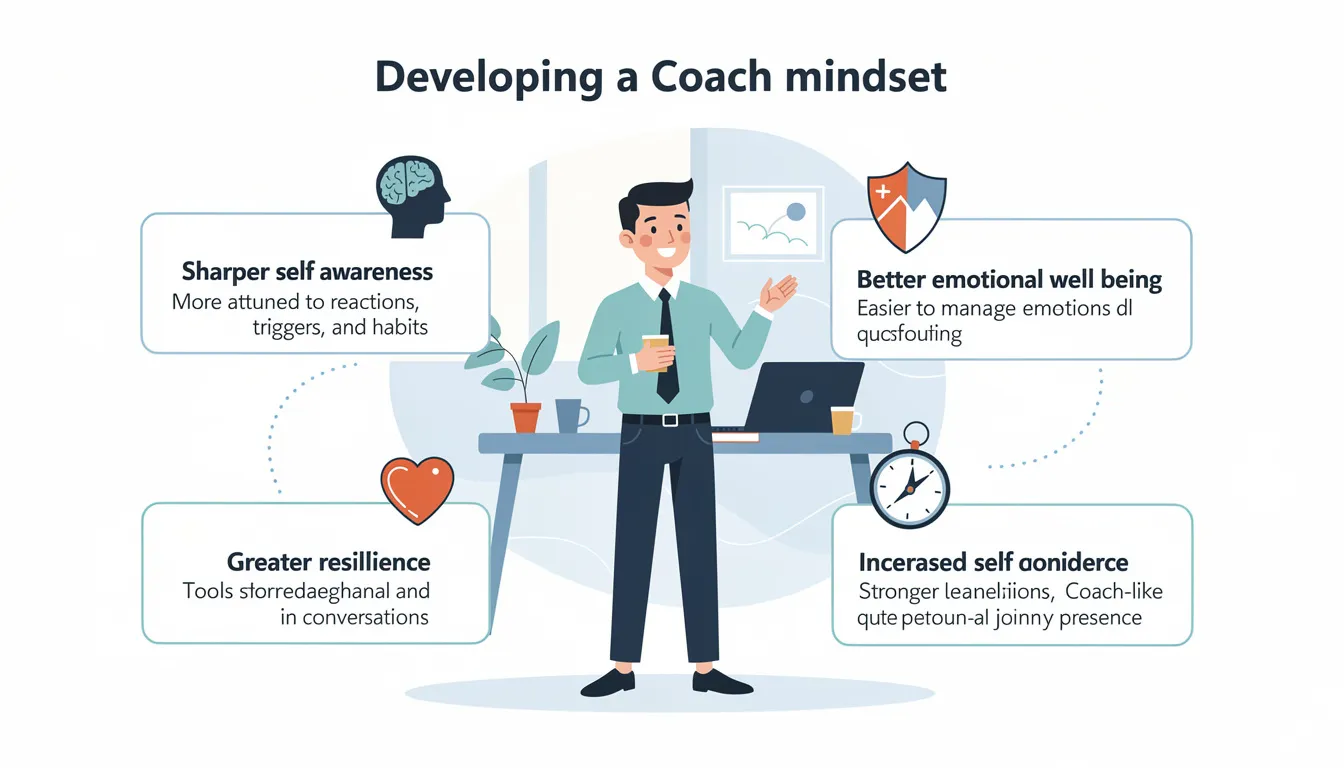
In this environment, a coach mindset isn’t a soft skill—it’s a strategic advantage.
Individual Benefits of a Mindset Coach and Personal Development
For you personally, developing a coach mindset creates:
-
Sharper self awareness: You become more attuned to your own reactions, triggers, and habits
-
Better emotional well being: Managing your emotions in conversations becomes easier with practice
-
Greater resilience: During reorganizations, layoffs, or career pivots, you have tools for reflection and decision-making
-
Clearer career decisions: Asking yourself coach-like questions helps you navigate your own journey
-
Increased self confidence in leadership and interpersonal situations
Team and Organizational Benefits of a Coach Mindset and Life Coaching Culture
For your team and organization, a coach mindset contributes to:
-
Higher engagement: People feel trusted and valued when their thinking is invited, not overridden
-
More ownership of goals: When people create their own path forward, they commit more deeply
-
Fewer bottlenecks: Teams become less dependent on managers for every decision
-
Better knowledge-sharing: A culture of curiosity encourages people to learn from each other
-
Improved psychological safety: People take more risks, admit mistakes, and ask for help
Research supports these outcomes. Studies on coaching-style leadership consistently link it to higher engagement, better retention, and stronger innovation climates. The Harvard Business Review has repeatedly highlighted coaching as a core leadership competency for today’s world.
Benefits Outside Work: Mindset Coach Skills for Life Coaching with Loved Ones
The mindset also improves life beyond the office:
-
More constructive conversations with loved ones
-
Better support for teenagers navigating school and future goals
-
Improved communication in relationships, including during conflict
A parent who approaches a teenager’s exam results with curiosity—“What happened from your perspective? What would you do differently?”—creates a safe space for growth rather than defensiveness.

How to Develop a Coach Mindset Step by Step: A Mindset Shift for Personal Development and Life Coaching
Developing a coaching mindset is a continuous journey that requires self-awareness, ongoing learning, and regular practice. Self-awareness is a foundational element in developing a coaching mindset, as it helps you notice your own habits and reactions. Continuous learning is essential for maintaining and deepening your coaching mindset, while practicing core coaching skills is necessary for growth. Developing a coaching mindset requires time, practice, and commitment, but the rewards are significant for both you and those you support.
Step 1: Notice and Interrupt the Advice Reflex in Coaching Sessions
Most of us default to giving advice. It’s faster, and it feels helpful. The first step is simply noticing when you do this.
-
In each 1:1 this week, notice when you feel the urge to give advice
-
Pause and ask a question instead: “What have you already considered?”
-
Track how often you catch yourself—awareness is the first skill
Step 2: Upgrade Your Questions for a Mindset Shift
Replace closed questions with open ones. Instead of “Did you try X?”, ask “What approaches have you explored?”
-
Prepare 2-3 go-to open ended questions before meetings
-
Practice asking “What else?” after the first response
-
Avoid questions that are advice in disguise: “Have you thought about…?” is really a suggestion
Step 3: Practice Deep Listening as a Mindset Coach
Listening sounds simple, but most people listen while preparing their response. Deep listening means:
-
Focusing entirely on what the other person is saying
-
Noticing tone, emotion, and what’s not being said
-
Summarizing before adding your perspective: “What I’m hearing is…”
Step 4: Reflect After Conversations for Personal Development
Continuous learning requires reflection. After key conversations:
-
Ask yourself: “What worked? What would I do differently?”
-
Notice patterns in your defaults—do you always jump to solutions?
-
Regularly reflect in a small journal or notes app
Step 5: Seek Feedback on Your Style as a Mindset Coach
Ask trusted colleagues: “When we talk, do you feel like I give you space to think?” Their answers provide valuable insights you can’t get from self-reflection alone.
Step 6: Consider Formal Training in Life Coaching or Mindset Coaching
While self-directed practice is powerful, formal training can accelerate development. Look for:
-
ICF-aligned courses from a reputable coaching academy
-
Internal corporate coaching programs
-
Workshops on solution focused coaching or neuro linguistic programming approaches
Even a two-day workshop can provide valuable frameworks and feedback.
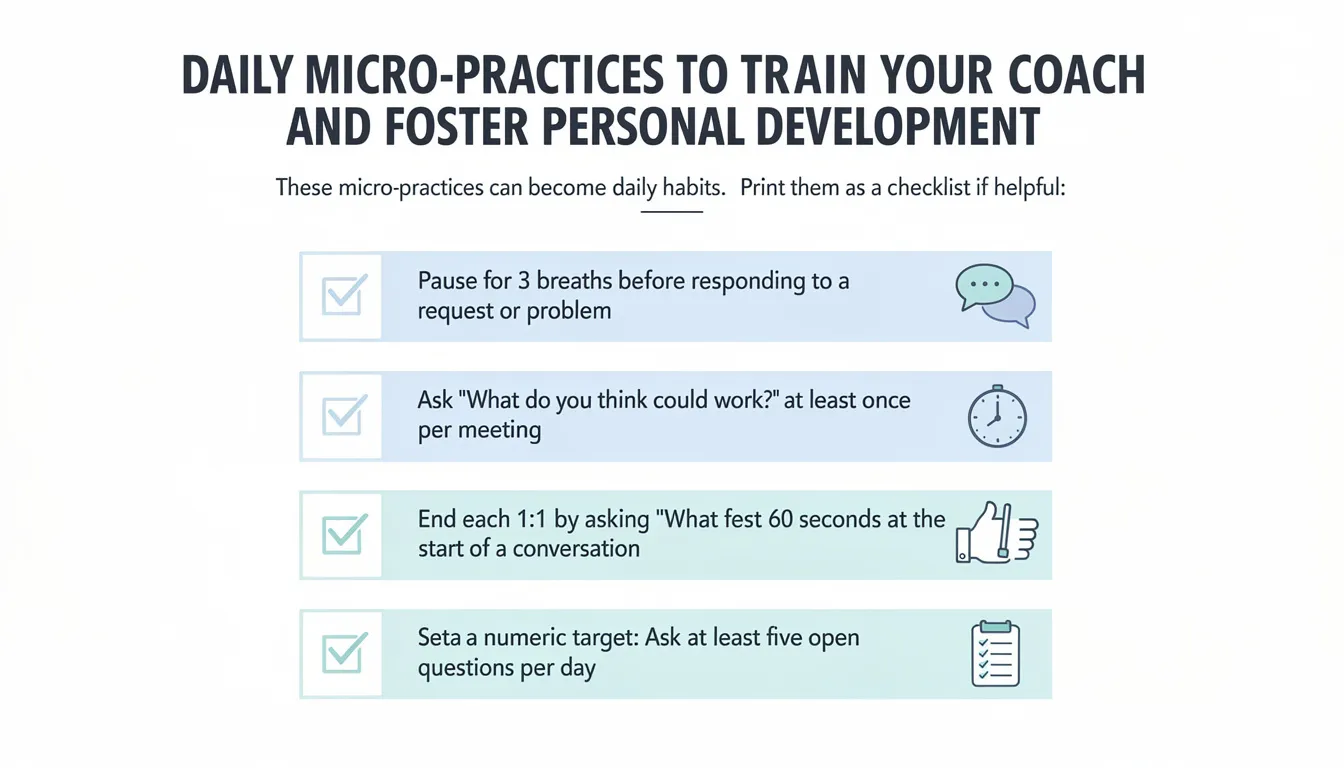
Daily Micro-Practices to Train Your Coach Mindset and Foster Personal Development
These micro-practices can become daily habits. Print them as a checklist if helpful:
-
Pause for 3 breaths before responding to a request or problem
-
Ask “What do you think could work?” at least once per meeting
-
End each 1:1 by asking “What feels most useful from today?”
-
Listen without interrupting for at least 60 seconds at the start of a conversation
-
Set a numeric target: Ask at least five open questions per day
Practice these in everyday situations—helping a colleague stuck on a task, talking with a friend about a 2025 goal, or debriefing a presentation that didn’t land.
Track your micro-practices over a 30-day period. Use a simple tally on paper or a habit app. This creates momentum and makes progress visible.

Common Challenges and How to Work Through Them in Developing a Coach Mindset
Shifting from telling to coaching can feel slow, awkward, or risky—especially in high-pressure environments like quarter-end, funding rounds, or launch weeks. Here’s how to handle common obstacles:
Challenge 1: “I Don’t Have Time for This” in Coaching Sessions
Reality: Coaching conversations don’t have to be long. A 5-minute mindset shift can happen in any conversation.
Strategies:
-
Use a “coach-first, advice-second” rule: Ask 2-3 questions before offering your view
-
Limit coaching-style questions to 5-7 minutes, then switch modes if needed
-
Remember that investing time now saves time later—people learn to solve problems independently
Challenge 2: “I’ll Lose Authority if I Don’t Have Answers” as a Mindset Coach
Reality: The best leaders in 2025 build authority through enabling individuals, not by being the smartest person in the room.
Strategies:
-
Frame questions as partnership: “Let’s think through this together”
-
Share your perspective after inviting theirs—not instead of
-
Notice that people often respect leaders who help them grow more than those who just direct
Challenge 3: “The Other Person’s Learning Curve Is Too Slow” in Personal Development
Reality: Some skills take time. Rushing creates dependence, not capability.
Strategies:
-
Focus on one development area at a time
-
Celebrate small progress to maintain motivation
-
Be honest about timelines and expectations—coaching isn’t the same as lowering standards
Challenge 4: “My Culture Expects Leaders to Have All the Answers” in Life Coaching Environments
Reality: Many organizations still reward the “hero leader” model.
Strategies:
-
Start quietly within your own team before trying to change organizational culture
-
Link coaching to business outcomes: faster problem-solving, higher engagement, better retention
-
Find allies who share your mindset and build a small community
Challenge 5: “My Colleagues Are Skeptical” About Mindset Shift
Reality: People may be suspicious if you suddenly change your style.
Strategies:
-
Explain what you’re trying to do: “I’m working on asking more questions before giving opinions”
-
Be patient—trust takes time to build
-
Focus on your own practice rather than converting others
Additional Support Strategies
-
Peer practice with another manager who wants to develop new skills
-
Short supervision or mentoring sessions with an experienced coach
-
An internal learning circle meeting monthly to share cases and challenges
Maintaining a Coach Mindset Over the Long Term: A Transformative Approach to Personal Development
A coach mindset is not a one-off skill you acquire and then possess forever. It’s an ongoing discipline that requires attention, especially as roles change—a promotion in late 2024, a new team in 2025, switching industries.
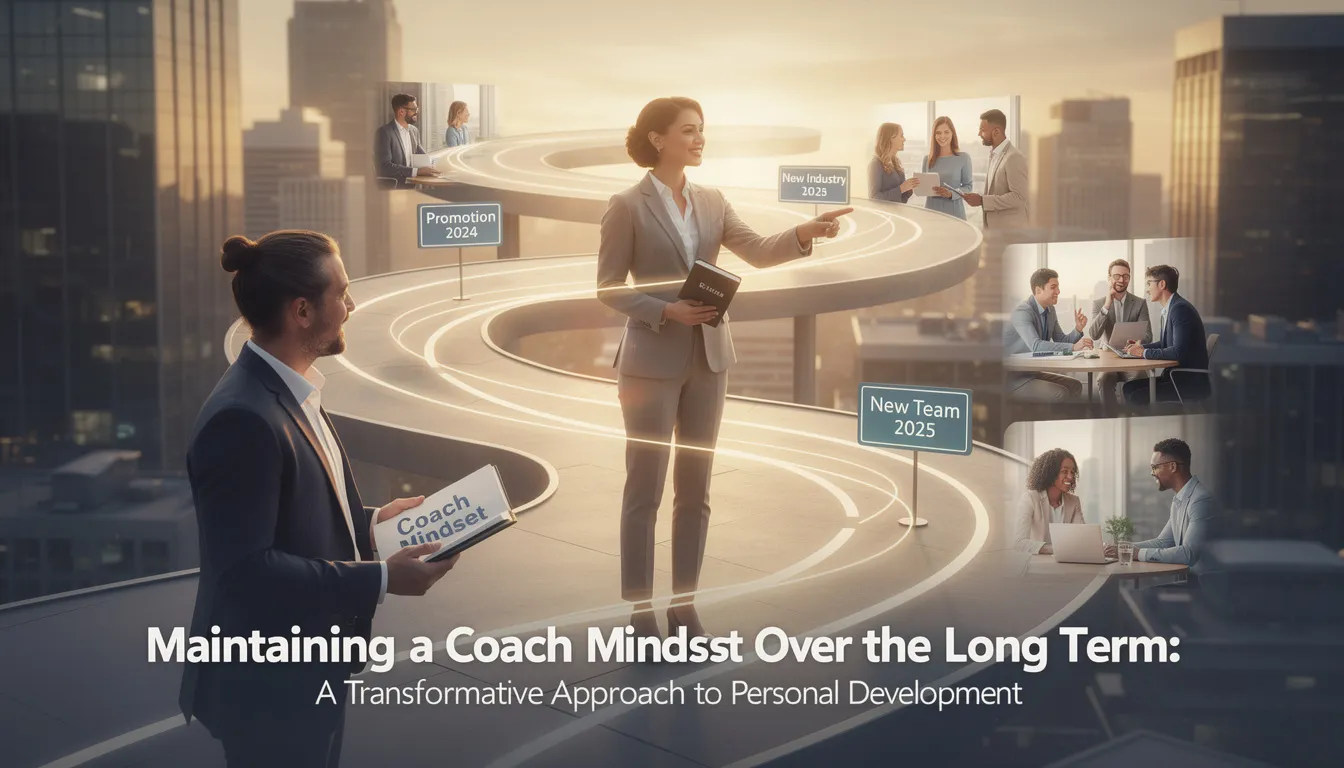
Regular Reflection Routines for Mindset Shift and Life Coaching
-
Quarterly self-reviews: How am I showing up in conversations? Am I asking more or telling more?
-
360-style feedback: Ask colleagues or clients to rate your listening and question-asking
-
Session reflection: After important conversations, journal briefly on what worked and what didn’t
Self-Care and Boundaries for Mindset Coaches
A mature coach mindset includes knowing when not to coach:
-
Crisis situations that require immediate directive action
-
Legal or compliance issues where specific requirements must be met
-
Mental health red flags that require referral to professional support, not coaching
-
Low mood or burnout in yourself—you can’t coach well when depleted
Self care isn’t optional. Being fully present for others requires being well-resourced yourself.
Staying Fresh Through Continuous Learning and More Posts
-
Read 1-2 coaching books per year (try titles on positive psychology, life coaching, or transformative approaches)
-
Attend workshops or conferences
-
Listen to coaching-focused podcasts during commutes
-
Follow developments in the field—mindset coaching and related areas continue to evolve
Building a Coach Circle for Personal Development and Mindset Coaching
Create or join a community where you can:
-
Share cases, successes, and mistakes in a confidential supportive environment
-
Practice skills with peers
-
Get feedback on challenging situations
-
Normalize the learning process—even experienced coaches keep developing
This could be an online community, an in-company learning group, or a small circle of colleagues committed to fostering personal growth in their leadership.

Conclusion: Choosing to Lead With a Coach Mindset and Embrace a Mindset Shift
A coach mindset is a deliberate choice to trust people’s potential and to lead through partnership, especially amid uncertainty. In a world where AI handles more tasks, where hybrid work creates distance, and where the only constant is change, the ability to help others think, grow, and find their own path becomes invaluable.
The shift begins with how you think, not with buying tools or getting a new title. You don’t need permission to start. A positive change in one conversation—asking instead of telling, listening before responding, creating space for someone else’s thinking—compounds over time. By December 2025, these small shifts can transform how your team operates, how people experience working with you, and how you experience your own journey as a leader.
Choose one specific conversation in the coming week. Maybe it’s a performance check-in on Monday, a project retrospective on Wednesday, or a career discussion with a direct report on Friday. Approach it with a positive mindset: curiosity over control, questions before answers, partnership over prescription.
Adopting a coach mindset in 2025 is both a professional advantage and a contribution to healthier workplaces and communities. The business case is clear. The human case is even clearer. People thrive when they’re trusted. Start there.
More Posts on Coach Mindset and Mindset Coach Development
If you're eager to deepen your understanding of the coach mindset and enhance your skills as a mindset coach, exploring additional posts can provide valuable insights and practical strategies. These posts cover a wide range of topics, including advanced coaching techniques, ways to overcome common challenges, and tips for fostering continuous personal and professional growth.
Some of the key areas you can explore include:
-
Developing Emotional Intelligence: Learn how to cultivate empathy, self-awareness, and emotional regulation to connect more deeply with clients and support their growth effectively.
-
Mastering Powerful Questioning: Discover how to craft open-ended, thought-provoking questions that encourage reflection and unlock new perspectives.
-
Building Psychological Safety: Understand techniques to create a safe, non-judgmental environment that empowers clients to share openly and take risks in their development.
-
Overcoming Limiting Beliefs: Explore methods for identifying and reframing limiting beliefs that hold clients back from reaching their full potential.
-
Practicing Self-Reflection: Gain tools for regular self-assessment to refine your coaching approach and maintain a growth mindset in your own journey.
-
Integrating Neuro Linguistic Programming (NLP): Learn how NLP techniques can enhance your coaching toolkit to facilitate mindset transformation.
-
Balancing Coaching and Leadership: Strategies for applying a coach mindset in leadership roles to inspire and motivate teams while fostering autonomy.
-
Maintaining Coach Well-being: Tips on self-care, setting boundaries, and preventing burnout to sustain your effectiveness and presence as a coach.
By engaging with these posts, you not only build your coaching skills but also stay updated on the latest trends and research in mindset coaching. This ongoing learning supports your ability to provide valuable insights, foster personal growth in others, and navigate the evolving landscape of coaching in 2025 and beyond.
Stay tuned for more posts that will guide you through practical exercises, case studies, and expert advice to help you embody the coach mindset fully and confidently.
Frequently Asked Questions About Coach Mindset and Mindset Coaching
What is a coach mindset?
A coach mindset is a way of thinking and being that emphasizes curiosity, empathy, and belief in others’ potential. It involves seeing people as resourceful and capable of finding their own solutions rather than problems to fix. This mindset prioritizes asking open-ended questions, active listening, and creating a safe, non-judgmental space that fosters personal and professional growth. It is about enabling others to explore their own journey and develop self-awareness, resilience, and confidence.
How does a coach mindset differ from an expert mindset?
An expert mindset focuses on having the answers and directing others on what to do, often emphasizing control and efficiency. In contrast, a coach mindset values collaboration, curiosity, and long-term growth. Instead of providing immediate solutions, a coach mindset creates space for others to think through challenges and discover their own path forward. It encourages learning, ownership, and empowerment rather than dependency.
Can anyone develop a coach mindset?
Yes, anyone can develop a coach mindset through intentional practice and self-reflection. It requires a willingness to shift from giving advice to asking powerful questions, to listen deeply, and to believe in the growth potential of others. While formal coaching training can accelerate this development, the mindset itself is accessible to managers, leaders, parents, educators, and peers who commit to continuous learning and personal growth.
What are the benefits of adopting a coach mindset?
Adopting a coach mindset offers numerous benefits, including enhanced self-awareness, better emotional well-being, and improved communication skills. It fosters psychological safety, higher engagement, and ownership of goals within teams and organizations. Beyond work, it can improve relationships with loved ones by promoting constructive conversations and empathy. Overall, it supports sustainable personal and professional development.
How do I start developing a coach mindset?
Begin by noticing when you default to giving advice and consciously pause to ask open-ended questions instead. Practice deep listening by focusing fully on the other person’s words, tone, and emotions. Reflect regularly on your interactions to identify patterns and areas for improvement. Seeking feedback and considering formal coaching training can also support your growth. Daily micro-practices, such as asking “What do you think?” and pausing before responding, help build momentum.
What are some common challenges in developing a coach mindset?
Common challenges include time constraints, resistance to change, fear of losing authority, and skepticism from colleagues. Developing patience for others’ learning curves and overcoming the urge to fix problems immediately can be difficult. Addressing these challenges involves setting realistic expectations, celebrating small wins, creating supportive environments, and practicing consistently. Building a community of fellow coaches or mentors can provide encouragement and accountability.
How does mindset coaching differ from life coaching?
While both mindset coaching and life coaching support personal development, mindset coaching specifically targets thought patterns, beliefs, and mental blocks that influence behavior. It focuses on shifting limiting beliefs and fostering a positive, growth-oriented mindset. Life coaching tends to address a broader range of life areas such as career, relationships, and health goals. Mindset coaching often incorporates techniques from psychology and neuro linguistic programming to facilitate deeper mindset transformation.
What techniques are commonly used in mindset coaching?
Mindset coaches use various techniques including mindset journaling, positive affirmations, visualization exercises, and challenging limiting beliefs through cognitive restructuring. They employ powerful, open-ended questions to encourage reflection and insight. Coaches also support clients in setting clear, actionable goals aligned with a growth mindset and provide constructive feedback to reinforce progress. These techniques help clients develop resilience, self-confidence, and a solution-focused approach.
Do I need to be certified to become a mindset coach?
Certification is not strictly required to become a mindset coach, but it can enhance credibility and coaching skills. Many reputable coaching programs aligned with organizations like the International Coach Federation offer training that deepens understanding of coaching principles and techniques. Starting by coaching friends or clients at reduced rates can help build experience. Certification can also open doors to more clients and professional opportunities.
How much does mindset coaching typically cost?
Mindset coaching costs vary depending on the coach’s experience, session length, and format. Hourly rates typically range from $100 to $300, with packages or programs costing several thousand dollars for ongoing support. Investing in mindset coaching is considered a valuable tool for personal growth and overcoming challenges, often leading to significant returns in confidence, productivity, and well-being.
How long does it take to see results from mindset coaching?
The timeline for results depends on individual circumstances, consistency, and the nature of mindset challenges. Some clients notice positive shifts within a few weeks, while deeper, sustainable transformation may take several months of applying coaching techniques and practices. Mindset change is a gradual process that benefits from patience, regular reflection, and ongoing effort.
Can a coach mindset be applied outside of professional coaching?
Absolutely. The coach mindset is valuable in many contexts including leadership, parenting, education, and everyday relationships. Applying coaching principles such as curiosity, active listening, and empowerment can improve communication, foster psychological safety, and support growth in any interpersonal interaction. It helps create more meaningful, constructive conversations and stronger connections.
How can I maintain a coach mindset over time?
Maintaining a coach mindset requires continuous learning, self-care, and reflection. Regularly seek feedback, engage in coaching communities, and stay updated on coaching research and practices. Set clear boundaries to avoid burnout and recognize when coaching is not appropriate. Incorporate micro-practices like pausing before responding and asking open questions daily. Remember that developing a coach mindset is a lifelong journey that evolves with experience and commitment.

0 comments