

Introduction to Coaching Models
What is Coaching? Understanding Coaching Skills and Their Impact
Coaching is a collaborative and dynamic process that fosters both personal and professional growth through a structured framework. It involves a coaching relationship where the coach focuses on assisting the client in achieving their desired outcomes by leveraging essential coaching skills such as active listening, powerful questioning, and empathy. These skills are foundational across most coaching models, as they promote self-awareness and motivation, helping clients explore their strengths and challenges effectively.
Effective coaching significantly improves work performance, relationships, and communication skills, with 77% of coaching clients reporting notable improvements in these areas. Additionally, 66% of HR professionals acknowledge that coaching leads to increased individual performance. Beyond skill development, coaching helps employees feel supported and engaged, reducing turnover and fostering a positive workplace coaching culture that supports continuous improvement.
This comprehensive guide is designed for leaders, managers, coaches, and HR professionals seeking to deepen their coaching skills and enhance team development. Understanding diverse coaching models empowers you to facilitate growth, improve performance, and cultivate a positive workplace coaching culture that supports continuous improvement.
Coaching Models and Frameworks
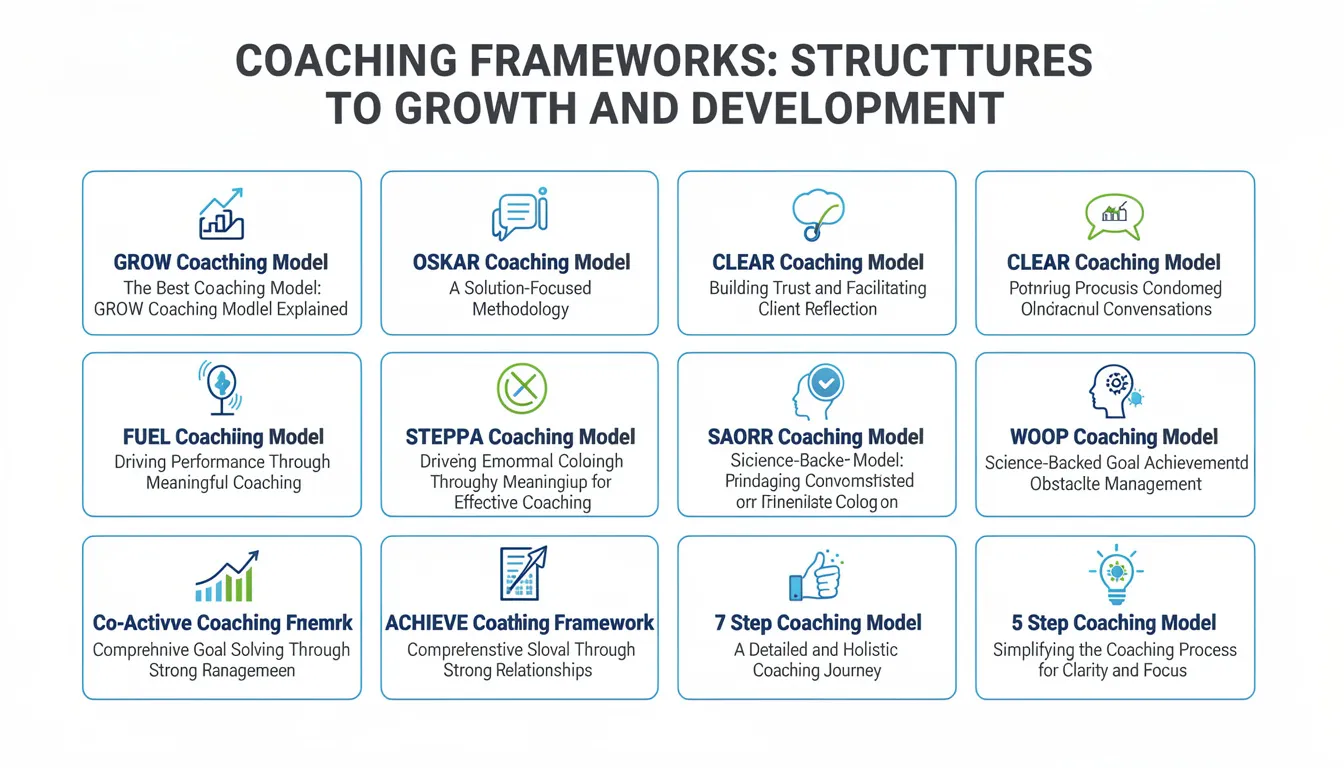
Coaching Frameworks: Structured Approaches to Growth and Development
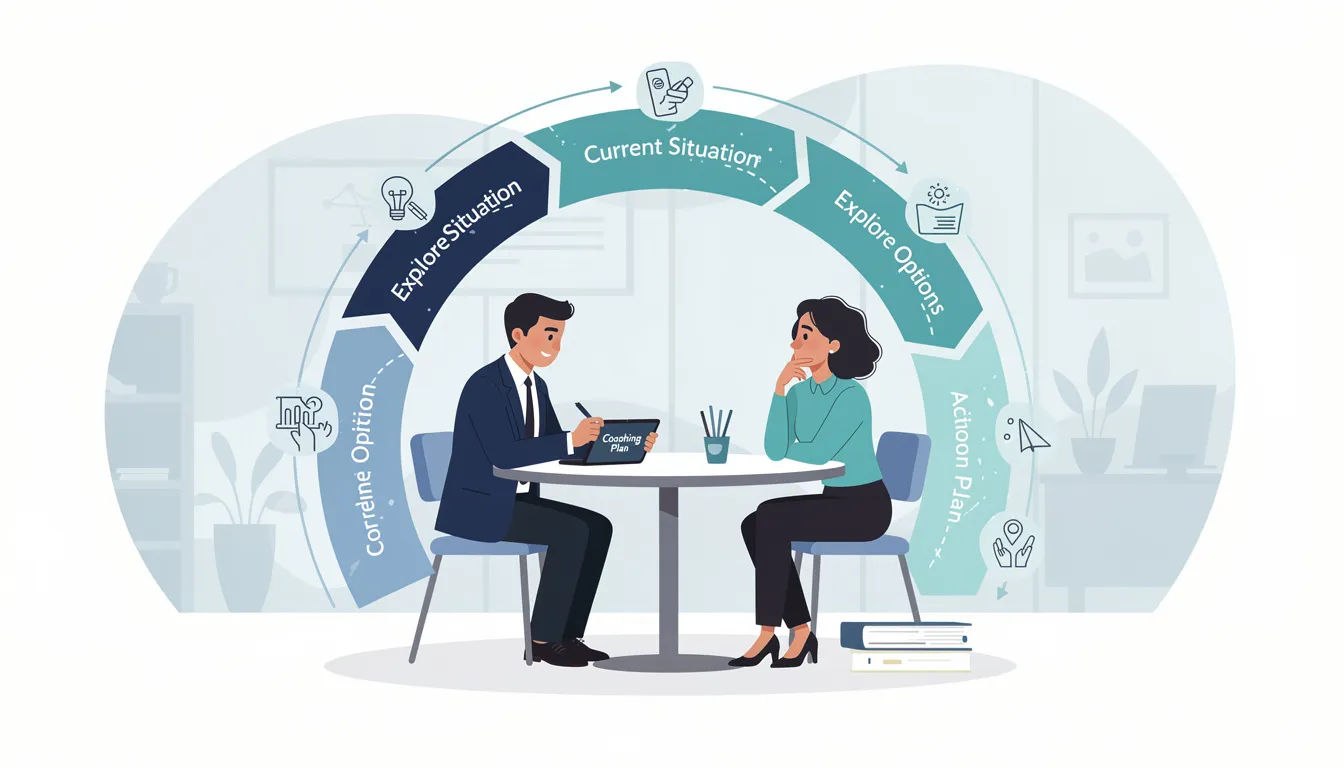
A coaching model is a structured framework that guides the coaching process via a systematic approach to facilitating growth, development, and problem-solving. These models break down the coaching journey into distinct phases or steps, offering clarity and direction for both the coach and the coachee. By using a coaching model, the coach assists the client to analyze their current situation, explore options, and create actionable plans, ensuring focused and productive coaching sessions.
Using a structured coaching model increases coaching efficiency by providing a repeatable framework that keeps sessions consistent and goal-oriented. This structure also boosts client engagement, as clients are more likely to stay committed and complete their coaching journey when they see tangible results.
Popular coaching frameworks such as the GROW coaching model, FUEL coaching model, OSKAR coaching model, STEPPA coaching model, and WOOP coaching model provide proven methodologies to structure coaching conversations effectively. Selecting the right coaching model depends on the client’s current situation, learning preferences, desired outcome, and the coaching style that best suits the context.
The Best Coaching Model: GROW Coaching Model Explained
The GROW coaching model is one of the most widely used and effective coaching methodologies for goal-setting and problem-solving. Developed by business coaches Graham Alexander, Alan Fine, and Sir John Whitmore, it guides clients through four key stages:
-
Goal: Clarify what the client wants to achieve, often using SMART goals — specific, measurable, attainable, relevant, and time-bound — to ensure clarity and motivation.
-
Reality: Assess the client’s current situation, strengths, and challenges.
-
Options: Explore possible strategies and solutions.
-
Will: Commit to specific, actionable steps.
This structured framework builds employee confidence, supports performance management, and enhances leadership training by helping clients visualize their path to success and maintain motivation throughout their coaching journey. The GROW model’s focus on tangible outcomes and clear action plans makes it particularly effective for performance-oriented coaching conversations.
OSKAR Coaching Model: A Solution-Focused Coaching Methodology
The OSKAR coaching model is a solution-focused coaching methodology that shifts the client’s mindset from problems to possibilities. It emphasizes leveraging strengths and resources rather than dwelling on obstacles. The acronym OSKAR stands for:
-
Outcome: Define clear and measurable goals.
-
Scaling: Assess progress using a rating scale.
-
Know-how: Identify necessary skills and resources.
-
Affirm & Action: Affirm successes and plan next steps.
-
Review: Reflect on progress and adjust as needed.
This model encourages client exploration and accountability, making it highly effective for coaching and mentoring in workplace settings.
CLEAR Coaching Model: Building Trust and Facilitating Client Reflection
The CLEAR coaching model is a relationship-driven framework that emphasizes deep listening and structured dialogue to foster self-awareness and behavioral change. Particularly useful in executive coaching and leadership development, CLEAR involves:
-
Contract: Establish coaching objectives and expectations.
-
Listen: The coach listens actively to understand the client’s perspective.
-
Explore: The client reflects on thoughts, feelings, and motivations.
-
Action: Identify and commit to actionable steps.
-
Review: Evaluate progress and refine plans.
By focusing on the coaching relationship, the CLEAR model helps build employee confidence, supports continuous improvement, and strengthens the coaching culture within organizations. Alongside GROW, CLEAR is one of the most established coaching models providing structured frameworks for transformative conversations.
FUEL Coaching Model: Driving Performance Through Meaningful Conversations
The FUEL coaching model, developed by the extraordinary coaches John Zenger and Kathleen Stinnett, is designed to facilitate structured and impactful coaching conversations that drive performance improvement. This model provides structured guidance through its stages, ensuring that coaching sessions remain focused and productive. Its stages include:
-
Frame the Conversation: Set context, goals, and expectations to establish a clear coaching relationship.
-
Understand the Current State: The coach assesses the client’s present challenges, assumptions, and mindset to gain a comprehensive understanding.
-
Explore the Desired Goal: Client and coach collaboratively brainstorm strategies, encouraging the employee to lead the exploration of possibilities.
-
Lay Out the Plan: Together, the coach and employee create a clear, actionable plan with deadlines and accountability measures, helping the employee create measurable steps toward their goals.
This model encourages clients to explore their motivations deeply and take ownership of their professional growth, making it ideal for leadership coaching and performance coaching contexts.
STEPPA Coaching Model: Leveraging Emotional Connections for Effective Coaching
The STEPPA coaching model uniquely integrates emotional awareness into goal-setting and action planning. It includes the following stages:
-
Subject: Identify the key issue or topic the employee leads in discussing.
-
Target: Define a clear and attainable goal.
-
Emotion: The coach assesses the emotional connection and impact related to the goal, understanding how feelings may support or hinder progress.
-
Perception: Analyze thoughts and beliefs influencing the goal, helping the employee gain new perspectives.
-
Plan: Develop a concrete action plan with structured guidance.
-
Act: Implement the plan and maintain momentum.
By addressing emotional connections, the STEPPA coaching model helps clients overcome barriers, maintain motivation, and achieve sustainable personal and professional growth.
WOOP Coaching Model: Science-Backed Goal Achievement and Obstacle Management
The WOOP coaching model is a practical, science-backed framework that helps employees turn their aspirations into concrete actions by addressing both motivation and obstacles. Grounded in psychology, WOOP combines positive visualization of desired outcomes with realistic planning to overcome potential barriers.
Its four stages include:
-
Wish: Identify a meaningful and challenging goal.
-
Outcome: Visualize the best possible result of achieving the goal.
-
Obstacle: Recognize internal or external barriers that might impede progress.
-
Plan: Develop “if-then” strategies to overcome obstacles and stay on track.
The WOOP model enhances motivation and self-regulation, making it a valuable addition to workplace coaching programs focused on goal achievement and personal development.
Leadership Coaching: Enhancing Skills and Driving Organizational Success
Leadership coaching focuses on developing the interpersonal skills, emotional intelligence, and decision-making capabilities of business leaders. Using coaching models like GROW, CLEAR, and FUEL, leadership coaching provides structured guidance that supports leaders in creating a positive coaching culture within their teams. Through this process, the coach assesses leadership challenges and helps leaders develop strategies to improve team performance, communication skills, and professional growth.
Employee-Led Coaching: Empowering Clients to Take Ownership
Effective coaching encourages the employee to lead the coaching conversation and take ownership of their development journey. Coaching models provide a framework where the employee create actionable plans and explore options, fostering self-directed learning and accountability. This approach enhances motivation and engagement, as employees feel supported to drive their own personal and professional growth.
Structured Guidance in Coaching: Ensuring Focus and Progress
Structured guidance is a critical element of successful coaching. By following established coaching models, coaches provide clear direction and maintain focus during coaching sessions. This ensures that clients stay on track toward their desired outcomes, with regular monitoring and adjustment of goals. Structured guidance also helps coaches tailor their approach based on the client’s current situation and learning preferences, increasing the effectiveness of the coaching process.FUEL Coaching Model: Driving Performance Through Meaningful Conversations
The FUEL coaching model is designed to facilitate structured and impactful coaching conversations that drive performance improvement. Its stages include:
-
Frame the Conversation: Set context, goals, and expectations.
-
Understand the Current State: The coach examines the client’s present challenges and assumptions.
-
Explore the Desired Goal: Client and coach collaboratively brainstorm strategies.
-
Lay Out the Plan: Develop a clear, actionable plan with deadlines and accountability.
This model encourages clients to explore their motivations deeply and take ownership of their professional growth, making it ideal for leadership and performance coaching.
STEPPA Coaching Model: Leveraging Emotional Connections for Effective Coaching
The STEPPA coaching model uniquely integrates emotional awareness into goal-setting and action planning. It includes the following stages:
-
Subject: Identify the key issue or topic.
-
Target: Define a clear and attainable goal.
-
Emotion: Explore the emotional connection and impact.
-
Perception: Analyze thoughts and beliefs influencing the goal.
-
Plan: Develop a concrete action plan.
-
Act: Implement the plan and maintain momentum.
By addressing emotional connections, the STEPPA coaching model helps clients overcome barriers, maintain motivation, and achieve sustainable personal and professional growth.
WOOP Coaching Model: Science-Backed Goal Achievement and Obstacle Management
The WOOP coaching model is a practical, science-backed framework that helps employees turn their aspirations into concrete actions by addressing both motivation and obstacles. Grounded in psychology, WOOP combines positive visualization of desired outcomes with realistic planning to overcome potential barriers.
Its four stages include:
-
Wish: Identify a meaningful and challenging goal.
-
Outcome: Visualize the best possible result of achieving the goal.
-
Obstacle: Recognize internal or external barriers that might impede progress.
-
Plan: Develop “if-then” strategies to overcome obstacles and stay on track.
The WOOP model enhances motivation and self-regulation, making it a valuable addition to workplace coaching programs focused on goal achievement and personal development.
Co-Active Coaching Model: A Holistic and Principle-Based Approach
The Co-Active Model is a holistic coaching approach that views the client as naturally creative, resourceful, and whole. This principle-based model emphasizes a partnership between coach and client, encouraging self-discovery, accountability, and balance across personal and professional domains.
By integrating emotional, cognitive, and behavioral aspects, the Co-Active Model supports deep transformation and sustained growth, complementing more structured frameworks like GROW and CLEAR.
AOR Coaching Model: Fostering Problem-Solving Through Strong Relationships
The AOR coaching model emphasizes the quality of the coach-employee relationship and uses a trial-and-error approach to resolve issues efficiently. It focuses on:
-
Activities: The coach examines the client’s daily work activities.
-
Objectives: Set challenging yet achievable goals.
-
Results: Review outcomes and adjust objectives for continuous improvement.
This model promotes measurable actions and feedback cycles, helping clients develop problem-solving skills and improve productivity.
ACHIEVE Coaching Framework: Comprehensive Goal Setting and Evaluation
Building on the GROW model, the ACHIEVE coaching framework adds structure and evaluation to the coaching process. Its stages are:
-
Assess: Analyze current situation and challenges.
-
Collaborate: Brainstorm potential solutions.
-
Hone Goals: Refine goals to be specific and measurable.
-
Implement Actions: Develop and execute a detailed plan.
-
Evaluate: Monitor progress and make necessary adjustments.
The ACHIEVE framework supports sustained client growth by incorporating ongoing evaluation and feedback.
7 Step Coaching Model: A Detailed and Holistic Coaching Journey
The 7 step coaching model guides clients through a thorough coaching journey, including:
-
Establish rapport and trust.
-
Set clear and motivating goals.
-
Explore the client’s current reality.
-
Identify options and opportunities.
-
Develop an actionable plan.
-
Implement strategies.
-
Review progress and outcomes.
This comprehensive approach supports both personal and professional development by ensuring every stage of the coaching process is addressed.
5 Step Coaching Model: Simplifying the Coaching Process for Clarity and Focus
The 5 step coaching model streamlines coaching into five essential phases:
-
Establish the coaching relationship.
-
Set clear and achievable goals.
-
Explore available options.
-
Commit to specific actions.
-
Review outcomes and progress.
This straightforward model is effective for coaches at all levels, helping maintain focus and structure in coaching sessions.
Coaching Styles and Methods
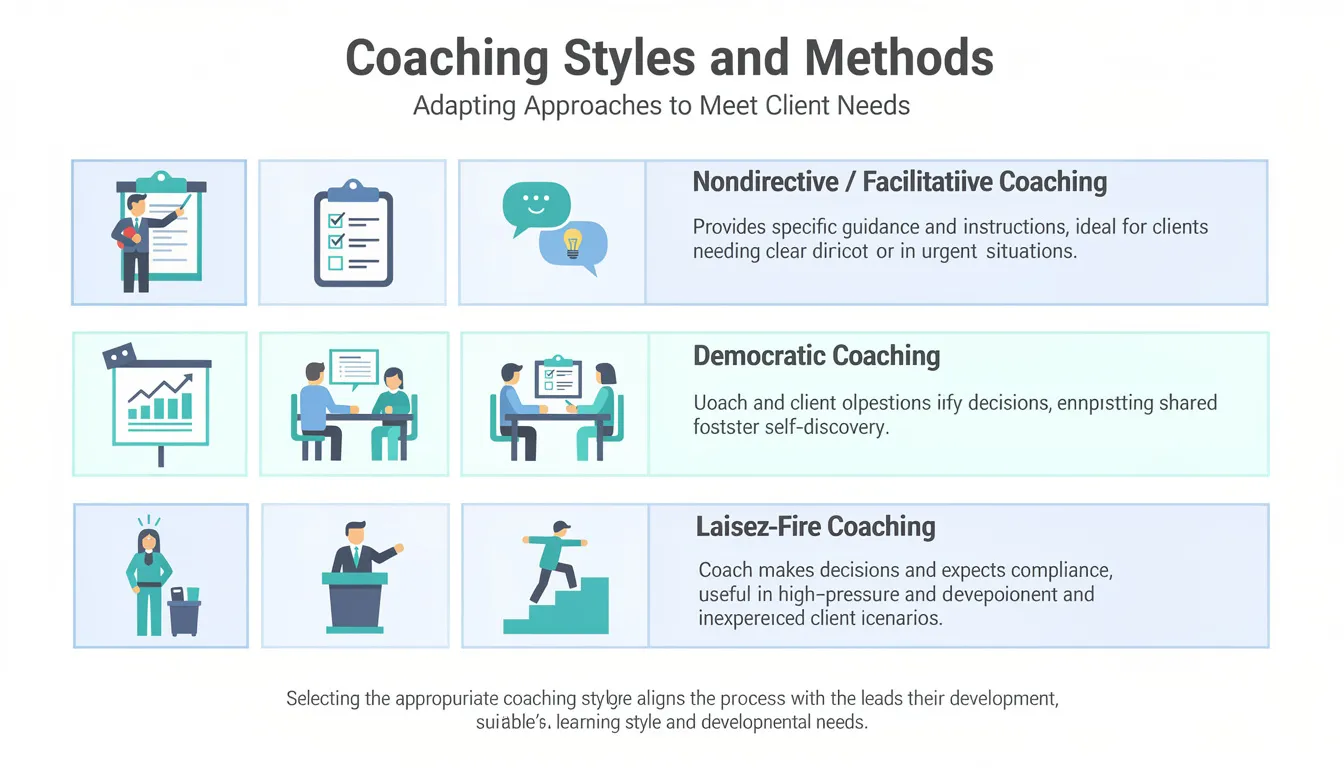
Coaching Styles: Adapting Approaches to Meet Client Needs
Coaching styles define how coaching is delivered and can be adapted based on the client’s preferences and context. Common coaching styles include:
-
Directive Coaching: The coach provides specific guidance and instructions, ideal for clients needing clear direction or in urgent situations.
-
Nondirective or Facilitative Coaching: The coach encourages client exploration through open-ended questions, fostering self-discovery.
-
Democratic Coaching: The coach and client collaborate on decision-making, promoting shared ownership and empowerment.
-
Autocratic Coaching: The coach takes full control, making decisions and expecting compliance, useful in high-pressure or inexperienced client scenarios.
-
Laissez-Faire Coaching: A hands-off approach where the client leads their development, suitable for highly motivated and self-directed individuals.
Selecting the appropriate coaching style ensures the coaching process aligns with the client’s learning style and developmental needs.
Coaching Methodology: Best Practices and Techniques for Successful Coaching
A coaching methodology encompasses the specific approaches, tools, and techniques used to guide coaching sessions and achieve desired outcomes. Effective methodologies integrate active listening, powerful questioning, empathy, and structured frameworks to facilitate client analyze, exploration, and growth. Coaches must maintain flexibility to adapt methodologies to different coaching situations and client goals, ensuring a personalized and impactful coaching experience.
Building a Coaching Business
Coaching Business: Establishing and Growing a Successful Coaching Practice
Building a thriving coaching business requires mastery of coaching models, styles, and methodologies. Influential business leaders and executive coaches, including Graham Alexander and Alan Fine, have shaped effective coaching models that support client achievement and organizational development. A successful coaching business offers structured coaching programs that empower clients to develop new skills, improve interpersonal skills, and achieve measurable outcomes.
Coaching Programs and Skills Development
Coaching Program: Designing Structured and Impactful Coaching Sessions
A coaching program consists of a series of well-designed coaching sessions aimed at achieving specific personal or professional goals. These programs incorporate a clear coaching framework, style, and methodology to guide the coaching process effectively. Whether for individual coaching or team coaching, well-structured programs help clients maintain motivation, monitor progress, and realize continuous improvement.
Coaching Skills: Essential Competencies for Effective Coaching
Effective coaching depends on a coach’s ability to:
-
Practice active listening to fully understand the client’s perspective.
-
Ask powerful, open-ended questions to encourage client explore and reflection.
-
Build trust and rapport to foster a safe coaching relationship.
-
Maintain accountability and motivation throughout the coaching journey.
-
Adapt coaching styles and methodologies to meet client needs.
Continuous professional development ensures coaches remain skilled and effective in facilitating personal and professional growth.
Best Practices for Coaching
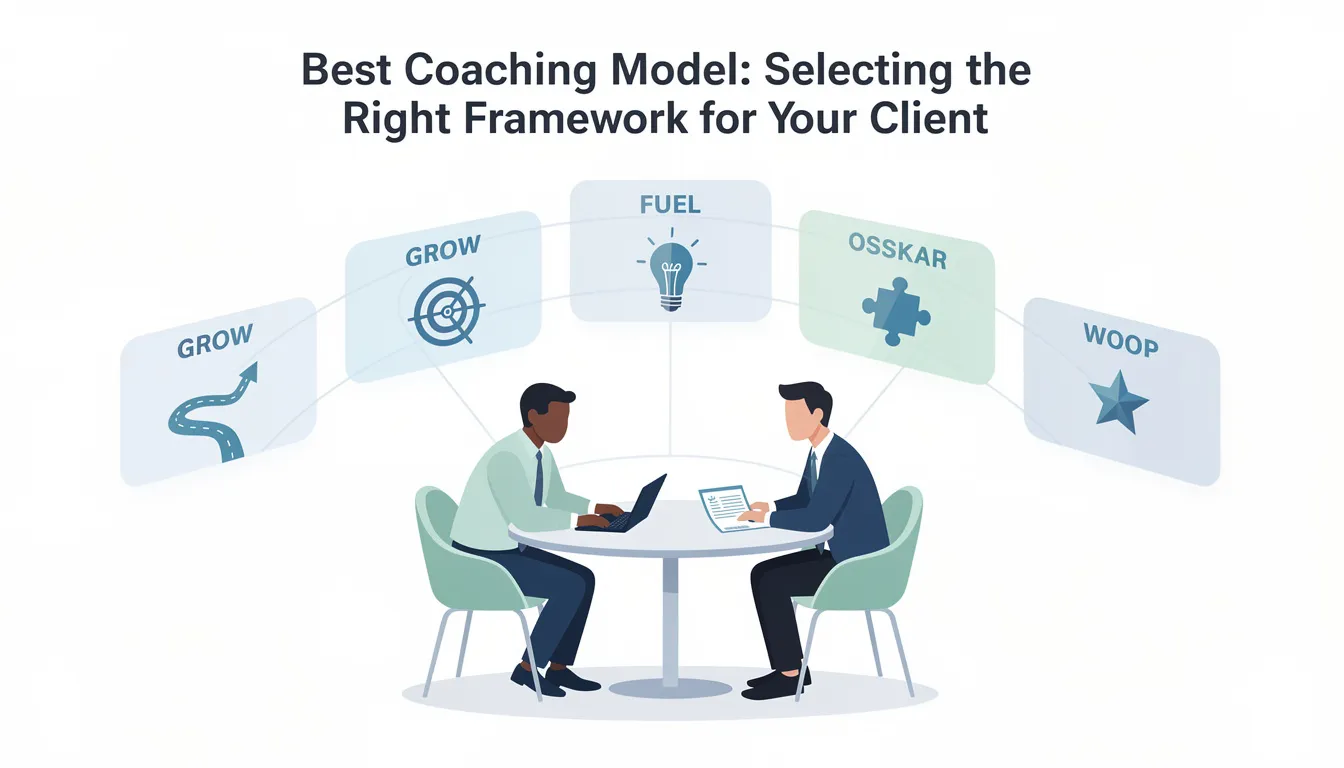
Best Coaching Model: Selecting the Right Framework for Your Client
Choosing the best coaching model requires understanding the client’s unique situation, learning preferences, and desired outcomes. Models such as the GROW coaching model, FUEL coaching model, OSKAR coaching model, STEPPA coaching model, and WOOP coaching model offer versatile approaches suitable for various coaching contexts. A flexible coaching methodology enables coaches to tailor sessions for maximum impact, supporting client accountability, motivation, and success.
Conclusion
Implementing the right coaching models, styles, and methodologies is essential for effective leadership and team development. By leveraging structured coaching frameworks and honing essential coaching skills, coaches can facilitate personal and professional growth that drives performance and fosters a positive coaching culture within organizations. Whether you are an executive coach, business coach, or team leader, understanding and applying these coaching principles empowers you to support your clients or employees in achieving their full potential.
Frequently Asked Questions About Coaching Models
What is a coaching model?
-
A coaching model is a structured framework that guides the coaching process.
-
It breaks down coaching into distinct phases to facilitate growth, development, and problem-solving.
-
Coaching models help both the coach and client stay focused on goals and outcomes.
Why are coaching models important in the workplace?
-
They provide clarity and structure to coaching sessions.
-
Coaching models improve coaching effectiveness and client engagement.
-
They help monitor progress and measure the success of coaching interventions.
-
Using coaching models supports employee development and boosts performance.
What are some popular coaching models?
-
GROW Model: Focuses on Goal setting, Reality assessment, exploring Options, and Will to act.
-
OSKAR Model: A solution-focused coaching methodology emphasizing strengths and resources.
-
CLEAR Model: Relationship-driven, emphasizing active listening and reflection.
-
FUEL Model: Structured to drive meaningful conversations and performance improvement.
-
STEPPA Coaching Model: Incorporates emotional context to define goals and action plans.
-
WOOP Coaching Model: Science-backed framework addressing motivation and obstacles.
How do I choose the right coaching model?
-
Consider the client’s current situation and desired outcome.
-
Assess the coaching style that best fits the client’s learning preferences.
-
Match the model to the coaching context, whether leadership, performance, or personal development.
-
Be flexible and adapt models as needed to suit individual coaching journeys.
What skills are essential for effective coaching?
-
Active listening to fully understand the client’s perspective.
-
Asking powerful, open-ended questions to encourage client exploration.
-
Building trust and rapport to foster a safe coaching relationship.
-
Maintaining accountability and motivation throughout the coaching journey.
How can coaching models improve leadership development?
-
They provide business leaders with clear frameworks to support employee growth.
-
Coaching models help leaders develop interpersonal skills and emotional intelligence.
-
Structured coaching enhances communication skills and decision-making.
-
They enable leaders to monitor progress and adjust strategies for continuous improvement.
Can coaching models be used for team coaching?
-
Yes, many coaching models are adaptable for both individual and team coaching.
-
They help teams set collective goals and explore collaborative solutions.
-
Coaching frameworks foster a positive coaching culture within teams.
-
Team coaching improves group dynamics, accountability, and performance.
What is the role of emotions in coaching?
-
Emotions can either support or hinder progress towards goals.
-
Models like STEPPA focus on understanding and managing emotional connections.
-
Addressing emotions helps clients overcome barriers and maintain motivation.
-
Emotional awareness enhances self-directed learning and personal development.
How do coaching models support continuous improvement?
-
They include review stages to reflect on progress and outcomes.
-
Coaches typically use feedback to refine goals and action plans.
-
Structured follow-ups ensure clients stay on track for future coaching sessions.
-
Continuous improvement fosters long-term success and professional growth.
How can I measure the effectiveness of coaching?
-
Track performance metrics relevant to the coaching goals.
-
Monitor client progress through structured coaching sessions.
-
Collect feedback from clients about successful sessions and outcomes.
-
Use coaching services and tools to analyze data and adjust coaching methods accordingly.

0 comments