

Introduction
This guide explains what an AI mindset is, why it matters in 2026 and beyond, and provides actionable strategies for professionals and organizations to develop and benefit from this way of thinking. Cultivating specific mindsets is key to success in adopting AI in the workplace. This guide will cover both the mindset required for AI adoption and practical steps for developing it, referencing the importance of seeing artificial intelligence as a powerful collaborator and enabler. A growth mindset is essential for continuous learning and adapting to AI in the workplace, and this guide will help you understand how to foster these qualities for personal and organizational success.
What Does an AI Mindset Mean?
An AI mindset involves seeing artificial intelligence as a powerful collaborator and enabler, combining technical understanding with core human skills like critical thinking and creativity. Key traits of an AI mindset include curiosity, collaboration, critical thinking, adaptability, and a focus on problem-solving. Cultivating specific mindsets is key to success in adopting AI in the workplace, as it enables individuals and organizations to leverage AI effectively, adapt to rapid changes, and drive innovation.
With a clear understanding of what an AI mindset is, let's move on to the key takeaways that summarize the most important points about developing and applying this mindset.
Key Takeaways on AI Mindset and Mindset AI
-
An AI mindset involves embracing curiosity, adaptability, and continuous learning to leverage artificial intelligence effectively in personal and professional contexts.
-
The five core pillars of an AI mindset are growth orientation, collaborative thinking, experimental approach, change readiness, and ethical awareness.
-
Organizations with employees who have developed AI mindsets see 25% faster task completion and 40% higher quality outputs compared to traditional approaches.
-
Building an AI mindset requires shifting from fear-based thinking to opportunity-focused strategies while maintaining human judgment and creativity.
-
Practical development involves daily AI tool experimentation, cross-functional collaboration, and treating AI as a thinking partner rather than just a productivity tool.
Now that you have a summary of the key points, let’s explore why an AI mindset matters in 2026 and how you can develop it for success in the modern workplace.
What is an AI Mindset and Why Mindset AI Matters in 2026
In 2026, the question isn’t whether artificial intelligence will transform your career—it’s whether you’ll develop the AI mindset to thrive alongside it. This page will explain what an AI mindset is, why it matters, and how to develop it for success in the modern workplace.
An AI mindset represents a fundamental shift in how we approach problem-solving, learning, and collaboration in an increasingly automated world. It goes far beyond simply knowing how to use AI tools. Instead, it’s a mental framework that embraces artificial intelligence as a collaborative partner rather than a threat or replacement. This approach transforms how professionals think about their work, focusing on augmentation rather than automation anxiety.

The statistics tell a compelling story. According to recent research, 78% of Fortune 500 companies now prioritize AI mindset development in their workforce transformation strategies. This isn’t just about staying current with technology—it’s about survival in a rapidly evolving business landscape.
The difference between having technical AI skills versus developing an AI-oriented way of thinking is profound. Technical skills teach you what buttons to click; an AI mindset teaches you when and why to leverage AI capabilities for maximum impact. It’s the difference between being a user and being a strategic partner with artificial intelligence.
McKinsey research reveals that AI-literate professionals are three times more likely to receive promotions in 2026. This correlation isn’t coincidental—it reflects how organizations value employees who can think strategically about AI integration rather than just clients who happen to use the latest tools.
Harvard Business Review studies show a direct connection between AI mindset and innovation capacity in organizations. Companies where employees embrace collaborative AI relationships report 40% higher innovation metrics compared to those treating AI as merely a productivity enhancement.
As we move forward, understanding the core pillars of an effective AI mindset will help you and your organization unlock the full potential of artificial intelligence.
The Five Core Pillars of an Effective AI Mindset and Growth Mindset
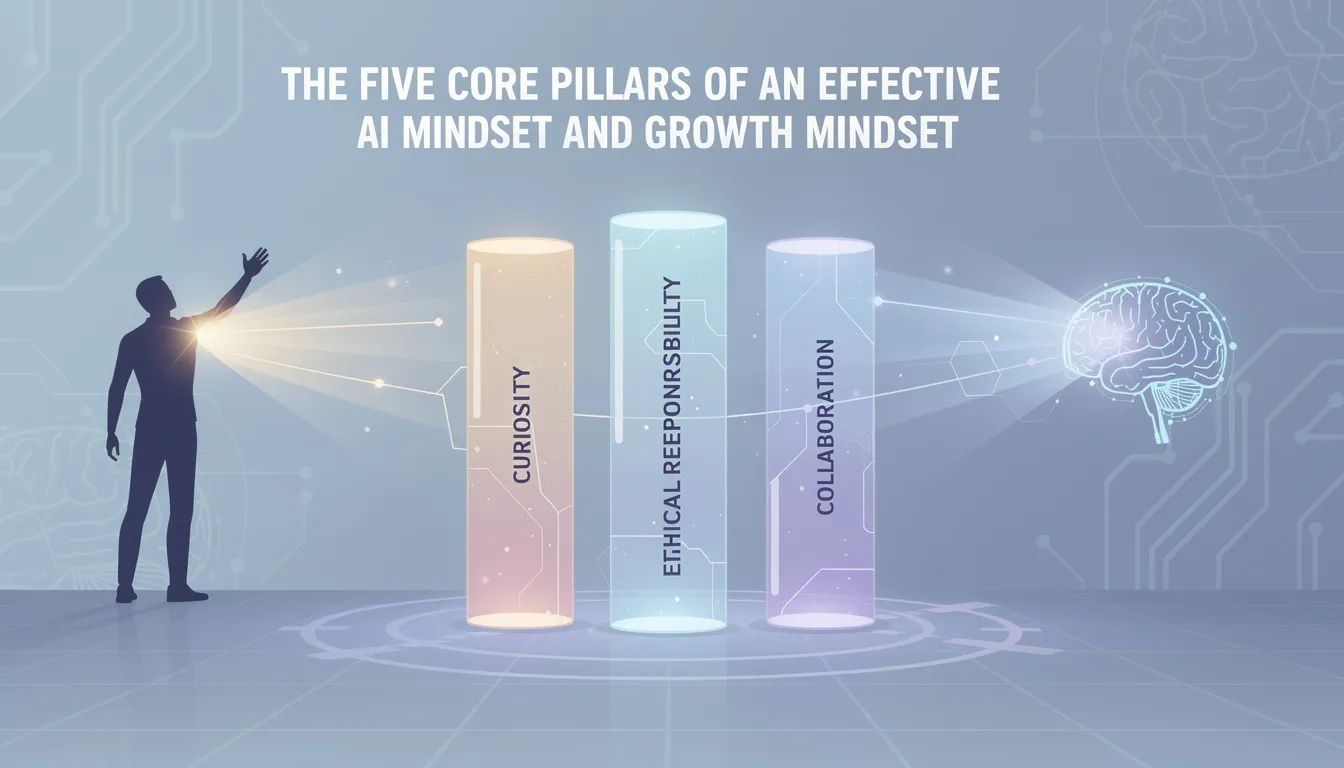
Growth-Oriented Learning Approach: Cultivating a Growth Mindset
The foundation of any effective AI mindset is viewing AI tools as learning accelerators rather than shortcuts to avoid skill development. This pillar represents a fundamental shift in how we approach professional growth and continuous improvement.
Platforms like Coursera report a 300% increase in AI-related course enrollments since January 2023, indicating widespread recognition that traditional learning approaches need updating. However, the most successful professionals don’t just take courses—they develop meta-learning skills to adapt to rapidly evolving AI capabilities and new tool releases.
Google’s AI training programs provide compelling evidence of this approach’s effectiveness. Participants who embraced a growth mindset around AI showed 65% improvement in adaptability scores compared to those who treated AI training as a one-time skill acquisition. The key difference was viewing each interaction with AI as a learning opportunity rather than a task to complete.
This growth-oriented approach means treating every prompt, every experiment, and every AI-generated output as data for improving your collaborative relationship with artificial intelligence. It’s about developing intellectual property in the form of better questions, more effective workflows, and deeper understanding of AI capabilities.
Collaborative Human-AI Partnership: Using AI as a Thinking Partner
The second pillar involves treating AI as an intelligent assistant that enhances rather than replaces human creativity and judgment. This collaboration requires understanding the complementary strengths where humans excel versus AI capabilities.
Humans bring empathy, context, strategic thinking, and ethical reasoning to the partnership. AI contributes data processing power, pattern recognition capabilities, and processing speed that far exceeds human limitations. The magic happens when these strengths combine rather than compete.
Microsoft and Salesforce have pioneered successful human-AI collaboration models that demonstrate this principle in action. At Microsoft, development teams using AI pair programming tools report that their focus shifted from writing code to designing solutions and ensuring quality. The AI handles syntax and routine logic while humans concentrate on architecture and user experience.
Communication strategies for working effectively with AI tools require developing new skills in prompt engineering and iterative refinement. The most effective practitioners learn to provide rich context, break complex tasks into manageable components, and maintain critical thinking throughout the collaboration process.
This collaborative mindset also means recognizing when to step back and let AI lead certain processes, and when to take control based on human insight and judgment. It’s about building a very good relationship with AI that maximizes both partners’ contributions.
Embracing AI Features and Agentic Experiences for Innovation
The third pillar emphasizes adopting a fail-fast, learn-quickly approach when testing new AI applications and use cases. This experimental mindset is crucial because AI capabilities evolve so rapidly that static approaches become obsolete quickly.
Creating safe spaces for AI experimentation without fear of making mistakes or producing imperfect results enables breakthrough discoveries. Amazon’s culture exemplifies this approach—their willingness to experiment with AI led to innovations like Alexa and sophisticated recommendation engines that now generate billions in revenue.
Structured approaches to A/B testing AI features and measuring their impact on productivity and outcomes provide the framework for systematic experimentation. This isn’t about random trial and error; it’s about hypothesis-driven testing that builds organizational knowledge about effective AI integration.
The most successful teams treat each AI experiment as a learning opportunity, documenting what works, what doesn’t, and why. This creates institutional knowledge that accelerates future AI adoption and helps teams avoid repeating unsuccessful approaches.
This experimental approach also extends to trying new AI features as they launch. Early adopters often discover competitive advantages by identifying use cases that others haven’t explored yet.
Agentic experiences, where AI agents proactively assist users rather than just responding to commands, are becoming a key differentiator in the market. These experiences require a mindset shift towards designing AI that anticipates needs and collaborates seamlessly with users.
Launch AI Agents and Embed AI for Seamless Integration
The fourth pillar involves developing comfort with ambiguity as AI capabilities evolve faster than regulatory frameworks and best practices can keep pace. This requires building resilience to handle workflow disruptions and role transformations caused by AI integration.
Netflix and Spotify demonstrate successful organizational change management during AI adoption. Both companies recognized that AI integration would fundamentally change how their teams worked, so they invested heavily in change management processes that helped employees adapt rather than resist.
Practical strategies for staying current with AI developments without becoming overwhelmed include curating information sources, setting boundaries on learning time, and focusing on principles rather than trying to master every new tool that emerges.
This adaptability pillar also means accepting that your job responsibilities will evolve as AI capabilities expand. Rather than clinging to traditional task definitions, change-ready professionals actively seek ways to add value in an AI-augmented environment.
The key is maintaining confidence while embracing uncertainty. AI will continue to surprise us with new capabilities, and professionals with an AI mindset view these surprises as opportunities rather than threats.
Launching AI agents within existing platforms and embedding AI through APIs and SDKs allow organizations to integrate intelligent capabilities seamlessly into workflows. This empowers teams to automate routine tasks and focus on higher-value activities. Companies like Fuse Universal have successfully embedded AI agents to enhance their learning platforms, demonstrating how AI tools can transform user experiences.
Ethical and Responsible AI Awareness: Building Trust with Customers Who Love AI
The fifth pillar focuses on understanding AI bias, fairness, and transparency issues that impact decision-making and business outcomes. This isn’t an add-on consideration—it’s fundamental to developing a sustainable AI mindset.
Developing frameworks for responsible AI use that align with company values and regulatory requirements protects both organizations and individuals from AI-related risks. IBM’s AI ethics board provides a practical model for how organizations can implement responsible AI principles without slowing innovation.
This ethical awareness includes understanding when human oversight is essential, how to detect and correct AI bias, and maintaining accountability for decisions influenced by artificial intelligence. It means asking critical questions about data sources, algorithmic fairness, and potential unintended consequences.
Balancing AI efficiency gains with human oversight and accountability in critical business processes requires deliberate design. The most effective approaches embed ethical considerations into AI workflows rather than treating them as separate compliance exercises.
Organizations that prioritize ethical AI build stronger trust with customers who love transparent and fair AI solutions, thereby enhancing brand reputation and loyalty.

With these foundational pillars in mind, let's explore practical strategies for developing your own AI mindset.
Practical Strategies for Developing Your AI Mindset and Using AI Daily
Daily AI Integration Practices for Growth and Confidence
Building an AI mindset requires consistent practice rather than sporadic learning sessions. The most effective approach starts with low-risk AI applications like email drafting, meeting summarization, and research assistance using tools like Claude or ChatGPT.
Establishing AI Learning Rituals
Creating AI learning rituals, such as spending 15 minutes daily exploring new AI capabilities, builds the habit of continuous discovery. These rituals work best when tied to existing routines—many professionals find success incorporating AI exploration into their morning coffee or end-of-day reflection time.
Tracking AI Tool Effectiveness
Documentation strategies for tracking AI tool effectiveness help identify best practices for your specific role and responsibilities. Keep a simple log of what prompts work well, which tasks AI handles effectively, and where human judgment remains essential. This personal database becomes invaluable for training team members and refining your own approaches.
30-Day AI Adoption Challenge
Setting up a structured 30-day AI adoption challenge with specific goals and measurement criteria creates accountability and tracks progress. To implement this challenge:
-
Identify daily AI tasks to experiment with (e.g., drafting emails, summarizing meetings).
-
Set weekly reflection points to review what’s working and what needs adjustment.
-
At the end of the month, assess how AI integration has changed your work patterns and identify areas for further improvement.
The key is treating AI integration as a skill that requires practice, not a technology that works automatically. Like any relationship, your collaboration with AI improves through consistent interaction and attention.
Fostering Cross-Functional AI Collaboration
Establishing AI learning communities within organizations accelerates mindset development by sharing discoveries and troubleshooting challenges collectively. These communities work best when they include diverse perspectives from different departments and skill levels.
Creating AI Learning Communities
Participating in external AI communities like Reddit’s r/artificial or LinkedIn AI professional groups with over 500,000 members provides access to cutting-edge insights and real-world applications beyond your immediate industry. These communities often share case studies, tool recommendations, and solutions to common AI integration challenges.
Organizing Lunch-and-Learn Sessions
Organizing lunch-and-learn sessions where team members demonstrate AI tools and share use cases relevant to different departments breaks down silos and encourages experimentation. The most effective sessions focus on practical applications rather than theoretical concepts, showing how AI solves real business problems.
Standardizing AI Tool Evaluation
Creating standardized processes for evaluating and adopting new AI tools across teams ensures consistent implementation while preventing chaos from everyone using different solutions. These processes should balance innovation encouragement with practical governance needs.
Cross-functional collaboration also means engaging with customers and understanding how AI integration affects their experience. Companies that involve client feedback in their AI development process often discover unexpected use cases and opportunities.
With these strategies in place, you can begin to measure and scale your AI mindset development for even greater impact.
Measuring and Scaling Your AI Mindset Development with AI Agents

Key performance indicators for tracking AI mindset maturity include tool adoption rates, collaboration frequency with AI, and innovation metrics that show how AI integration drives business outcomes. These measurements should focus on behavioral change rather than just technical competency.
Self-assessment frameworks based on research from MIT’s Computer Science and Artificial Intelligence Laboratory (CSAIL) provide structured approaches to evaluating AI mindset development. These frameworks typically assess curiosity levels, comfort with AI collaboration, ethical awareness, and practical application skills.
Organizational dashboards for monitoring AI sentiment and usage patterns across different team functions and skill levels help leaders understand where additional support or training might be needed. These dashboards can reveal adoption patterns, common challenges, and success stories that inform broader AI strategy.
ROI measurement strategies should demonstrate how improved AI mindsets translate to measurable business outcomes like reduced project timelines, increased customer satisfaction, and enhanced innovation capacity. The most compelling measurements show before-and-after comparisons of team performance and output quality.
Scaling strategies for extending AI mindset development from individual contributors to entire organizational cultures requires a systematic approach. This includes leadership modeling, recognition programs for AI innovation, and integration of AI considerations into performance reviews and career development conversations.
The measurement process itself becomes part of mindset development, as teams learn to think analytically about AI’s impact on their work and continuously refine their approaches based on data rather than assumptions.
Next, let’s address some of the most common challenges professionals face when developing an AI mindset and how to overcome them.
Common AI Mindset Challenges and How to Overcome Them When Using AI
Addressing the “AI will replace me” fear requires realistic job market analysis and clear reskilling pathways. The data shows that AI typically transforms jobs rather than eliminating them entirely, creating opportunities for those who develop complementary skills and collaborative approaches.
Overcoming perfectionism when AI outputs require human refinement and iteration is crucial for productive AI relationships. Many professionals initially expect AI to produce perfect results immediately, leading to frustration when outputs need editing or context adjustment. The mindset shift involves treating AI output as a starting point for human enhancement rather than a finished product.
Managing information overload from the rapidly evolving AI landscape requires curated learning approaches and deliberate boundaries. Focus on understanding principles and frameworks rather than trying to master every new tool or technique that emerges. This approach builds transferable knowledge that remains valuable as specific technologies evolve.
Balancing AI reliance with maintaining core human skills and independent thinking capabilities requires intentional practice. Use AI to enhance your thinking rather than replace it, and regularly challenge yourself to solve problems without AI assistance to maintain cognitive flexibility.
Handling organizational resistance to AI adoption often involves addressing fears about job security, demonstrating clear value through small wins, and involving skeptics in the experimentation process rather than imposing AI solutions from above.
The training industry has learned that successful AI mindset development requires addressing emotional and psychological barriers alongside technical learning. People need to feel safe to experiment and make mistakes while building new capabilities.
With these challenges in mind, let’s look ahead to the future of AI mindset and what trends to expect in the coming years.
The Future of AI Mindset and Generative AI: Trends and Predictions for 2026-2030

Emerging trends in AI-human collaboration, based on research from Stanford’s Human-Centered AI Institute, suggest that the future workplace will involve even more seamless integration between human intelligence and artificial intelligence. Agentic experiences will become more conversational and contextually aware, requiring humans to develop new skills in managing AI agent relationships.
Expected evolution of AI mindset requirements includes greater sophistication in prompt engineering, better understanding of AI limitations and capabilities, and enhanced skills in evaluating AI output quality. As generative AI becomes more sophisticated and integrated into business processes, professionals will need deeper knowledge of how to leverage AI effectively while maintaining quality and accuracy.
Industry-specific AI mindset developments are emerging in healthcare, finance, education, and creative fields. Healthcare professionals are learning to collaborate with AI for diagnostic support while maintaining patient relationship focus. Financial professionals are developing skills in AI-assisted analysis while ensuring regulatory compliance and risk management.
Predictions for new skills and competencies that will become essential components of AI mindset in the next five years include AI workflow design, cross-platform AI integration, AI ethics implementation, and AI performance optimization. These skills will build on current capabilities while addressing more complex collaboration scenarios.
The transition from AI mindset as competitive advantage to baseline expectation in professional environments means that today’s early adopters are establishing the standards for tomorrow’s workplace norms. Organizations that invest in AI mindset development now are positioning their teams for future success when AI collaboration becomes as fundamental as using email or spreadsheets.
Natural language interfaces will become more sophisticated, requiring professionals to develop better communication skills with AI systems. This includes learning to provide context, ask clarifying questions, and iterate effectively through conversation rather than just command-based interactions.
The sense of AI as a separate tool will diminish as it becomes more embedded in standard software and business processes. This integration will require mindset shifts toward thinking of AI as an ambient capability rather than a distinct technology to master.
As we conclude, let’s summarize the importance of embracing an AI mindset for future success.
Conclusion: Embracing a New Way of Thinking with AI Mindset and Mindset AI
Developing an AI mindset is no longer optional; it’s essential for thriving in the modern workforce. By cultivating growth mindset principles, embracing collaboration with AI agents, experimenting with new AI features, and embedding AI thoughtfully into workflows, professionals and organizations can unlock unprecedented opportunities.
Companies that foster this mindset and leverage tools like Mindset AI to launch AI agents and create agentic experiences will be at the forefront of innovation and customer satisfaction. The journey requires continuous learning, ethical awareness, and a willingness to adapt, but the rewards include higher productivity, better decision-making, and a future-ready workforce.
Embrace this new way of thinking, listen to the evolving AI landscape, and confidently move forward with AI as your partner in success.
Frequently Asked Questions about AI Mindset and Mindset AI
What is an AI mindset?
An AI mindset is a way of thinking that embraces artificial intelligence as a collaborative partner rather than a threat or mere tool. It involves curiosity, adaptability, continuous learning, and a growth-oriented approach to leveraging AI technologies effectively in both personal and professional contexts. This mindset encourages viewing AI as an enabler that enhances human creativity, judgment, and problem-solving capabilities. Developing an AI mindset helps individuals and organizations stay competitive in the evolving digital landscape by fostering openness to new ideas, experimentation, and ethical AI use.
What is the 30% rule for AI?
The 30% rule for AI refers to the observation that AI adoption can reduce workloads, such as customer support tasks, by up to 30%. This efficiency gain demonstrates how integrating AI tools and AI agents into workflows can automate routine and repetitive tasks, freeing up human talent to focus on strategic and creative work. By leveraging AI, companies can improve productivity, reduce operational costs, and enhance customer satisfaction. The 30% rule highlights the tangible benefits of adopting an AI mindset and embedding AI features across business processes.
What are the 4 pillars of AI?
The four pillars of AI typically refer to foundational concepts that support effective AI integration and development of AI mindset:
-
Data: High-quality, relevant, and well-governed data is essential for training AI systems and ensuring accurate, fair, and unbiased outcomes.
-
Algorithms: These are the mathematical models and machine learning techniques that enable AI systems to learn from data, recognize patterns, and make informed decisions.
-
Computing Power: Robust hardware and cloud infrastructure provide the necessary processing speed and capacity to handle complex AI computations efficiently.
-
People: Skilled professionals who design, implement, and oversee AI systems play a critical role in ensuring ethical use, maintaining intellectual property, and driving innovation.
Together, these pillars create a strong foundation for building AI solutions that deliver real business value and foster a growth mindset towards AI adoption.
How does Mindset AI help organizations develop an AI mindset?
Mindset AI offers advanced AI tools and platforms designed to support learning and development professionals in embedding AI into their workflows. By enabling organizations to launch AI agents within their existing platforms and embed AI through APIs and SDKs, Mindset AI facilitates seamless integration of AI features that enhance productivity and collaboration. The platform helps teams cultivate a growth mindset by providing tools that encourage experimentation, feedback, and continuous learning. With Mindset AI, businesses can build very good relationships between human expertise and AI capabilities, resulting in improved task completion rates, higher quality outputs, and greater innovation.
Why is a growth mindset important when working with AI?
A growth mindset is crucial when working with AI because it fosters resilience, adaptability, and a willingness to learn from both successes and failures. AI technologies evolve rapidly, and professionals with a growth mindset are more confident in experimenting with new AI features, learning from feedback, and continuously improving their AI collaboration skills. This mindset helps overcome fear or resistance to AI adoption and encourages individuals to see AI as a partner that can enhance their talent and job performance. Cultivating a growth mindset supports long-term success in an AI-driven world by promoting curiosity, creativity, and ethical awareness.
How can AI agents improve business workflows?
AI agents are intelligent software programs that can perform tasks autonomously or assist humans by providing insights, automating routine processes, and enhancing decision-making. By launching AI agents within existing business platforms, organizations can streamline workflows, reduce manual workload, and increase operational efficiency. AI agents can handle customer inquiries, provide personalized recommendations, and support learning and development activities, enabling employees to focus on strategic initiatives. Integrating AI agents supports a collaborative human-AI partnership, driving innovation and delivering better outcomes for customers and businesses alike.
What role does ethical AI awareness play in developing an AI mindset?
Ethical AI awareness is a vital component of an AI mindset because it ensures that AI technologies are used responsibly, transparently, and fairly. Professionals who understand AI bias, data privacy, and accountability are better equipped to design and implement AI solutions that align with organizational values and regulatory requirements. Ethical awareness helps build trust with customers who love transparent AI practices and protects organizations from reputational and legal risks. Developing this pillar of the AI mindset promotes sustainable AI adoption and fosters a culture of integrity and social responsibility.
How can professionals overcome common challenges when developing an AI mindset?
Common challenges in developing an AI mindset include fear of job displacement, information overload, perfectionism with AI outputs, and organizational resistance. Professionals can overcome these obstacles by adopting a growth mindset, seeking continuous learning opportunities, and treating AI as a collaborative partner rather than a replacement. Establishing AI learning rituals, participating in AI communities, and engaging in cross-functional collaboration help build confidence and reduce uncertainty. Leaders play a crucial role by articulating AI’s value, addressing employee concerns, and fostering psychologically safe environments for experimentation and innovation.
How does embracing an AI mindset impact career growth?
Embracing an AI mindset positively impacts career growth by positioning professionals as forward-thinking, adaptable, and valuable contributors in an AI-augmented workplace. Research shows that individuals with strong AI mindsets complete tasks faster, produce higher quality work, and are more likely to receive promotions. Developing skills in AI collaboration, prompt engineering, and ethical AI use differentiates talent and opens opportunities in various industries. By continuously evolving their mindset and leveraging AI tools effectively, professionals can future-proof their careers and belong to the next generation of innovative leaders.
Where can I learn more about developing an AI mindset?
There are many resources available for learning about AI mindset development, including online courses, webinars, professional communities, and industry reports. Platforms like Mindset AI offer specialized training and tools tailored for learning and development professionals. Additionally, following thought leaders, subscribing to newsletters, and engaging with AI-focused groups on LinkedIn or Reddit can provide valuable insights and practical tips. Embracing a commitment to lifelong learning and staying curious about AI advancements are key to cultivating a confident and effective AI mindset.

0 comments