

Digital marketing now drives tenders, enquiries, and framework invitations for construction firms in ways that were unthinkable just five years ago. In 2026, 79% of potential customers begin their supplier evaluations online, and 62% will dismiss your company outright if you lack a strong online presence.
This shift matters for every corner of the construction industry. Google Search, Google Business Profile, LinkedIn, Facebook, Instagram, and YouTube form the core channels for UK, US, and Australian construction companies seeking new customers. Social media marketing is a crucial part of a comprehensive digital marketing strategy for construction companies, helping to build brand awareness and engage target audiences across these platforms. The outcomes are concrete: more RFQs, more design-and-build enquiries, higher-margin projects, and fewer “race to the bottom” tenders that erode profitability. Digital marketing strategies are designed to drive leads by generating more enquiries and new customer opportunities for construction businesses.
Since 2020, buyer behaviour has transformed. Specifiers, quantity surveyors, and homeowners all research builders before making contact. Your marketing efforts must meet them where they are—online, cross-referencing case studies, reviews, and credentials. The most effective digital marketing strategies for construction companies combine a high-trust online presence with targeted local visibility.
This article provides a practical roadmap for your construction marketing strategy, from fixing your website to running targeted PPC campaigns and tracking real ROI.

Understand How Construction Buyers Actually Choose Suppliers
Different audiences require different approaches. Main contractors seek subcontractors via B2B platforms emphasising compliance and safety records. Developers and architects prioritise design-build portfolios. Commercial clients—FM managers, QSs, finance directors—evaluate through committee-driven processes. Homeowners focus on visual proof and local reviews.
The typical buyer journey in 2026 follows a predictable path. It starts with a Google search, moves to your website, progresses through case studies and reviews, includes LinkedIn or social validation, and ends with an enquiry form or phone call. Around 70% of residential builders now use CRM-integrated tracking to map this journey from first click to project award.
Common search terms buyers use:
-
“office fit out contractors London”
-
“design and build contractor Brisbane 2026”
-
“commercial roofing company near me”
-
“school refurbishment contractors UK”
-
“house extension builder Manchester”
Long sales cycles make lead generation through email, LinkedIn, and remarketing essential. Construction deals can take 3-18 months, and content marketing generates 54% more leads than traditional methods during this period.
Mini customer journey diagram:
-
Stage 1 (Awareness): Google search for services
-
Stage 2 (Consideration): Website, case studies, reviews
-
Stage 3 (Decision): Social proof, enquiry submission
Many decisions involve committees with multiple stakeholders. Your digital marketing must build relationships and trust across different roles, not just with a single decision-maker.
Build a Professional, Conversion-Focused Construction Website
Your website is now your primary pre-qualification document. Potential clients often check it before PQQ or RFI approval, so it must demonstrate your expertise instantly.
Platform Choices
WordPress remains popular for construction SMEs, powering roughly 70% of small to mid-sized firm websites. It offers flexibility for service pages, case studies, and CRM integrations. Webflow suits design-focused firms but requires more technical knowledge. Custom builds cost 2-3x more for maintenance and can limit scalability without developer support.
Must-Have Pages
Your website should include these essential pages:
-
Home (with hero banner featuring a 2024-2026 project)
-
Services (e.g., “Industrial warehouse construction,” “School refurbishment,” “M&E installation”)
-
Sectors
-
Case Studies
-
About (team bios, accreditations)
-
Blog/Insights
-
Contact
The homepage banner should feature a hero image of a recent project, a clear headline stating what you build and where, a subheading highlighting your expertise, and a strong CTA button (“Request a site visit” or “Upload your drawings”).
UX Basics and Trust Elements
Mobile-first design is non-negotiable—over 70% of local searches occur on mobile devices, and 55% of website traffic comes from mobile. Pages must load in under 3 seconds; use image optimisation to achieve this. Choose accessible fonts (sans-serif, 16px+) and create easy navigation for non-technical visitors like QSs scanning tenders.
Trust elements above the fold boost conversions significantly. Display:
-
Accreditations (ISO 9001, CHAS, SafeContractor)
-
Trade body memberships (NAHB, HIA, FMB)
-
Insurance levels (£10M+ coverage)
-
Safety statistics (“Zero Lost Time Incidents in 2025”)
-
Multiple CTAs throughout: quote forms, “book a consultation” buttons, click-to-call phone numbers, and downloadable capability statements in PDF format
High-quality images and detailed case studies enhance your website’s role as a digital headquarters, showcasing your expertise and past project successes. Before-and-after transformations are especially powerful marketing tools that visually demonstrate the quality and impact of your work.
Creating localized landing pages for specific service areas improves your visibility in local searches, a critical factor since construction is inherently local. Ensure your website is professional and mobile-optimized to establish credibility and generate leads effectively.
Quick website checklist
-
Audit load speed via Google PageSpeed Insights (aim for 90+)
-
Verify HTTPS
-
Embed LocalBusiness schema
-
Test all forms on mobile
-
Update project photos quarterly
Use SEO to Get Found for High-Value Construction Searches
SEO remains critical for high-value terms like “commercial builder + city,” “groundworks contractor near me,” and “office refurbishment 2026.” With 1.7 million monthly searches targeting contractors in the UK alone, firms invisible in the research phase lose tenders to competitors.
Keyword Research Tools
Use:
-
Google Keyword Planner for free volume estimates
-
Ahrefs or SEMrush for competitor gap analysis
-
Google Search Console for performance tracking
Long-tail keywords segment by market:
-
Residential (“loft conversion cost Manchester 2026”)
-
Commercial (“retail fit out Leeds”)
-
Industrial (“warehouse groundworks Birmingham”)
-
Public sector (“school PFI framework contractors UK”)
On-Page and Off-Page SEO
On-page tactics include:
-
Unique meta titles (“Office Fit Out Contractors London | 20+ Years Experience”)
-
Proper H1/H2 hierarchies
-
Dedicated service pages for each discipline
-
Geo-targeted landing pages (“Commercial Roofing Projects in Brisbane, 2023-2026” with maps and testimonials)
Off-page SEO builds authority through:
-
Quality backlinks from council sites
-
Construction directories (Constructionline, CHAS)
-
Industry magazines (Construction News, ENR)
-
Local chamber features
Technical SEO elements include:
-
Image alt-text for project galleries (compress to under 100KB)
-
LocalBusiness/Service schema for rich snippets
-
HTTPS security
Content optimised for AI search features—Google AI Overviews and ChatGPT—should prioritise intent-led case studies that answer buyer questions directly.
Local SEO is critical for construction companies because construction is inherently local. Optimizing your Google Business Profile with accurate NAP data and creating localized landing pages will boost your visibility in local search results.
Optimise Google Business Profile and Local Search
For most construction companies, Google Business Profile drives 50%+ of local calls and directions. Fully optimised listings outperform incomplete ones by 7x in impressions.
Setting Up Your Profile
-
Claim your listing and select primary categories (“Construction Company,” “General Contractor”) plus relevant secondaries (“Roofing Contractor”)
-
Input accurate hours
-
Define service areas (e.g., “within 50km of Manchester”)
-
Complete your services list (“Design & Build,” “Refurbishment,” “Civil Works”)
Photos and Posts
-
Upload 100+ high-quality photos quarterly: before/after project shots, team members in PPE, equipment, cranes, yards, and office images
-
Listings with over 100 images receive significantly more clicks on Google Business Profile, boosting engagement by 2.5x
-
Publish GBP Posts bi-monthly covering project updates, job vacancies, and safety awards
Reviews and Local SEO
-
Request reviews post-handover using scripted requests: “Share your experience on Google: [short link] – thanks for choosing us!”
-
Target 4.8-5.0 averages across Google, Houzz, Angi, and Trustpilot
-
Ensure consistent NAP (Name, Address, Phone) across 50+ directories using tools like BrightLocal for audits and Moz Local for syndication
Google Local Services Ads allow construction companies to appear above traditional ads, billed only when a customer contacts them. This offers a cost-effective way to gain premium visibility in local searches.
Leverage Content Marketing to Showcase Expertise and Projects
Content marketing transforms your site knowledge into trust-building assets. Blogging proves effective for 56% of marketers, and the right content helps you reach new audiences actively researching the built environment.
Blog Topics That Resonate
Create educational blogs that answer client questions, enhancing your credibility. Examples include:
-
“2026 Office Refurbishment Trends: Modular Prefab Rise”
-
“How Much Does a Steel Frame Extension Cost in Sydney?”
-
“School Refurbishment Procurement Routes: JCT vs NEC Explained”
Case Study Structure
Follow a repeatable format for each case study:
-
Client (e.g., Local Council)
-
Location (Birmingham)
-
Timeline (12 weeks)
-
Budget (£2M)
-
Scope (Refurb)
-
Challenges (Weather delays)
-
Solutions (Phased prefab)
-
Results (“3-week early finish, 10% under budget”)
Lead Magnets and Content Repurposing
Offer downloadable resources as lead magnets:
-
2026 cost guides
-
Planning checklists
-
H&S client briefs
Refresh pricing and regulation references each Q1. Repurpose 1,500-word blogs into:
-
LinkedIn carousel posts
-
Instagram galleries
-
Short YouTube explainers
Video content adoption among builders now reaches 45%.
Video Content and Jobsite Walkthroughs
Video content will dominate marketing strategies by 2026, particularly in the construction industry. Video marketing, including short-form videos, often generates higher engagement than static images.
-
Jobsite walkthroughs using drones or smartphones demonstrate project processes and site safety to prospective clients, building trust and transparency.
Use Social Media Strategically for Construction Brands
Each platform serves a distinct purpose in 2026. LinkedIn handles B2B connections with main contractors. Instagram showcases visual residential work. Facebook builds local awareness. YouTube delivers in-depth video content. TikTok remains optional for consumer-facing builders seeking wider audience reach. Social media marketing is a powerful tool for construction companies to reach a wider audience and increase brand awareness.
Utilizing social media effectively can help construction companies reach a wider audience and enhance brand awareness.
Using social media platforms like Instagram and LinkedIn can help construction companies connect with potential clients and industry professionals.
Posting Ideas and Frequencies
For a mid-sized builder, aim for:
-
LinkedIn: 3x/week
-
Instagram: 3-5x/week
-
YouTube: 2x/month
Post:
-
Progress updates
-
Time-lapse builds
-
“Day on site” reels
-
Staff spotlights
-
Safety milestones
-
Award winning moments
-
Client testimonials
Hashtags and Engagement
Use targeted hashtags and geotags:
-
#ConstructionLife
-
#OfficeFitOutLondon
-
#BrisbaneBuilders
-
#HomeExtension
-
#CommercialConstruction
Tag architects, engineers, and suppliers to expand reach and secure shares—this can generate 2-3x more engagement.
High-quality photography is crucial for showcasing completed projects on social media and websites. Regularly updating social media profiles with fresh content helps maintain audience engagement and interest.
Creating a strong brand presence on social media can lead to increased trust and credibility among potential clients. Engaging with past clients through social media helps maintain relationships and encourages referrals.
Drive Fast Results with PPC and Paid Ads
Google Ads and Microsoft Ads generate immediate enquiries for high-intent searches like “design build contractor near me” or “emergency roof repair [city].” PPC comprises roughly 24% of marketing budgets for construction companies actively investing in digital.
Campaign Structure
Organise campaigns by:
-
Service (e.g., “loft conversions,” “office fit outs”)
-
Ad groups by location
-
Tightly themed keywords
Ad copy should highlight:
-
Years in business
-
Accreditations
-
24/7 emergency availability
-
Free site surveys
Budgets and Landing Pages
-
Starting budgets typically range from £1,000-£2,000/month in the UK ($1,500-$3,000/month in the US)
-
Cost-per-lead averaging $95-125
-
Always send traffic to dedicated landing pages with clear CTAs, project photos, short forms, and proof elements—never the homepage
Remarketing via Google Display or social ads recaptures approximately 20% of visitors who abandon quote forms. Track all campaigns with conversion goals to measure true performance and drive sales effectively.
Turn Website Visitors into Enquiries: CRO and User Experience
Getting website traffic is only half the job. Conversion rate optimisation makes visitors call, email, or send drawings.
Form Design
-
Keep contact forms short but useful
-
Request name, email, phone, project type, location, budget range, and timeline—but limit to 4-6 fields to avoid abandonment
-
Test different layouts to discover what converts best for your target audience
Lead Magnets and Trust Signals
Offer micro-conversions:
-
“Download our 2026 refurbishment cost guide”
-
“Book a 15-minute consultation call”
-
Newsletter sign-ups
Display trust signals above the fold:
-
Client logos (councils, developers)
-
Testimonials
-
Project counts like “150+ projects completed since 2010”
A/B test headlines, banner images, and CTAs on key service pages. Improving conversion from 1% to 3% can triple your enquiry volume without increasing ad spend.
Email Marketing and Marketing Automation for Long Sales Cycles
Construction deals often take 3-18 months. Email marketing and automation keep your company front-of-mind through the entire process, helping you build relationships with existing customers and new leads alike.
Email Sequences
Set up basic sequences:
-
Welcome series after guide downloads
-
Nurture sequences for design enquiries
-
Follow-ups for lapsed quotes
Monthly or quarterly newsletters should include:
-
Project spotlights
-
Regulation updates for 2025/2026
-
Cost trend insights
-
Maintenance tips
Tools and Segmentation
Marketing automation tools like HubSpot, Mailchimp, or ActiveCampaign enable sophisticated campaigns. Segment lists by audience type:
-
Homeowners
-
Commercial clients
-
Public sector contacts
-
Architects
-
Subcontractor partners
This inbound marketing approach can reduce acquisition costs by 10-15%.
Track email open rates, click-through rates, and how many enquiries or tenders result from each campaign to refine your marketing strategy over time.
Email marketing remains an effective tool for construction companies to nurture leads and maintain relationships with past clients.
Online Reputation Management and Reviews
In 2026, reviews often make or break construction deals. Strong ratings improve both SEO rankings and conversion rates by approximately 20%.
Collecting Reviews
Request reviews at practical milestones:
-
Practical completion
-
Final account sign-off
Send direct review links and follow up once. Target:
-
Google
-
Facebook
-
Houzz
-
Angi
-
HomeAdvisor
-
Trustpilot (depending on your region)
Positive feedback from your customers helps sell your next customer by proving that your business is trustworthy and provides value. Homeowners rely heavily on reviews when choosing a builder, so establishing a presence on trusted review platforms can significantly boost your credibility.
Showcasing and Responding
-
Create a dedicated testimonials page
-
Embed quotes on home, service, and case study pages
-
Include names, roles, and locations for authenticity
When responding to negative feedback, stay professional:
“Thank you for your feedback. We’re sorry to hear about your experience and would like to resolve this. Please contact [phone/email] so we can discuss directly.”
Moving conversations offline protects your brand while showing responsiveness.
Educational content, professional images, and consistent reviews tell homeowners that a builder is the real deal.
Maintaining relationships with former clients can lead to repeat business and strong referrals.
Measuring ROI: Analytics, Tracking, and Real Construction KPIs
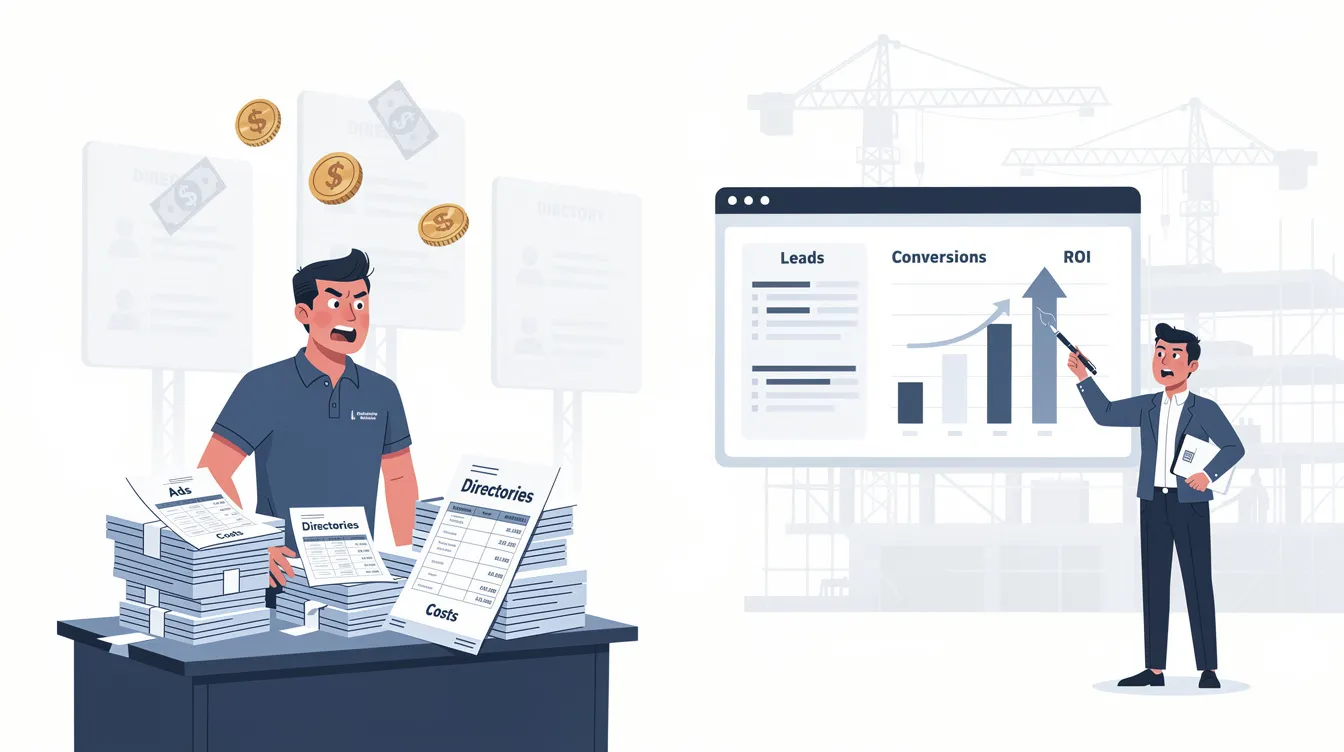
Many construction businesses overspend on ads and directories because they fail to track results accurately. Proper measurement helps you meet your business objectives and business goals efficiently.
Setting Up Tracking
-
Install Google Analytics 4 and Google Search Console
-
Configure conversion tracking for forms, phone calls (via call tracking numbers), and PDF downloads
-
Connect your CRM to track deals from first click to completed project
A CRM system can help construction companies record every single lead and enquiry so that nothing gets missed. Using a CRM system can also help automate follow-ups to stay on top of quotes, ensuring no opportunities slip through the cracks.
Core KPIs
Monitor these metrics:
-
Website traffic by channel
-
Enquiry volume
-
Cost per enquiry
-
Quote-to-win rate
-
Project value
Worked example:
A £2,000/month ad budget generates 20 enquiries, leading to 5 quotes and 2 awarded jobs worth £80,000. That’s a 3900% ROI—clear justification for continued investment.
Use CRM pipeline stages typical for the construction sector:
-
Enquiry
-
Site visit
-
Proposal/tender
-
Negotiation
-
Awarded
-
In progress
-
Completed
Hold monthly or quarterly review meetings to refine campaigns based on performance data.
Practical 90-Day Digital Marketing Plan for a Construction Company
This action plan suits a small to mid-sized firm starting in Q2 or Q3 2026. Whether you’re working with a marketing manager or handling things yourself, this timeline builds momentum without overwhelming your marketing team.
Weeks 1-4: Foundation
-
Complete website audit and quick fixes
-
Set up Google Analytics 4
-
Optimise Google Business Profile
-
Gather recent project photos
-
Draft 3-4 case studies
Weeks 5-8: Content and Social
-
Publish core service pages
-
Start blog schedule (2 posts/month)
-
Launch or refresh LinkedIn and Instagram profiles
-
Send first newsletter
Weeks 9-12: Paid and Automation
-
Launch small Google Ads campaign in one priority service + city
-
Set up basic email automation for new leads
-
Review analytics and refine efforts
The goal isn’t perfection—it’s momentum. Consistent publishing, advertising tests, and follow-up with qualified leads will help you discover what drives results for your business.
Conclusion: Building a Future-Proof Digital Presence
Strong digital marketing in 2026 positions your construction company for steadier pipelines and better-quality projects. Success comes from combining channels—SEO, Google Business Profile, content creation, social media, PPC, and email—rather than relying on just one.
Working with a construction marketing agency or developing capabilities in-house, the fundamentals remain the same. Conduct market research, understand your sector, and create engaging content that demonstrates your knowledge.
Whether you’ve been in the industry over three decades or you’re a newer firm seeking more work, start with 2-3 priority actions this month. Update your new website, optimise your GBP, and request 10 new reviews. These steps help potential clients find you and give them confidence to make contact.
Many marketing experts agree: review your digital marketing performance every quarter. A dedicated marketing agency can help, but even a solo marketing manager can stay ahead by tracking results and adjusting campaigns based on what the data reveals.
The clients businesses you want to win are researching contractors online right now. Make sure they find you.
Frequently Asked Questions (FAQs) for Construction Companies
FAQs are a powerful tool in construction marketing, serving multiple purposes: educating potential clients, addressing common concerns, and establishing your company as a trusted authority in the industry. Creating detailed, well-organized FAQ pages helps improve your website’s SEO, enhances user experience, and builds credibility with prospective customers.
Why are FAQs important for construction companies?
FAQs help answer common questions that potential clients have during their decision-making process. By proactively addressing concerns about project timelines, costs, licensing, insurance, and safety standards, you reduce barriers to contact and build trust. Additionally, FAQ content enriches your website with relevant keywords, improving search engine rankings and driving more qualified traffic.
How can a CRM system improve lead management from FAQs?
Integrating your FAQ pages with a Customer Relationship Management (CRM) system ensures that every lead or enquiry generated through your website is captured and tracked. This prevents missed opportunities and enables automated follow-ups, keeping your team on top of quotes and consultations. A CRM also helps segment leads, allowing personalized communication tailored to client needs.
What role does a well-structured marketing strategy play in leveraging FAQs?
A comprehensive marketing strategy uses FAQs as part of a broader content marketing approach to drive website traffic, encourage form submissions, and increase consultation requests. By aligning FAQ content with buyer intent and common search queries, construction companies can attract the right target audience and nurture them through the sales funnel effectively.
How does email marketing complement FAQs and lead nurturing?
Email marketing is a cost-effective way to nurture leads captured via FAQs and other website interactions. Sending regular newsletters, project updates, and educational content keeps your company top-of-mind with existing customers and prospects. Automated email sequences triggered by form submissions can provide timely information, build relationships, and encourage conversions over long sales cycles typical in construction.
What digital marketing tactics enhance the effectiveness of FAQs?
Combining FAQs with video content—such as jobsite walkthroughs using drones or smartphones—can provide dynamic, engaging answers that build trust faster than text alone. High-quality images, before-and-after project transformations, and detailed case studies linked from FAQs further showcase your expertise and professionalism.
Optimizing your website for mobile devices and ensuring fast load times make FAQs accessible and user-friendly, as over 70% of local searches occur on mobile. Localized landing pages and an optimized Google Business Profile (GBP) with accurate contact details (NAP) improve visibility for location-specific searches, driving more qualified local leads.
How do reviews and accreditations relate to FAQs?
Including positive customer reviews and prominently displaying licensing, insurance, and professional accreditations within or near your FAQ pages reinforces credibility. Educational blogs and thought leadership content linked from FAQs position your company as an expert, further influencing potential clients’ trust and decision-making.
How can construction companies track the success of their FAQs and marketing efforts?
Using tools like Google Analytics 4 and CRM reporting, companies can monitor which FAQ pages and related content drive the most traffic, form submissions, and consultation requests. Tracking helps refine marketing strategies, allocate budgets effectively, and focus on channels that generate the highest return on investment.
Summary
FAQs are more than just answers—they are a strategic asset in digital marketing for construction companies. When combined with CRM systems, email marketing, video content, and local SEO, they help build a high-trust online presence that attracts and converts potential customers. Regularly updating FAQs to address new questions and industry trends keeps your content fresh, relevant, and aligned with your business goals.

0 comments