

Introduction to Google AI
Google’s AI technology is at the forefront of transforming how we interact with information and complete complex tasks. Google's AI, especially through its Gemini model, leverages massive datasets to perform multi-step reasoning, planning, and multimodal understanding. Gemini integrates advanced capabilities such as multi-step reasoning, planning, and multimodality into its AI applications. This guide is designed for users, marketers, and businesses interested in leveraging Google's AI for search, productivity, and digital marketing. Understanding these advancements is essential for staying competitive and making the most of new search and productivity tools.
Applications Beyond Search
Beyond search, Google’s AI extends into diverse applications, including:
-
Digital marketing
-
Research
-
Content creation
These AI tools help automate workflows, personalize content, and improve decision-making processes.
For example, the healthcare model Cell2Sentence-Scale, based on Gemini, assists researchers in discovering potential cancer therapy pathways, showcasing AI’s impact on critical scientific advancements. WeatherNext 2 enhances meteorological forecasting by generating storm and cyclone predictions with unprecedented 1-hour resolution, significantly faster than previous systems.
In the home environment, Gemini for Home replaces traditional voice assistants by analyzing motion patterns to suggest personalized energy-saving routines, exemplifying AI’s role in everyday life. Google’s AI is also deeply integrated with its suite of services such as Gmail, Calendar, and Maps, streamlining user productivity and connectivity.
Project Astra represents a leap in real-time, multimodal assistance by identifying objects and answering questions based on live visual surroundings. Additionally, Google’s AI can proactively perform complex tasks like booking tickets or managing schedules, demonstrating agentic capabilities that autonomously plan and execute actions across platforms via the open Agent2Agent protocol. Artists are also leveraging Google’s AI tools to explore new forms of artistic expression and creativity.
Underpinning these advancements are Google’s custom-built Tensor Processing Units (TPUs), which provide a scaling advantage for training and deploying autonomous agent workflows at scale. Together, these innovations illustrate Google’s commitment to creating AI that is not only powerful but also practical and accessible.

How Google's AI Impacts Your Search Experience
Google's AI, especially through features like AI Overviews and Gemini, is directly reshaping the way users interact with search results. AI Overviews synthesize information from multiple sources to provide comprehensive summaries, leading to more zero-click searches and fundamentally changing how users interact with search results. These AI-generated summaries often allow users to find the answers they need without clicking through to external websites, resulting in a significant increase in zero-click searches—currently, 59% of Google searches result in no clicks. The presence of AI Overviews has also led to a measurable 34.5% reduction in click-through rates for top search results. This shift is transforming user behavior, making it more likely for users to get the information they need directly from the search page, and altering the dynamics of web traffic and engagement for content creators.

Understanding AI Overviews
AI Overviews are a key feature of Google’s AI-powered search experience, first introduced as part of the Search Generative Experience (SGE) in May 2023 and rebranded in May 2024. AI Overviews are Google's generative artificial intelligence summaries that appear prominently on search results, often before organic listings and sometimes even above ads. These are generative artificial intelligence (AI) summaries, also referred to as ai responses, that provide users with concise overviews by synthesizing relevant information from multiple authoritative sources. As of May 2025, Google expanded AI Overviews to over 200 countries and more than 40 languages.
These ai responses appear prominently in Google search results, often before organic listings and sometimes even above ads, delivering straightforward answers that allow users to access key information quickly without needing to click through multiple links or perform multiple searches. Users can also adjust the complexity of the language in AI Overviews, choosing between simplified or detailed options to better suit their understanding. While both AI Overviews and featured snippets appear in search results, featured snippets are selected based on structured data and schema markup, and play a distinct role in enhancing search visibility and ranking for optimized content.
While AI Overviews enhance the search experience by offering immediate, relevant information, they have faced criticism for occasionally producing misleading or nonsensical claims. In response, Google has continuously refined its algorithms and improved content validation to ensure higher accuracy and reliability. User feedback, such as helpfulness ratings and reports on inaccuracies, is crucial in improving the accuracy and relevance of AI Overviews, helping Google optimize ai responses and search ranking.
A significant consequence of AI Overviews is the rise of zero-click searches, where users find the information they need directly on the search results page without visiting external websites. Notably, links within AI Overviews tend to receive more clicks compared to traditional search listings, impacting ranking, visibility, and engagement for content creators. This shift changes the importance of site visits and time spent on site, as users often get answers directly from the search results page rather than spending time on individual sites. This has led to a measurable 34.5% reduction in click-through rates for top search results when AI Overviews are present, fundamentally changing the dynamics of web traffic and user behavior. As a result, many publishers have raised concerns about a decline in web traffic as users increasingly rely on AI Overviews instead of visiting source websites.
Exploring AI Mode
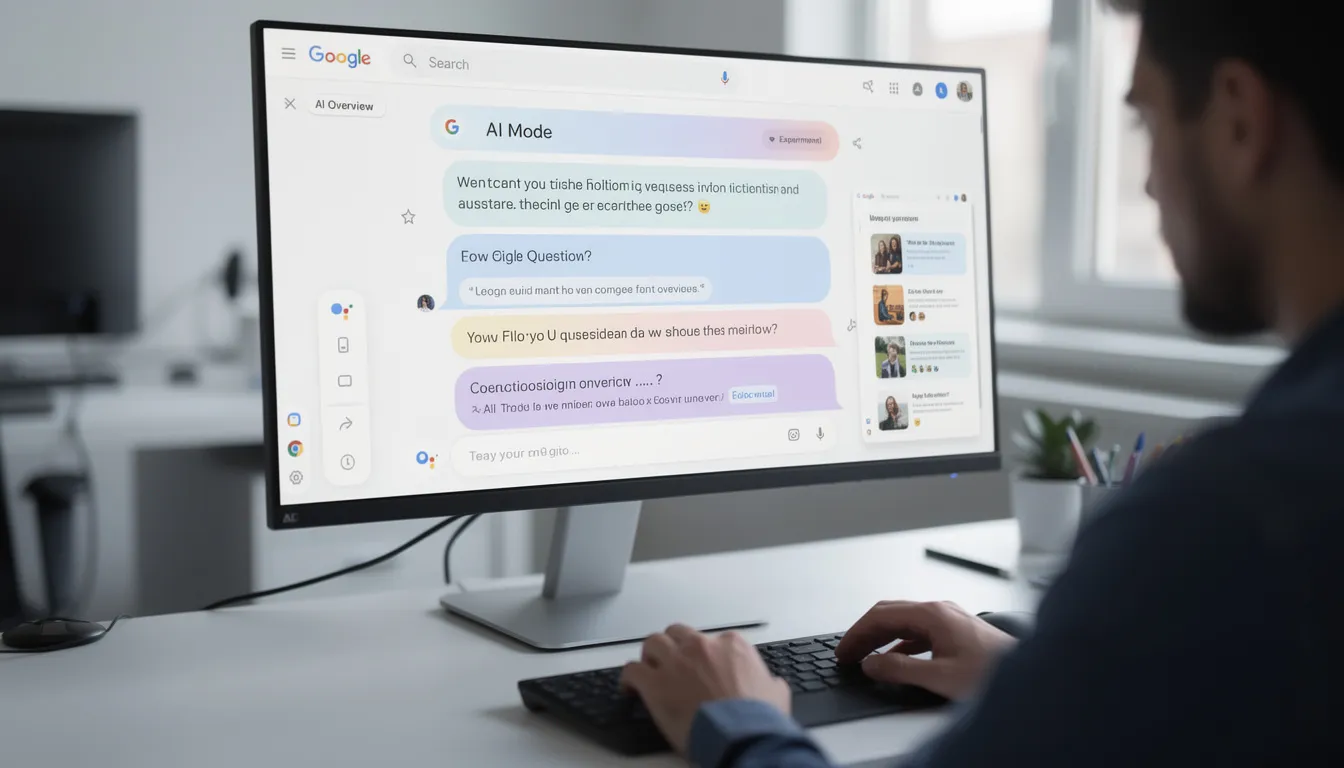
Complementing AI Overviews, AI Mode represents a conversational overhaul of Google Search, ushering in a new era of ai search that enables users to interact with Google’s AI in a more dynamic and engaging manner. Launched as an experimental feature, AI Mode allows users to ask follow-up questions and explore topics in greater depth within the same search experience.
Powered by the same generative AI technology as AI Overviews, AI Mode acts as an ai tool for planning, booking, and brainstorming ideas. It facilitates complex tasks such as booking events, planning, and brainstorming—all achievable in one go without multiple searches. This interactive experience enhances creativity and planning by allowing users to dive deeper into subjects and receive more nuanced responses. Unlike the rest of traditional search, which often requires browsing through multiple links or waiting for several pages to load, AI Mode streamlines the process by providing conversational, direct responses.
Google is actively testing features that let users toggle between ‘Classic View’ and ‘AI View’ within search results, providing flexibility for those who prefer traditional search layouts or the new AI-powered interfaces. This dual approach reflects Google’s commitment to balancing innovation with user choice.
Discovering AI Features
The evolving landscape of ai search is reshaping how users interact with information and how marketers approach visibility and engagement.
Google’s AI features, including AI Overviews and AI Mode, harness machine learning and natural language processing to understand user queries and deliver highly relevant information. These AI-powered tools focus on providing comprehensive, authoritative answers by drawing from a greater diversity of reputable sources across the web.
The integration of AI into Google Search has transformed the user journey from a linear process—searching, clicking, and visiting sites—to an immediate, synthesized experience where users can discover, explore, and act on information seamlessly. This shift has profound implications for digital marketing and SEO, as marketers now need to optimize for AI discoverability, prioritizing content that demonstrates clear expertise, authoritativeness, and trustworthiness (E-E-A-T). AI tools are increasingly enhancing marketing strategies through:
-
Automation
-
Personalized content
-
Efficiently targeting audiences
-
Streamlining content creation
In AI-driven search environments, brand visibility, mentions, and citations have become critical for ensuring a brand remains prominent and trusted within AI-generated search results and content summaries.
Continuous Innovation and Multimedia AI
Furthermore, Google’s AI features are evolving rapidly, with continuous updates that expand capabilities and improve user engagement. Innovations like Veo 3 and Veo 3.1 bring cinematic quality to video content creation, integrating audio and dialogue to enrich multimedia experiences.
The Power of Generative AI
Imagine a digital artist with a blank canvas and a palette of infinite colors—generative AI works much the same way, transforming raw data into creative outputs that mimic human ingenuity. At the core of Google’s AI features lies generative AI technology, which uses advanced machine learning and natural language processing to produce human-like text, summaries, and responses. This technology enables Google to create AI-generated summaries that are not only accurate but also contextually rich and easy to understand.
Generative AI Applications Beyond Search
Generative AI’s flexibility allows Google to support a wide range of applications beyond search, including art and music generation, healthcare research, weather forecasting, and intelligent home automation. For example, AI-powered image generation and editing tools let users upload images to transform styles, create photorealistic visuals, or enhance creative projects. As an ai tool, generative AI empowers artists and creators to explore new forms of artistic expression and push the boundaries of digital creativity.
When users interact with Google’s AI Overviews and related features, these elements often occupy a significant portion of the screen in search results, especially on mobile devices. This increased screen presence can impact the visibility of traditional organic listings and shape user engagement.
As generative AI becomes more central to Google’s search strategy, the company is committed to balancing AI-generated content with traditional search results. This hybrid approach ensures users benefit from both synthesized answers and direct access to authoritative sources, fostering a more transparent and trustworthy search ecosystem.
In summary, Google’s AI advancements—including Gemini, AI Overviews, AI Mode, and related technologies—are revolutionizing how we find, understand, and interact with information. By embracing these tools, users and marketers alike can unlock new levels of efficiency, insight, and creativity in their digital experiences.
Tackling Complex Questions with AI Overview
AI Overviews are redefining how users approach complex questions on Google Search. Instead of piecing together information from scattered search results, users now receive AI-generated summaries that distill key information from a wide range of authoritative sources. This means that when you pose a multifaceted or nuanced question, AI Overviews can synthesize relevant data, allowing you to access a comprehensive answer in one go—eliminating the need for multiple searches.
What sets AI Overviews apart is their interactive nature. If you want to dig deeper into a topic, you can ask follow-up questions directly within the search results page. Google’s AI responds with additional context and details, enabling users to explore subjects more thoroughly without leaving the results page. This dynamic approach not only saves time but also empowers users to expand their understanding of complex topics efficiently.
For example, if you’re researching the history of a cultural movement or the details of a scientific breakthrough, AI Overviews will present a concise summary and offer links to authoritative sources for further reading. As you continue to ask related questions, the AI adapts, providing increasingly relevant information tailored to your interests. This seamless experience allows users to explore, access, and expand their knowledge with ease, making Google Search a more powerful tool for tackling even the most challenging queries.
Conclusion
In conclusion, AI Overviews are transforming the way we interact with Google Search, making it easier than ever to find relevant information and tackle complex questions. By providing concise, AI-generated summaries and enabling users to dig deeper with follow-up questions, these features streamline the search process and deliver authoritative sources and links directly on the results page. As Google continues to expand its AI features—such as AI Mode and other generative AI-powered tools—the search experience is becoming more dynamic, creative, and user-focused.
Looking ahead, the integration of AI Overviews and related features will continue to shape the future of online search, offering users greater access to relevant information and new ways to start tracking their learning journeys. Whether you’re exploring a new topic, planning a project, or seeking in-depth answers, Google’s AI-powered search results provide the tools you need to discover, create, and innovate. By embracing these advancements, users can unlock a new era of creativity and efficiency, ensuring that Google Search remains at the forefront of information discovery in our ever-evolving digital world.
If you're looking to harness the power of Google's AI and elevate your digital presence, Sterling Media & Communications is here to help. With expert strategies tailored to the evolving landscape of AI-driven search and marketing, Sterling Media & Communications can guide your brand to greater visibility and engagement. Visit smcww.co.uk today to discover how their innovative solutions can transform your approach to digital marketing and keep you ahead in the AI-powered future.
Frequently Asked Questions about Google's AI and AI Overviews
What is the Healthcare model Cell2Sentence-Scale, and how does it relate to Google's AI?
The Healthcare model Cell2Sentence-Scale is an advanced AI application based on Google's Gemma technology. It plays a crucial role in medical research by assisting scientists in discovering potential cancer therapy pathways. By analyzing complex biological data, this model helps identify promising treatment options, showcasing the impactful use of Google's AI beyond traditional search and into critical health advancements.
How does Gemini for Home improve upon traditional voice assistants?
Gemini for Home represents a significant evolution in smart home technology. Unlike traditional voice assistants that respond to direct commands, Gemini for Home analyzes motion patterns within the home environment to proactively suggest personalized energy-saving routines. This AI-powered system enhances convenience and efficiency by learning from daily habits and optimizing energy use without constant user input.
What concerns have been raised by content publishers regarding AI Overviews?
Since the introduction of AI Overviews, many content publishers have expressed concerns about a decline in web traffic. Because AI Overviews provide synthesized summaries directly within Google search results, users often find the information they need without visiting the original source websites. This shift has led to worries about reduced site visits and engagement, impacting publishers' visibility and revenue.
How has the rise of AI Overviews affected user behavior on Google Search?
The advent of AI Overviews has significantly increased the prevalence of zero-click searches—searches where users obtain answers directly on the search results page without clicking through to external websites. Currently, approximately 59% of Google searches result in no clicks, highlighting a major change in how users consume information and interact with search results.
How widely available are AI Overviews?
AI Overviews have been rolled out extensively and are now available in over 200 countries and territories worldwide. They support more than 40 languages, making this AI-powered feature accessible to a broad global audience. This widespread availability underscores Google's commitment to enhancing the search experience for users everywhere through generative AI technology.

0 comments