

Introduction to E-E-A-T: Experience, Expertise, Authoritativeness, and Trustworthiness
E-E-A-T stands for Experience, Expertise, Authoritativeness, and Trustworthiness. These four pillars are foundational to content quality and search engine optimization (SEO) success. Google introduced E-E-A-T as an evolution of the original E-A-T framework to emphasize the critical role of real-world experience in creating content that ranks well. The addition of the second 'E' for 'Experience' was made in late 2022 to highlight the importance of firsthand knowledge in content creation. Understanding and applying E-E-A-T principles is essential for content creators and site owners aiming to improve their search rankings and build a strong brand reputation.
Google’s human quality raters evaluate content created across the web based on these criteria to ensure users receive accurate, trustworthy, and relevant information. By aligning your content marketing and content strategy with E-E-A-T, you can create quality content that meets Google’s quality guidelines and resonates with your target audience—especially for Your Money or Your Life (YMYL) topics, which are subjects that can impact a person's health, financial stability, or safety.
What is meant by E-E-A-T?
E-E-A-T is a framework used by Google to assess the overall quality of web content and its creators. It stands for four key components:
-
Experience: Firsthand or life experience related to the topic.
-
Expertise: In-depth knowledge or skill in the subject area.
-
Authoritativeness: Recognition as a trusted go-to source by other reputable websites and users.
-
Trustworthiness: Transparency, accuracy, and reliability of the content and website.
Together, these pillars help Google determine which content is valuable, credible, and safe for users, especially for Your Money or Your Life (YMYL) topics that require the highest standards.
The Importance of Content Quality and E-E-A-T in SEO

Content quality is at the heart of effective SEO. Google’s search algorithm prioritizes web pages that demonstrate strong experience, expertise, authoritativeness, and trustworthiness. These factors help Google identify content that is reliable and valuable, especially for YMYL topics that can impact a person’s financial stability, health, or safety.
Google's Search Quality Rater Guidelines emphasize that low-quality YMYL pages can negatively impact a person's happiness, health, financial stability, or safety. Because of this, content created with a focus on E-E-A-T principles tends to rank higher in search engine results pages (SERPs) because it meets the expectations of both users and Google's quality raters. High-quality content supports a positive brand reputation, builds user trust, and drives sustainable traffic and revenue.
Why does E-E-A-T matter?
E-E-A-T matters because it helps Google surface the most trustworthy and relevant content to users. Trustworthiness is considered the most critical component of E-E-A-T, as untrustworthy pages are rated low regardless of their experience or expertise. By emphasizing these factors, Google aims to minimize misinformation and prioritize content that positively impacts users’ well-being and decision-making. For businesses and content creators, strong E-E-A-T signals improve search visibility, enhance brand reputation, and contribute to long-term SEO success.
Is E-E-A-T a direct ranking factor?
While E-E-A-T itself is not a direct ranking factor in Google's algorithm, it plays a crucial role in informing Google's quality raters who provide feedback used to refine the search algorithm. This indirect influence means that content demonstrating strong E-E-A-T is more likely to perform well in search rankings over time.
Is E-E-A-T still relevant?
Yes, E-E-A-T remains highly relevant in SEO. Google continues to refine its algorithms and quality rater guidelines to emphasize the importance of experience, expertise, authoritativeness, and trustworthiness. With increasing concerns about misinformation and AI-generated content, adhering to E-E-A-T principles is more critical than ever for ranking content effectively.
Experience, Expertise, Authoritativeness, and Trustworthiness: The Core of E-A-T
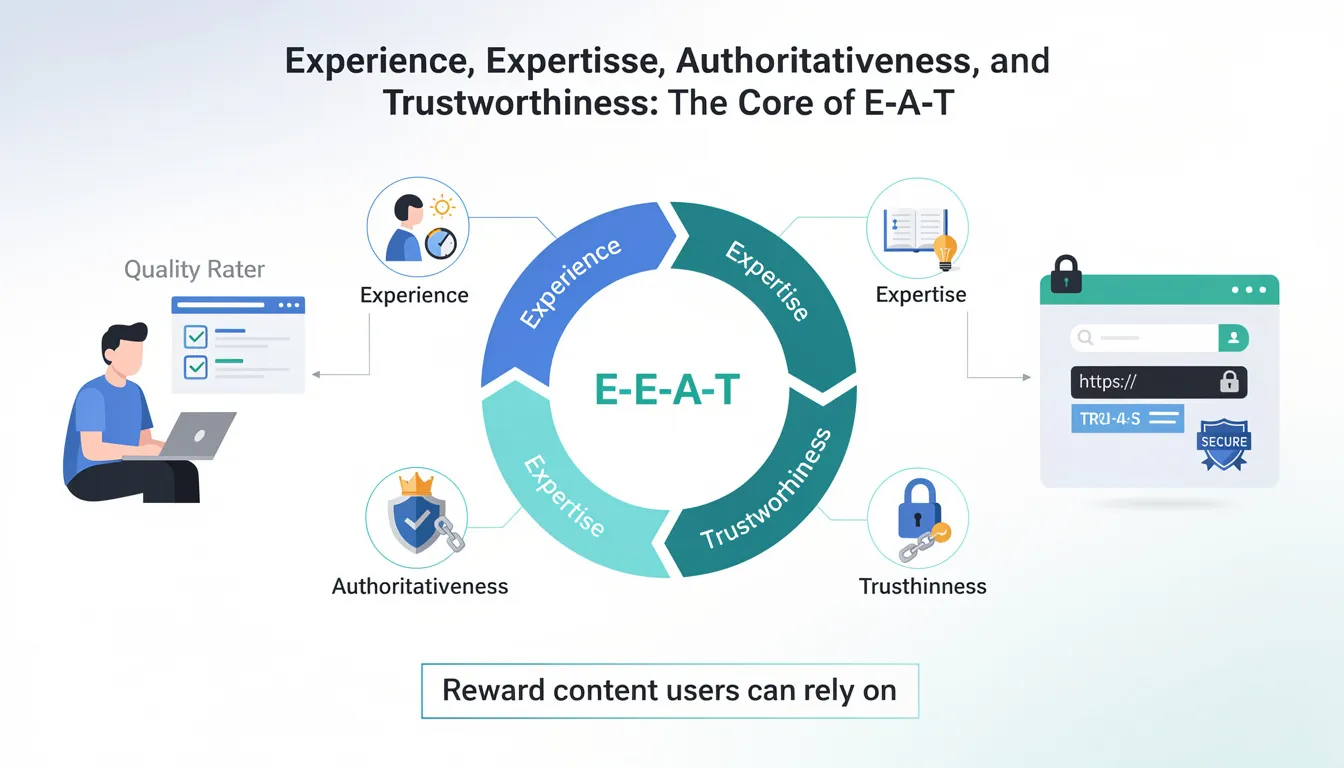
E-A-T remains a fundamental part of the E-E-A-T framework, representing the expertise, authoritativeness, and trustworthiness of content creators and their content. Google’s quality raters assess these elements meticulously to evaluate page quality.
-
Expertise reflects the content creator’s in-depth knowledge or skill in the subject area.
-
Authoritativeness is demonstrated by recognition from other websites, backlinks from reputable sources, and the overall reputation of the web domain.
-
Trustworthiness is the most critical element, encompassing transparency, accuracy, and security measures such as HTTPS and up-to-date SSL certificates to protect user data.
Together with experience, these factors help Google reward content that users can rely on.
What is the difference between E-A-T and E-E-A-T?
E-A-T stands for Expertise, Authoritativeness, and Trustworthiness and has been a core part of Google's quality evaluation for years. In late 2022, Google added the extra "E" for Experience to emphasize the importance of firsthand, real-world experience in content creation. This addition highlights that content creators should not only be knowledgeable but also have direct experience with the topics they cover.
What are the principles of E-E-A-T?
The principles of E-E-A-T involve:
-
Demonstrating real-world experience with the subject matter.
-
Showcasing adequate expertise through credentials, knowledge, or skills. Detailed author bios listing degrees, certifications, years of experience, and links to professional social media profiles help establish this expertise.
-
Building authoritativeness by earning recognition and backlinks from reputable sources.
-
Ensuring trustworthiness via transparency, accurate information, website security, and maintaining clear contact information and easily accessible privacy policies.
Adhering to these principles helps create valuable, credible content that aligns with Google’s quality guidelines.
What is an example of E-E-A-T in SEO?
An example of E-E-A-T in SEO is a health blog post written by a certified medical professional who shares personal clinical experience, cites authoritative medical studies, links to reputable health organizations, maintains a secure website with clear contact information, and includes a disclaimer stating that the content has been reviewed by a qualified professional. This combination demonstrates experience, expertise, authoritativeness, and trustworthiness, making the content highly valuable to users and favored by Google.
Leveraging Experience in Content Created for E-E-A-T
Experience is the newest addition to the E-E-A-T acronym, highlighting the importance of firsthand or life experience in content creation. Content created by individuals who have real-world experience with the topic is more likely to be accurate, relevant, and engaging.
Demonstrating Experience in Content
For example, a blog post reviewing a product written by someone who has personally used it will carry more weight than generic or secondhand information. Demonstrating experience through personal stories, case studies, or original research can significantly boost your content’s credibility and search performance.
Using personal case studies and examples provides practical applications and firsthand usage details that resonate with readers and signal to Google that the content creator has genuine experience.
Navigating AI Generated Content and Maintaining Content Quality

Challenges of AI-Generated Content for E-E-A-T
AI generated content has become a popular tool in content marketing and SEO, but it presents both opportunities and challenges regarding E-E-A-T. While AI tools can assist in generating content ideas, drafting outlines, and optimizing for keywords, Google emphasizes that AI content must be reviewed and refined by humans to ensure it meets quality standards.
AI tools do not hold degrees, work experience, or professional credentials, which limits their ability to demonstrate expertise. AI-generated content may struggle to meet E-E-A-T criteria due to the lack of genuine experience. Trust is the most critical component of E-E-A-T, and AI's susceptibility to errors and misinformation undermines trust.
Google's quality raters are trained to identify AI content that lacks experience, expertise, or trustworthiness. Therefore, integrating AI generated content into your content strategy requires careful human oversight to maintain authenticity and accuracy. Using AI as a support tool rather than a replacement for human expertise helps uphold content quality and aligns with Google's quality guidelines.
Understanding Google’s Quality Raters and Their Role in Evaluating E-E-A-T
Google’s quality raters are real people who assess the quality of web content based on the Search Quality Rater Guidelines. These guidelines provide a framework to evaluate E-E-A-T and overall page quality, influencing Google’s algorithm updates indirectly.
Quality raters focus on whether content is created by credible authors, backed by authoritative sources, and trustworthy for the topic at hand. Their feedback helps Google refine its ranking algorithms to prioritize content that meets these high standards, making their role crucial for SEO success.
What are the Google E-E-A-T guidelines?
Google’s E-E-A-T guidelines are part of the Search Quality Rater Guidelines, a detailed document used by human quality raters to evaluate web content. These guidelines define how raters assess experience, expertise, authoritativeness, and trustworthiness, especially for YMYL pages. They emphasize the importance of accurate, transparent, and well-sourced content and provide examples of high and low-quality pages.
What is Google's 20% rule?
Google's 20% rule is an internal guideline suggesting that at least 20% of a webpage's content should be original, high-quality, and valuable to users. This rule supports the creation of unique, relevant content that adds meaningful information beyond what is found on other pages, aligning with E-E-A-T principles.
Building a Content Strategy That Emphasizes Experience, Expertise, Authoritativeness
A successful content strategy incorporates E-E-A-T principles from the ground up. This means planning content that showcases real-world experience, demonstrates subject matter expertise, and earns authoritative recognition.
Effective Content Marketing Should Include:
-
Conducting thorough research on the topic to ensure content is based on accurate and up-to-date information.
-
Collaborating with experts to create original content.
-
Using clear author bios that highlight credentials and experience.
-
Linking to reputable external sources to support claims.
-
Regularly updating content to keep it current and accurate, reflecting the latest information and developments in your field.
-
Encouraging genuine customer reviews and testimonials to build trust.
-
Using clear and concise language to write in a way that is easy to understand, avoiding jargon and overly complex sentences.
-
Optimizing for user experience and accessibility to ensure content is accessible to all users, including those with disabilities.
-
Focusing on customer experience to align with user expectations and improve engagement with content.
By embedding these practices into your content strategy, you enhance your brand reputation and improve your chances of ranking well on Google search.
What is the 80/20 rule for SEO?
The 80/20 rule for SEO suggests that 80% of your results come from 20% of your efforts. In practice, this means focusing on creating high-quality, relevant content and optimizing key pages that drive the majority of your traffic and conversions. Aligning efforts with E-E-A-T principles helps maximize the impact of your SEO strategy.
Measuring and Maintaining Strong E-E-A-T for Long-Term Brand Reputation
Measuring the success of your E-E-A-T efforts involves monitoring key performance indicators such as search rankings, organic traffic, user engagement, and brand reputation metrics. Regular content audits help identify opportunities to refresh outdated information and strengthen trust signals.
Maintaining strong E-E-A-T is an ongoing process that requires commitment to quality content creation, transparent communication, and responsiveness to user feedback. A strong brand reputation built on these pillars can sustain search visibility and financial stability over time.
Is 4.2 a good Google rating?
A 4.2 out of 5 Google rating is generally considered good, indicating a positive reputation and user trust. Maintaining high ratings contributes to trustworthiness, an essential pillar of E-E-A-T, and can influence users' perception and click-through rates.
Frequently Asked Questions (FAQ)
Frequently Asked Questions About E-E-A-T and SEO
What are the 4 pillars of SEO?
-
Technical SEO: Optimizing website infrastructure for crawling and indexing.
-
On-Page SEO: Crafting relevant content and optimizing HTML elements.
-
Off-Page SEO: Building backlinks and online reputation.
-
User Experience (UX): Ensuring site usability, speed, and engagement.
E-E-A-T primarily supports on-page SEO and off-page SEO by enhancing content quality and authority.
What is E-E-A-T in Google?
E-E-A-T in Google refers to the framework Google uses to evaluate the quality and credibility of web content and its creators. It guides quality raters and influences algorithm updates to prioritize trustworthy, expert, and experienced content that serves users' needs.
Can I learn SEO in 3 months?
Yes, it is possible to learn the fundamentals of SEO in 3 months with focused study and practice. Understanding key concepts like E-E-A-T, keyword research, on-page optimization, link building, and analytics provides a solid foundation to start optimizing websites effectively.
Is Google E-E-A-T still relevant?
Absolutely. Google E-E-A-T continues to be a critical concept for SEO, especially for YMYL topics. It shapes how content quality is assessed and how websites can build trust and authority to rank well in search results.
By mastering E-E-A-T principles and integrating them into your content marketing and SEO strategies, you can significantly enhance your content quality, build a strong brand reputation, and achieve lasting success in Google search results. Prioritizing experience, expertise, authoritativeness, and trustworthiness will help you create valuable content that both users and search engines recognize as authoritative and reliable.

0 comments