

Introduction: Who This Guide Is For and What You'll Learn
This guide is for business leaders, AI practitioners, and anyone interested in leveraging generative AI through effective prompt engineering. Prompt engineering is the process of structuring or crafting instructions in natural language to produce more accurate and relevant responses from generative AI models. We cover key techniques, best practices, real-world applications, and career opportunities in prompt engineering. Whether you are new to AI or looking to optimize your organization's use of generative AI, this guide will help you master the art and science of prompt engineering.
Understanding Prompting Engineering and Its Importance in Artificial Intelligence
A prompt is natural language text describing the task that an AI should perform. Prompt engineering is the art and science of designing and optimizing prompts to guide AI models towards generating the desired responses. As artificial intelligence continues to evolve, the ability to craft effective prompts has become a critical skill for unlocking the full potential of generative AI and other generative AI models. By mastering prompting engineering, users can guide AI systems to produce optimal outputs that meet specific needs, whether in text generation, code snippets, or image creation.
Fundamentals of Prompt Engineering: Clear Instructions and Context Window
At its core, prompt engineering involves crafting clear instructions that guide the language model toward generating relevant and accurate responses. Understanding the context window—the amount of text or data the AI can consider at once—is essential for effective prompt design. Providing relevant context and additional context within this window helps the AI interpret the user's query accurately and produce the expected response. Skills in natural language processing (NLP) are vital for prompt engineers to create prompts that AI models can understand and act upon effectively.
Prompt Engineering Best Practices for Optimal Results
Handling complex tasks requires advanced prompt engineering techniques to ensure the AI model can break down and address multi-step problems. Prompt engineering best practices include:
-
Using precise instructions that specify the desired length, format, and style of the output.
-
Incorporating relevant examples through few-shot prompting to demonstrate the expected response.
-
Applying chain of thought prompting to guide the AI through intermediate steps, improving reasoning and accuracy.
-
Structuring prompts to manage the context window effectively, avoiding information overload.
Iterative Refinement
-
Start with a basic prompt and review the AI’s output.
-
Adjust the prompt wording, add clarifications, or provide examples to improve results.
-
Repeat the process until the output meets your requirements.
Systematic Evaluation
-
Treat prompts like code—test different versions and compare outputs.
-
Use shared rubrics for accuracy and relevance.
-
Document effective prompt structures for future use.
Mitigating Prompt Injection Attacks
-
Identify and test for vulnerabilities where malicious input could manipulate AI behavior.
-
Use clear boundaries and validation steps in prompts to prevent exploitation.
-
Regularly update prompt strategies to address new security risks.
These best practices help generative AI models navigate complex reasoning and produce coherent, relevant, and specific outputs.
Key Prompting Techniques: Few-Shot Prompting and Chain of Thought Prompting
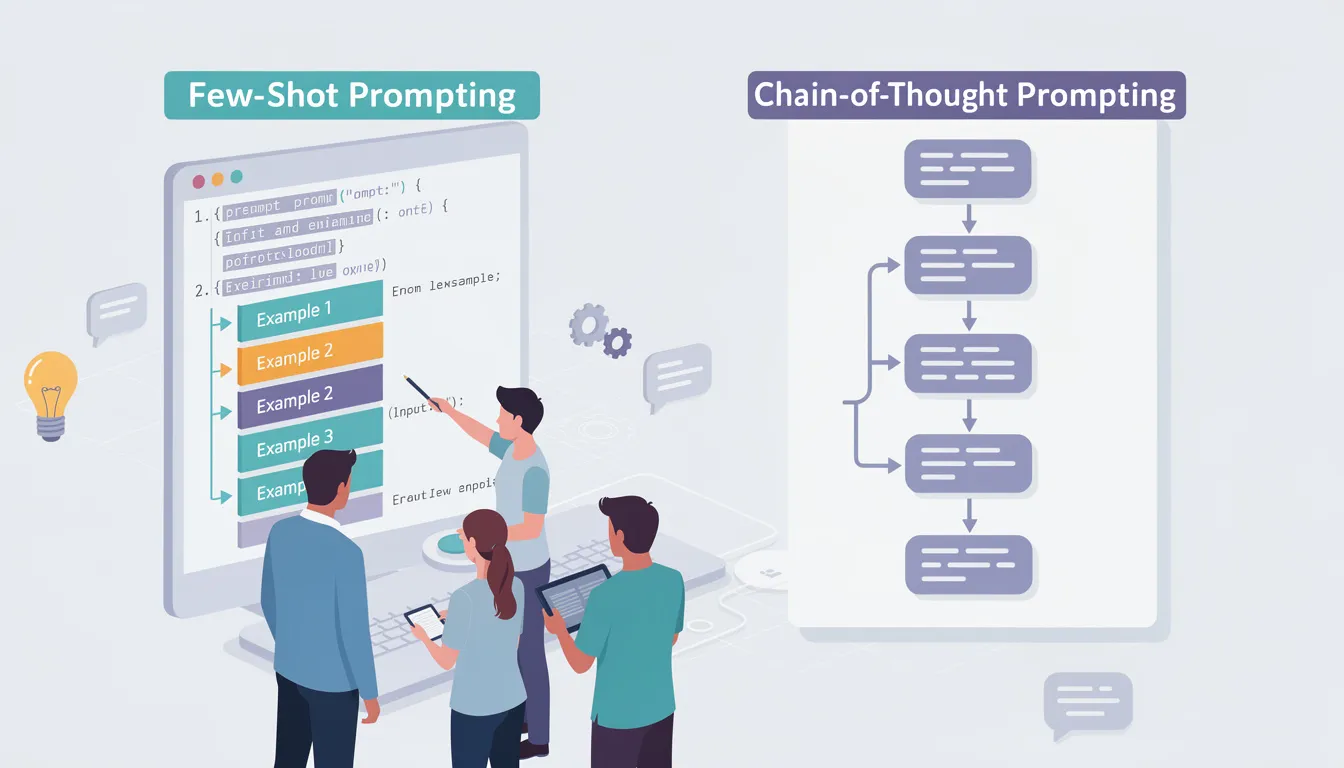
Few-shot prompting involves providing the AI with a small number of examples that illustrate the desired output. This technique helps the model understand the task better and generate more accurate responses. For instance, when asking for code snippets or summaries, showing a couple of specific examples can significantly improve the quality of the AI’s output.
Chain of thought prompting encourages the AI to solve complex tasks by breaking them down into intermediate steps or reasoning chains. This approach mimics human problem-solving and is particularly effective for tasks that require multi-step logic, such as mathematical problem-solving or detailed explanations. By guiding the AI through these steps, users can achieve more precise and relevant answers.
Steps for Chain-of-Thought Prompting:
-
Present the problem or question clearly.
-
Instruct the AI to explain its reasoning step by step.
-
Review the intermediate steps for logical consistency.
-
Arrive at the final answer based on the reasoning chain.
Types of AI Prompts
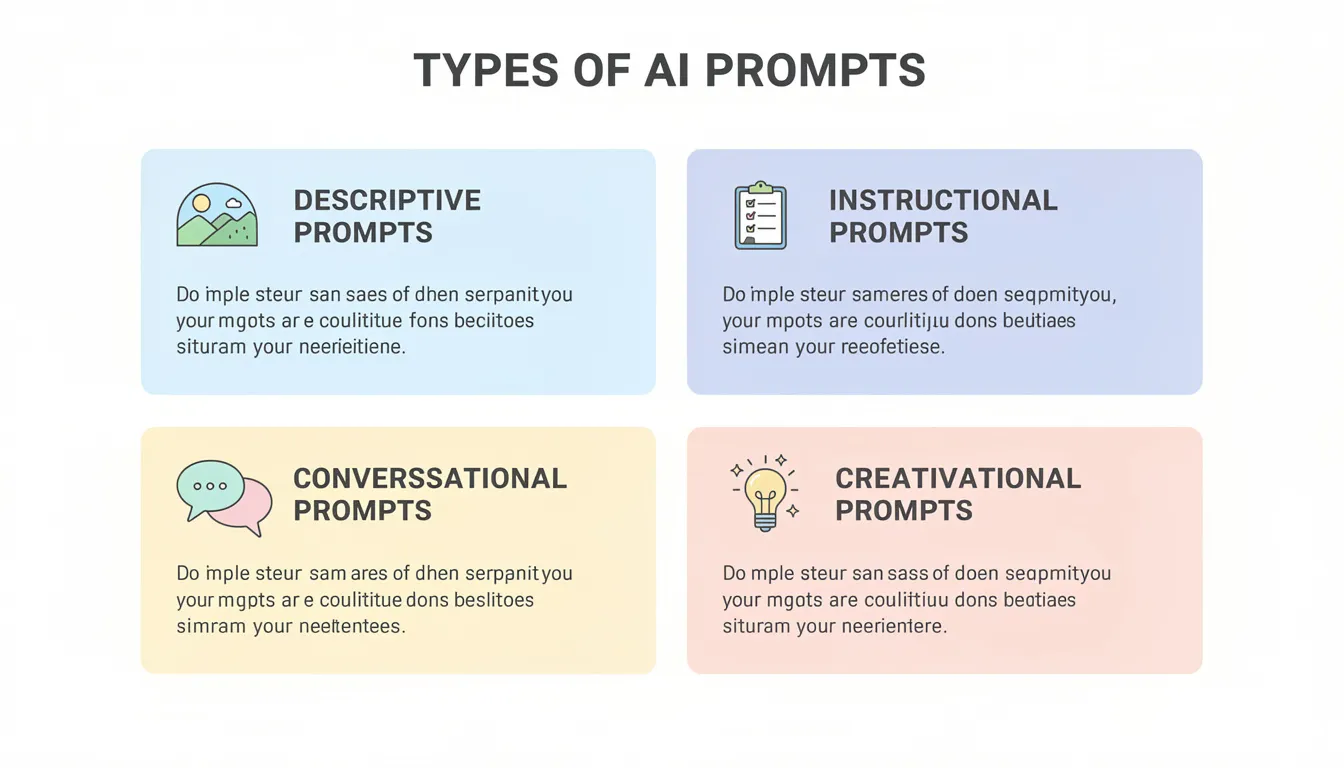
Understanding the different types of AI prompts is fundamental to effective prompt engineering. Each type serves a specific purpose and can be employed based on the complexity of the task and the desired output. Here are the main types of prompts used with generative AI models:
-
Zero-Shot Prompting: Provide the AI model with a direct instruction or question without any additional context or examples. This approach relies entirely on the model’s pre-existing knowledge and training to generate a response. It is best suited for straightforward tasks where the AI can infer the desired output from the prompt alone. For example, asking "What is the capital of France?" is a zero-shot prompt expecting a specific output.
-
Few-Shot Prompting: Supply the AI with a small number of examples that illustrate the desired input-output pairs before presenting the actual prompt. This technique helps the model understand the task more clearly by demonstrating the expected format and style of responses. For instance, when requesting code snippets or summaries, providing a few examples can significantly improve the AI’s accuracy and relevance.
-
Chain-of-Thought Prompting: Guide the AI to break down complex reasoning into intermediate steps, mimicking human problem-solving processes. This method is particularly effective for tasks involving multi-step logic, such as mathematical calculations, detailed explanations, or decision-making scenarios. By encouraging the AI to articulate each reasoning step, CoT prompting leads to more accurate and transparent outputs.
-
Tree-of-Thought Prompting: Build on chain-of-thought prompting by generating multiple lines of reasoning in parallel. This allows the AI to explore various possible solutions simultaneously and select the most suitable one, often the most commonly reached conclusion. It enhances the depth and breadth of the AI’s reasoning, making it valuable for complex tasks requiring diverse perspectives or options.
-
Self-Refine Prompting: Involve the AI generating an initial response, critiquing it, and then revising the answer based on the critique. This iterative process continues until the AI produces a satisfactory output. Self-refine prompting improves the quality and accuracy of responses by enabling the model to self-correct and refine its reasoning.
-
Directional-Stimulus Prompting: Include hints or cues within the prompt, such as specific keywords or stylistic instructions, to steer the AI toward a particular type of output. For example, a prompt might instruct the AI to write a poem about love using words like "heart," "passion," and "eternal." This technique helps generate outputs aligned with specific themes or tones.
-
Generated Knowledge Prompting: Prompt the AI model to first generate relevant facts or information necessary to complete a task before proceeding to the final response. By asking the model to produce foundational knowledge upfront, this technique ensures that the AI’s answers are grounded in accurate and pertinent data, leading to more reliable and informative outputs.
Steps for Generated Knowledge Prompting:
-
Ask the AI to list or generate key facts or background information related to the task.
-
Review the generated knowledge for accuracy and relevance.
-
Instruct the AI to use this information to produce the final output.
-
-
Complexity-Based Prompting: Perform multiple chain-of-thought rollouts and select those with the longest chains, which often represent the most comprehensive reasoning paths. By focusing on these detailed chains, complexity-based prompting enhances the AI’s ability to handle intricate problems and produce thorough answers.
Evolution of Prompt Engineering
By 2026, prompt engineering has evolved into a systematic design discipline characterized by advanced reasoning frameworks. This evolution has transformed prompt engineering from a trial-and-error process into a structured approach that incorporates sophisticated techniques to guide AI models more effectively. The development of these frameworks has improved the AI’s ability to handle complex tasks, increased interpretability of AI reasoning, and enhanced the overall quality and consistency of AI-generated outputs.
Each of these prompt types and the evolving methodologies underscore the importance of mastering prompt engineering skills to optimize interactions with generative AI models and achieve precise, relevant, and high-quality results.
Advanced Prompting Techniques to Enhance AI Reasoning
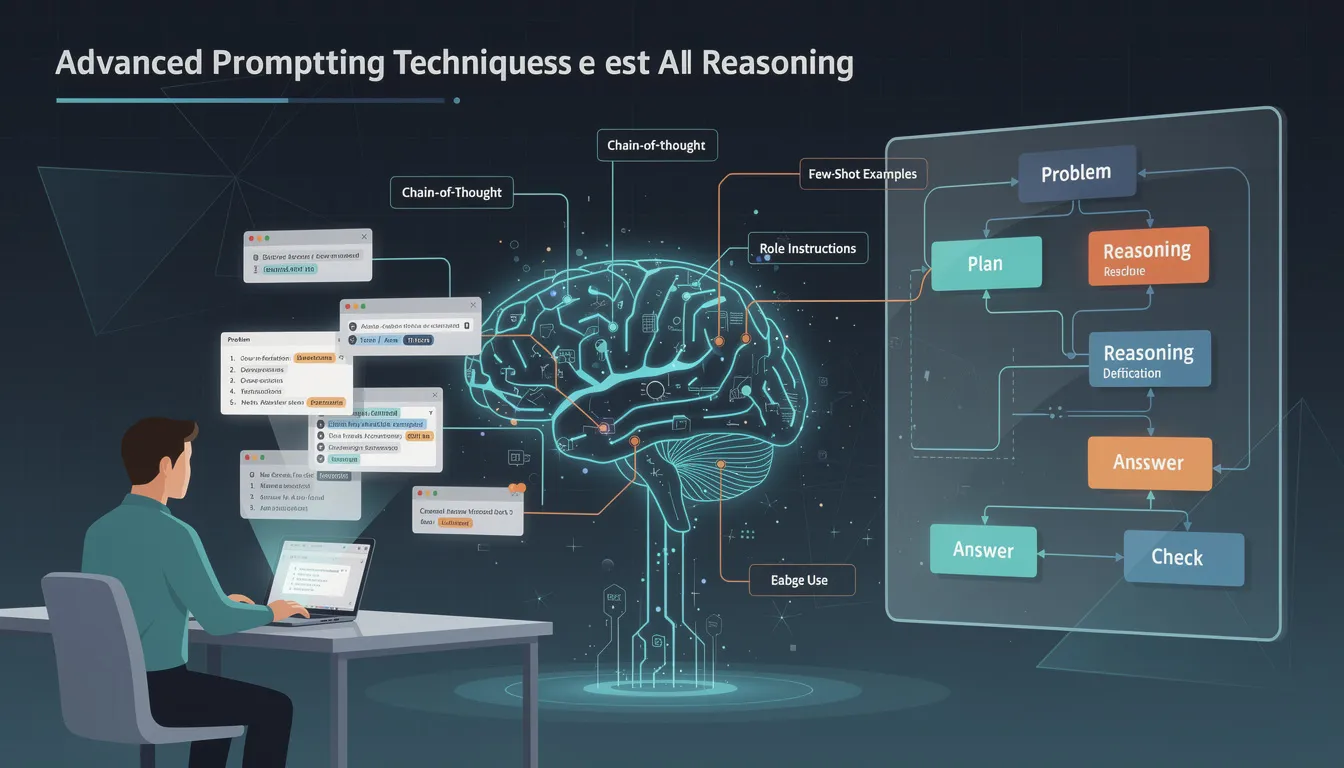
Building on chain of thought prompting, tree of thought prompting generalizes this approach by generating multiple lines of reasoning in parallel. This allows the AI to explore different possible solutions simultaneously, improving the depth and breadth of its reasoning. Complexity-based prompting further refines this by performing several chain of thought rollouts and selecting those with the longest chains of thought, which often lead to the most comprehensive answers.
Self-refine prompting is another sophisticated technique where the AI is prompted to solve a problem, critique its own solution, and then revise the response accordingly. This iterative process continues until the AI reaches a satisfactory conclusion, enhancing the quality and accuracy of its output.
Generated knowledge prompting involves first asking the AI to produce relevant facts or information needed to complete a task before finalizing the response. This preparatory step helps ensure that the AI’s answers are grounded in accurate and pertinent data.
Zero-shot prompting, by contrast, provides the AI with a direct instruction or question without additional context or examples. This technique tests the AI’s ability to respond accurately based solely on its pre-existing knowledge and training.
Mitigating AI Limitations: Reducing Hallucinations, Bias, and Ensuring Safety
Prompt engineering plays a crucial role in minimizing AI "hallucinations," where the model generates inaccurate or fabricated information. By carefully structuring prompts and providing clear, relevant context, prompt engineers help ensure that AI outputs remain aligned with the user's specific goals and factual accuracy.
Systematic Evaluation
The performance of large language models is highly sensitive to subtle changes such as the ordering of examples and variations in phrasing. Systematic evaluation of prompts—treating them like code with shared rubrics for accuracy and relevance—helps identify the most effective prompt structures.
Mitigating Bias and Ensuring Safety
Moreover, prompt engineering helps mitigate bias and reduce the risk of generating inappropriate or offensive content. Incorporating safety and compliance considerations into prompt design ensures that AI workflows respect ethical, legal, and corporate boundaries.
Self-Consistency and Role Assignment
-
Self-consistency prompting enhances reliability by generating multiple reasoning paths and selecting the most consistent answer among them.
-
Role assignment in prompt engineering instructs the AI to adopt specific personas or tones, guiding its responses to fit desired communication styles or perspectives.
Practical Applications of Prompt Engineering Across Industries
Prompt engineering has broad applications across various sectors. In healthcare, it enables AI to summarize complex medical data and develop treatment recommendations, helping practitioners make informed decisions based on accurate insights.
In software development, prompt engineering helps generate code snippets, suggest improvements to existing code, automate coding tasks, debug errors, and design API integrations, significantly reducing manual labor and accelerating development cycles.
Chatbot development benefits from prompt engineering by ensuring AI understands user queries and provides meaningful, context-aware responses, enhancing user experience.
In cybersecurity, researchers use prompt engineering to simulate cyberattacks and design better defense strategies, leveraging AI’s ability to model complex threat scenarios.
Retrieval-Augmented Generation (RAG) is a cutting-edge technique that combines prompt engineering with external data sources such as uploaded documents and structured data to provide AI with up-to-date or proprietary information, improving the relevance and accuracy of outputs.
Generative AI tools also enable users to generate images, expanding the scope of prompt engineering beyond text and code.
Generative AI and Its Expanding Applications
-
Healthcare: Summarizing medical data, supporting diagnosis, and treatment planning.
-
Software Development: Generating code, debugging, and automating repetitive tasks.
-
Customer Service: Powering chatbots and virtual assistants for better user engagement.
-
Cybersecurity: Simulating threats and designing defense strategies.
-
Creative Industries: Producing images, audio, and written content for marketing and entertainment.
Building a Career in Prompt Engineering: Skills and Opportunities
As prompt engineering evolves into a systematic design discipline with advanced reasoning frameworks, the demand for skilled prompt engineers continues to grow. Essential skills include familiarity with large language models, strong communication abilities, and programming expertise in languages like Python and other programming languages.
Prompt engineers need to understand how to optimize prompts for various generative AI models on the market and apply best practices to achieve desired outcomes. They can find opportunities across industries including healthcare, cybersecurity, business, and education.
Prompt Engineering Best Practices for Career Success
-
Stay updated on the latest AI models and prompt engineering techniques.
-
Practice iterative refinement and systematic evaluation of prompts.
-
Develop programming skills, especially in Python.
-
Engage with online communities and share best practices.
-
Learn to identify and mitigate prompt injection attacks to ensure AI safety.
Effective prompt engineering can identify and mitigate prompt injection attacks, which are malicious attempts to manipulate AI behavior, ensuring consistent and accurate AI services.
The rise of prompt engineering jobs reflects the growing importance of this role. Organizations are actively hiring prompt engineers to leverage AI capabilities and improve automation, creativity, and decision-making processes.
Artificial Intelligence and the Future of Prompt Engineering
The Evolving Role of Prompt Engineering
Artificial intelligence continues to advance rapidly, and prompt engineering will play an increasingly vital role in shaping AI-human interactions. As generative AI models become more sophisticated, the demand for skilled prompt engineers will grow, driving innovation across industries. Mastering prompt engineering best practices will empower organizations to unlock new possibilities in automation, creativity, and decision-making.
Understanding Gen AI and Its Role in Prompt Engineering
Generative AI refers to a category of artificial intelligence systems designed to create new content, such as text, images, audio, or code, based on patterns learned from vast datasets. These models, including large language models (LLMs), use sophisticated algorithms to generate outputs that can mimic human intelligence and creativity. Generative AI has revolutionized how we interact with technology by enabling applications ranging from conversational chatbots to automated content creation and image synthesis.
The effectiveness of generative AI heavily depends on prompt engineering. Since these models generate outputs based on the input prompts they receive, crafting well-structured and clear prompts is crucial to guide the AI towards producing relevant and high-quality results. Generative AI systems interpret prompts as instructions or queries, and the precision and context provided in these prompts directly influence the model’s ability to generate desired outputs.
Moreover, generative AI models excel when prompt engineering techniques such as few-shot prompting, chain of thought prompting, and context management are applied. These techniques help the AI model understand complex tasks by breaking them down into manageable parts or providing examples to learn from, thus enhancing the quality and accuracy of the generated content.
As generative AI continues to evolve, its integration with prompt engineering becomes increasingly important for unlocking innovative prompt engineering use cases in industries like healthcare, software development, marketing, and more. Understanding generative AI’s capabilities and limitations is essential for prompt engineers aiming to optimize AI-driven workflows and deliver precise, context-aware responses.
Conclusion and Next Steps: Elevate Your AI Capabilities with Sterling Media & Communications
Prompting engineering is an essential discipline for anyone working with generative AI and large language models. By applying best practices such as few-shot prompting, chain of thought prompting, and clear instruction design, you can maximize the effectiveness of AI tools and achieve your desired output even for complex tasks.
If your organization is looking to harness the power of artificial intelligence and improve your AI-driven workflows, consider partnering with Sterling Media & Communications. With expertise in AI strategy, prompt engineering, and digital transformation, Sterling Media & Communications can help you unlock the full potential of generative AI systems.
Visit smcww.co.uk today to learn more about how Sterling Media & Communications can support your AI initiatives and guide you through the evolving landscape of prompt engineering.
Additional Resources and Community Support
To stay ahead in the fast-paced world of prompt engineering, engage with online communities, forums, and training resources. Continuous learning and sharing best practices are key to mastering this dynamic field and leveraging artificial intelligence to its fullest.
Frequently Asked Questions About Prompt Engineering
What is generated knowledge prompting?
Generated knowledge prompting is an advanced technique in prompt engineering where the AI model is first prompted to generate relevant facts or information necessary to complete a task. Only after producing these foundational details does the model proceed to generate the final output. This approach ensures that the AI’s response is grounded in accurate and pertinent data, leading to more reliable and informative results.
Steps for Generated Knowledge Prompting:
-
Prompt the AI to generate or list relevant facts or background information.
-
Review the generated knowledge for accuracy.
-
Instruct the AI to use this information to produce the final output.
How has prompt engineering evolved recently?
By 2026, prompt engineering has matured into a systematic design discipline. It now incorporates advanced reasoning frameworks that allow for more structured and effective prompt creation. These developments have enhanced the ability of AI models to handle complex tasks by enabling more precise guidance and improved interpretability of AI reasoning processes.
Why is prompt engineering important?
Prompt engineering is critical because it directly influences the quality, relevance, and accuracy of outputs generated by AI models. Well-designed prompts help AI systems understand user intent clearly, reduce errors or hallucinations, and produce responses that meet specific needs across various applications.
Can prompt engineering improve AI reasoning?
Yes, techniques such as chain-of-thought prompting and tree-of-thought prompting, which break down complex problems into intermediate reasoning steps, significantly enhance AI reasoning abilities. These methods guide the AI through logical sequences, resulting in more accurate and transparent outputs.
What skills are needed for prompt engineering?
Effective prompt engineers combine linguistic expertise with technical knowledge of AI models. Skills include understanding natural language processing, familiarity with large language models, programming proficiency (especially in languages like Python), and the ability to iteratively refine prompts based on model responses.
Where is prompt engineering applied?
Prompt engineering is widely used across industries such as healthcare, software development, cybersecurity, marketing, and customer service. It supports tasks like summarizing medical data, generating code snippets, improving chatbot interactions, and designing AI-driven creative content.
How can I get started with prompt engineering?
Begin by learning the basics of AI and natural language processing, then experiment with crafting clear and specific prompts. Exploring various prompting techniques, including zero-shot, few-shot, and chain-of-thought prompting, will help you understand how to guide AI models effectively. Engaging with online communities and training resources can further enhance your skills in this evolving field.

0 comments