

Running a handmade jewellery brand means every visitor to your site represents hours of craft, care, and creativity. At Saras Beads & Jewellery, we’ve learned that attracting shoppers—whether they find us through Instagram, Google, or walk past our Harrow boutique—is only half the story. The real question is: how many of those visitors actually become customers? Optimizing conversion rates is crucial because it allows you to grow your business without increasing your marketing spend. Optimizing conversion rates ensures you get the most value from your existing website traffic, making every visit count toward your business growth. This guide is for handmade jewellery e-commerce store owners and marketers looking to increase sales from their existing website traffic.
Conversion rate optimization (sometimes called conversion rate optimization CRO) is simply the practice of making your website work harder for you. Conversion rate optimization (CRO) aims to increase the percentage of visitors who perform a desired action on a website. A conversion rate is the percentage of visitors who complete a desired action, like completing a web form, signing up for a service, or purchasing a product. Conversion rates are calculated by dividing the number of conversions by the number of visitors and multiplying that number by 100 to get a percentage. Instead of spending more on ads to bring in more visitors, you focus on turning existing website traffic into sales, sign-ups, and loyal customers. By optimizing for conversions from your existing traffic, you can achieve better results without the need to constantly increase your visitor numbers. This approach helps you get more value from the same visitors, making your marketing spend more efficient and boosting your return on investment. For a niche UK jewellery brand like ours, this approach makes particular sense—every sterling silver bracelet or Evil Eye necklace sold from the same traffic directly improves your bottom line.
In 2024–2025, the average website conversion rate for an ecommerce website across industries is 2.35%, with ecommerce typically sitting around 2.5–3% and 3%+ considered strong for independent retailers. That might sound modest, but here’s the reality: if you currently convert at 2% and lift that to 3%, you’ve just increased revenue by 50% without spending an extra penny on marketing. For brands selling handmade 18K gold-plated earrings or one-of-a-kind birthstone pieces, that difference funds new collections, covers materials, and grows the business sustainably.
This guide will cover a systematic, data-driven approach to optimizing your website's conversion rate, focusing on improving user experience, building trust, and conducting rigorous A/B testing.
Setting up for Success: Foundations of CRO in Handmade Jewellery
Before diving into advanced tactics, it’s essential to lay a strong foundation for conversion rate optimization (CRO) in your handmade jewellery e-commerce business. At its core, CRO is about understanding user behavior—how visitors interact with your site, what motivates them to buy, and where they might hesitate or drop off. For most handmade jewellery brands, the average conversion rate hovers between 2% and 3%. This means that out of every 100 website visitors, only two or three will complete a purchase. While this might seem low, it’s a realistic benchmark for the industry and provides a clear starting point for your optimization strategy.
To boost conversions, focus on the key elements that shape the user experience from the moment someone lands on your site. This includes everything from intuitive navigation and compelling product pages to a seamless checkout process. With the majority of shoppers now browsing and buying on mobile devices, optimizing your site for mobile is no longer optional—it’s essential. Responsive design, fast load times, and easy-to-tap buttons all contribute to a smoother journey and a higher conversion rate.
Effective conversion rate optimization strategies start with knowing your audience. Use user research and analytics to uncover what your customers value most—whether it’s hypoallergenic materials, unique gemstone combinations, or fast, free shipping. By aligning your site’s structure and messaging with these priorities, you’ll create a more engaging experience that encourages visitors to take action. Remember, every small improvement in your site’s conversion rate can have a big impact on your bottom line, especially when you’re working with existing website traffic.
Understanding and Calculating Your Jewellery Store’s Conversion Rate
Before you change a single product photo or rewrite any descriptions, you need to know your starting point. Your current conversion rate is your baseline—the number you’ll measure all future improvements against. Tracking key metrics, such as conversion rate and other indicators of user engagement, is essential for ongoing improvement and informed decision-making.
The core formula is straightforward:
Site's conversion rate = (Number of conversions ÷ Number of visitors) × 100
Let’s make that concrete. Say your jewellery website received 1,500 visitors in March 2025, and 50 of them purchased a necklace. Your ecommerce conversion rate would be:
(50 ÷ 1,500) × 100 = 3.33%
If your website has 10,000 visitors per month that generate 100 leads, the website visitor-to-lead conversion rate would be 1%.
That’s a solid rate for an independent jewellery brand. But “conversions” don’t always mean purchases—for Saras Beads & Jewellery, we track several types:
|
Conversion Type |
What It Measures |
|---|---|
|
Completed orders |
Direct sales from website |
|
Add-to-basket |
Interest and purchase intent |
|
Email sign-ups |
Newsletter subscriptions for new birthstone launches |
|
Bespoke enquiry submissions |
Custom commission requests |
|
“Visit our shop” clicks |
Intent to visit our Harrow boutique (Mon–Sat 9:00–18:00, Sun 11:00–17:00) |
To gather data effectively, you’ll want to calculate conversion rate separately for different segments:
-
Overall site: Your headline number across all pages and traffic sources
-
Product pages only: How well individual items convert once someone views them
-
By traffic source: Instagram visitors vs Google organic search behave differently
-
By device: Desktop vs mobile users often convert at very different rates
Many independent jewellery stores see conversion rates between 1.5% and 3%. Highly targeted traffic—like someone searching “sterling silver evil eye pendant UK”—can push rates to 3–4% or higher. But the most useful comparison isn’t against industry averages; it’s against your own past performance. If you converted at 2.1% last quarter and hit 2.6% this quarter, that’s genuine progress worth celebrating.
Transition: Now that you understand how to measure and benchmark your conversion rate, let’s see how conversion rate optimization and SEO work together for handmade jewellery brands.
CRO and SEO for a Handmade Jewellery Brand
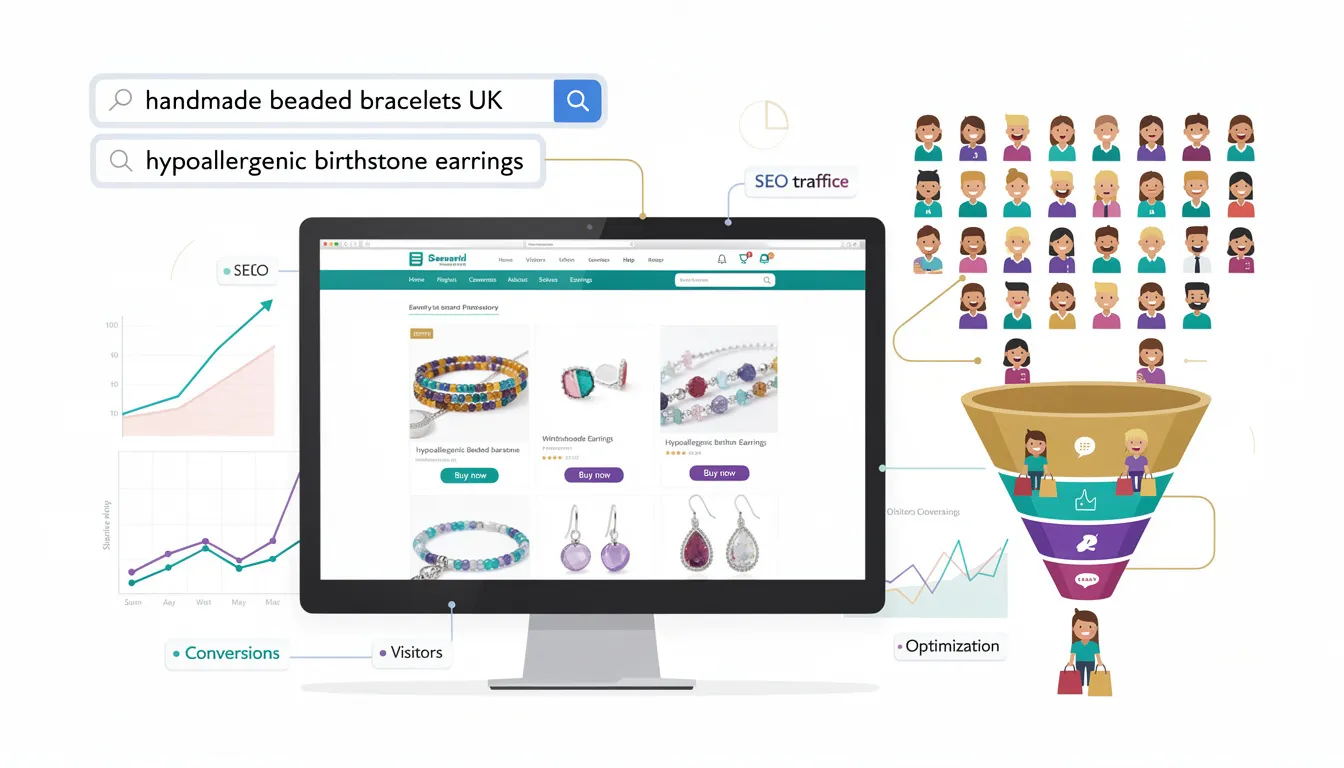
Search engine optimization brings visitors to your site—people typing “handmade beaded bracelets UK” or “hypoallergenic birthstone earrings” into Google. Conversion optimization turns those visitors into buyers. The two work hand-in-hand, and improvements to one often boost the other.
When you speed up your pages, add clearer product photos, and improve mobile layouts, you’re not just helping conversions. Optimizing each web page—such as landing pages and product pages—for both user experience and search performance is crucial for identifying and fixing issues that may hinder conversions. Google’s 2025 experience signals reward exactly these elements, which can improve your search engine ranking and bring in more organic traffic. It’s a virtuous cycle: better user experience means better rankings means more visitors means more sales.
Here’s how this plays out for jewellery-specific keywords:
|
Search Term |
CRO Element That Helps |
|---|---|
|
“18k gold plated hoop earrings UK” |
Clear product photos, visible price, strong CTA |
|
“hypoallergenic birthstone jewellery” |
Trust badges, skin-friendly claims near buy button |
|
“copper turquoise ring handmade” |
Artisan story, material details, lifestyle imagery |
|
“handmade jewellery Harrow” |
Store hours, directions, “Visit us” page optimised |
Blog content amplifies both efforts. A post like “How to Care for Your Sterling Silver Jewellery” can attract readers searching for care advice, then guide them toward your collections with well-placed internal links and contextual CTAs. Instead of hoping readers stumble onto products, you actively lead them there.
For brands with physical shops, local SEO combined with CRO is particularly powerful. When someone searches “handmade jewellery Harrow,” your optimised “Visit our boutique” page—complete with opening hours, parking details, and compelling imagery—can turn that web traffic into an in-person customer browsing your Evil Eye collection the next Saturday morning.
Transition: With an understanding of how CRO and SEO work together, let’s identify the most impactful areas of your jewellery website to focus your optimization efforts.
Where to Focus CRO on a Jewellery Website
Not all pages deserve equal attention. A smart CRO strategy prioritises the pages that see the most traffic and have the highest potential to influence purchases. For Saras Beads & Jewellery, these are the priority areas:
-
Homepage: Your digital shop window
-
Collection pages: Evil Eye, copper turquoise, birthstones, beaded pieces
-
Individual product pages: Where purchase decisions happen
-
Blog and content pages: Where browsers become interested buyers
-
Campaign landing pages: Mother’s Day 2025, Eid collections, seasonal promotions
-
Checkout and forms: Where sales are won or lost
The order of priority depends on your data. Start with pages that already bring significant web traffic but underperform on sales—these represent your biggest opportunities. A bestselling Evil Eye necklace page with 500 monthly visitors converting at 1.5% could jump to 3% with better photos and clearer CTAs. That’s doubling sales without additional marketing efforts.
Use Google Analytics 4’s ecommerce reports to identify these underperformers. Google Analytics is a widely used tool for tracking visitor behavior and conversions, helping identify areas for improvement in CRO. Analyzing behavioral data—such as clicks, engagement patterns, and navigation behavior—helps you understand user decision-making and pinpoint friction points. Look for pages with high traffic but low add-to-cart rates, or products frequently added to baskets but rarely purchased. These patterns reveal exactly where to focus your optimization efforts.

Now that we've identified the key areas to focus on, let's explore how to optimize each page type for maximum conversions.
Homepage
Your homepage functions as the digital equivalent of your Harrow boutique’s window display—it’s often the first thing visitors see, whether they arrive from Instagram, a Google search, or a friend’s recommendation. Those first few seconds determine whether they stay and explore or click away. A well-designed site structure, starting from the homepage, ensures logical organization and easy navigation, helping visitors quickly find key content and improving engagement.
A benefit-driven hero message immediately tells visitors what makes your brand worth their time. Something like “Handmade, hypoallergenic jewellery with free UK delivery over £35” combines your key value proposition with a tangible benefit. Pair this with a clear primary call to action—“Shop Sterling Silver” or “Explore the Evil Eye Collection”—so visitors know exactly where to go next.
Seasonal relevance keeps your homepage fresh and conversion-focused:
-
May 2025: Feature emerald birthstone pieces in your hero
-
December 2025: Lead with gift guides and bestsellers
-
February 2025: Highlight Valentine’s Day-ready pieces
-
Cultural festivals: Showcase relevant collections for Eid, Diwali, or other celebrations
Below your hero, curated product rows guide visitors deeper. Consider sections like:
-
Bestsellers: Your proven winners that reliably convert
-
New arrivals: Fresh pieces for returning customers
-
Gifts under £40: Accessible entry points for new buyers
Each product card should include high quality product images with quick-view or “Add to bag” functionality. The fewer clicks between interest and basket, the higher your conversion rate climbs.
Lightweight social proof rounds out an effective homepage:
-
“Over 500 five-star reviews since 2021”
-
A subtle badge noting “Hypoallergenic, nickel-free materials.”
These trust signals reassure first-time visitors without overwhelming them.
Collection and Category Pages
Themed collection pages—Evil Eye, birthstones by month, copper turquoise, Mediterranean-inspired designs—serve dual purposes. They help with search engine optimization by targeting specific keyword clusters, and they create focused shopping experiences that boost conversions.
Each collection benefits from a short introduction (2–4 lines) explaining its meaning or story. The Evil Eye collection, for instance, resonates more when visitors understand the protective symbolism. Copper turquoise pieces gain appeal when you share why this particular stone combination creates such distinctive marbling patterns. Birthstone pages connect emotionally when each month’s meaning is explained.
Filters for Jewellery Shoppers
The key options to offer:
|
Filter Category |
Options to Include |
|---|---|
|
Metal type |
Sterling silver, 18K gold-plated |
|
Stone |
Turquoise, opal, amethyst, birthstones |
|
Price range |
Under £25, £25–£50, £50–£100, £100+ |
|
Features |
Hypoallergenic, nickel-free |
|
Occasion |
Everyday, gifting, wedding |
Product cards themselves should be clean and informative: visible price, metal type, shipping note (“Free UK shipping over £35”), and review ratings. Each card is a mini conversion opportunity—make it easy for shoppers to click through to the full product page.
Consider A/B testing layout variants as your traffic grows: different grid densities, varying numbers of products per row, and the balance between lifestyle and close-up imagery. Use both quantitative and qualitative data to inform your design decisions and understand what truly resonates with your shoppers. Even small changes can significantly boost conversion rates on high-traffic collection pages.
Product Pages
Product pages are where purchase decisions happen. A visitor viewing your sterling silver birthstone ring is already interested—your job is to answer every question and remove every hesitation that stands between them and the “Add to basket” button.
Imagery Requirements
For jewellery, visuals carry more weight than almost any other product category. Research suggests high-resolution zoomed images can increase add-to-cart rates by 25% or more. Your product photo lineup should include:
-
Multiple angles on neutral backgrounds
-
Close-ups showing stone details (copper turquoise marbling, opal flash)
-
Clasp and fastening details
-
At least one lifestyle shot showing scale on a model
-
Group shots for pieces that layer or stack
Description Structure
High-converting jewellery descriptions follow a pattern:
-
Opening line: Lead with a benefit or emotional hook
-
Key specifications: Materials, dimensions, weight feel
-
Story and symbolism: Origin of gemstones, cultural meaning, design inspiration
-
Reassurance: Hypoallergenic claims, ethical sourcing, care instructions
For a copper turquoise bracelet, this might read:
A statement piece that draws the eye with every gesture. Handcrafted in our Harrow studio using ethically sourced copper turquoise—each stone’s unique marbling means no two bracelets are identical.
Reducing Abandonment with Information
Sizing uncertainty kills jewellery conversions. Include bracelet lengths in centimetres, ring size guides, and notes about adjustable features. The more confident a customer feels about fit, the less likely they are to abandon their cart or request a return.
Near your CTA, prominently display:
-
Clear shipping information
-
Return and warranty policies
-
Transparent pricing information or a link to an optimized pricing page can further reduce hesitation and increase signups or purchases by making costs clear and easy to understand.
-
Offering unique handcrafted jewellery that enhances style and trust can also differentiate your store and appeal to discerning customers.
Subtle urgency works when it’s genuine: “Only 3 left in stock” (if true), “Order by 2pm for same-day dispatch,” or “Final pieces from this gemstone batch.” Avoid artificial scarcity—savvy shoppers spot it, and it damages trust.
Finally, add social proof directly on product pages. Star ratings, short reviews mentioning comfort and skin-friendliness, and user generated content from Instagram (with permission) all contribute to user engagement and conversion.
Blog and Content Pages
Blog posts attract potential customers who aren’t ready to buy yet—people searching “how to clean tarnished silver jewellery” or “what birthstone is October.” This organic traffic represents an opportunity to nurture interest into purchase, but only if your content guides readers toward your products naturally. It’s essential to direct readers to take action on your own website, ensuring that all engagement and conversions happen within your digital platform.
Each article should focus on a concrete topic with clear, contextual CTAs woven throughout:
|
Article Topic |
Natural CTA Opportunity |
|---|---|
|
“How to layer 18K gold plated necklaces” |
Link to layered necklace sets |
|
“Birthstone meanings by month” |
Link to each month’s collection |
|
Caring for sterling silver jewellery and how to maintain gold-plated pieces like the Golden Heartbeat Stud Earrings. |
Link to silver cleaning products or care kits |
|
“What to wear to summer weddings in London” |
Link to statement earrings and bridal pieces |
In-text, anchor-linked CTAs outperform banner ads for blogs. “Explore our Evil Eye bracelets for everyday protection” reads naturally and feels helpful rather than salesy.
Content ideas anchored in dates perform particularly well:
-
May 2025: Mother’s Day gift guide with birthstone picks
-
June–August 2025: Wedding season styling advice
-
November 2025: Black Friday preview and gifting countdown
-
December 2025: Christmas gift guides by recipient type
Email capture embedded within articles extends your reach. A simple offer—“Get 10% off your first order and early access to new copper turquoise designs”—with a small lead generation form can turn casual readers into subscribers and eventual customers.
Landing Pages for Campaigns and Local Shoppers
Dedicated landing pages serve specific campaigns and audiences without the distractions of your main navigation. A “Handmade Valentine’s Day Gifts 2025” page focuses entirely on converting gift-seekers. A “Handmade Jewellery in Harrow – Visit Our Boutique” page exists solely to drive store visits.
Each landing page should centre on one goal:
-
Collection purchase: Showcase curated Valentine’s or Mother’s Day picks
-
Email capture: Offer early access to a new collection launch
-
Store visit: Convert local searchers into in-person shoppers
For local landing pages specifically, include:
-
Embedded Google Map
-
Opening hours clearly displayed (Mon–Sat 9:00–18:00, Sun 11:00–17:00)
-
Parking and public transport details
-
Photos of your boutique interior
-
A compelling reason to visit in person (“See pieces before you buy, try on for size”)
A/B testing reveals what resonates with different audiences. Hero images featuring product close-ups might work better for national shoppers, while in-store photography connects with locals. Test headlines, imagery, and primary CTAs to see what drives the desired action for each segment.
Checkout, Cart and Forms
Checkout is where many jewellery sales slip away. Industry data suggests cart abandonment rates of 70–80%, with 55% of abandonments caused by unexpected costs appearing at the final step. For small orders under £50—common in jewellery—this friction feels particularly painful.
Checkout Best Practices
-
Guest checkout: Don’t force account creation before purchase
-
Minimal fields: Name, address, payment—nothing more unless essential
-
Progress indicators: Show customers where they are in the process
-
Automatic UK address lookup: Reduces typing and errors
The single most effective checkout page change for many jewellery brands: show shipping costs and thresholds early. If you offer free UK shipping over £35, display this prominently in the cart—not as a surprise at checkout. Customers who know they’re £8 away from free shipping often add another piece rather than abandon.
Reassurance Elements Near “Complete Order”
-
Secure payment icons and security badges
-
Clear returns microcopy (“Free returns within 30 days”)
-
Warranty information (“12-month quality guarantee”)
-
Contact details for questions
For bespoke enquiry forms, brevity increases submissions. Keep fields to essentials:
-
Name and email
-
Rough budget range
-
Preferred metal and stone
-
Brief description of what they’re looking for
Include a note about response time (“Sarah typically responds within 24 hours”) to set expectations and encourage submissions.
After a cart abandonment, consider using an on-site survey to ask why the customer didn’t complete their purchase. Gathering user feedback in this way provides direct insights into obstacles in your checkout process, helping you identify and address issues that may be impacting conversion rates.
Transition: With each page type optimized, let’s look at the key CRO elements to test and improve for ongoing growth.
Key CRO Elements for Jewellery: What to Test and Improve
Improvements should be tested, not guessed. The elements most likely to influence jewellery buyers fall into predictable categories: imagery, copy, CTAs, navigation, trust signals, page speed, and mobile experience.
For brands with modest traffic, formal A/B testing (split testing) can feel impractical—statistical significance requires volume. But you can still run simple tests: change a CTA button colour for two weeks, compare results to the previous period, and note any patterns. Or alternate hero images monthly and track which performs better.
Qualitative insights often prove just as valuable as quantitative data. Heatmaps show where visitors click and scroll. Session recordings reveal confusion points and rage clicks. Customer feedback through post-purchase surveys or live chat logs surfaces pain points you’d never spot in analytics alone.
The conversion rate optimization process works best when you combine both approaches: let quantitative data identify where problems exist, such as local marketing challenges, then use qualitative research to understand why and what to change.

Product Photography and Visuals
For jewellery e-commerce, imagery isn’t just important—it’s primary. Customers can’t touch, try on, or examine pieces in person, so your photos must bridge that gap entirely.
Ideal shot list for each product:
-
Neutral background product shots (white or light grey)
-
Close-ups of stones, textures, and metalwork
-
On-skin shots for scale (wrist, neck, ear, hand)
-
Group shots showing stacking and layering potential
-
Detail shots of clasps and fastenings
Test whether lifestyle or studio images work better as your lead photo. Some customers respond to aspirational lifestyle imagery; others prefer clean, detailed product shots. Your target audience might lean one way—and if you're marketing products with deep cultural or symbolic meaning, like birthstones with evil eye protection, the image you choose can be especially important.
For high-value pieces—intricate beaded necklaces, statement copper turquoise rings—consider short product videos or GIFs. Movement reveals sparkle and dimension that static images can’t capture.
One critical note: image optimisation matters for page speed. Compress files without sacrificing clarity. Slow load times frustrate mobile users and directly hurt conversions—research suggests pages loading in under 3 seconds see 32% lower bounce rates.
Copy That Converts: Benefits, Stories and Symbolism
The best jewellery copy blends persuasive selling with storytelling. For Saras Beads & Jewellery, this means weaving Sarah’s Lebanese and Mediterranean heritage into descriptions that feel authentic rather than manufactured.
Structure for product descriptions:
-
Compelling first line: Lead with benefit or emotional hook (“A daily reminder of protection and positivity”)
-
Bullet specifications: Metal, dimensions, weight, stone details
-
Story paragraph: Inspiration, symbolism, cultural roots
Address common objections directly:
-
Skin sensitivity: “Crafted with hypoallergenic, nickel-free findings—safe for sensitive skin”
-
Durability concerns: “Our 18K gold plating is applied to high-quality base metals for lasting wear”
-
Tarnish worries: “Sterling silver naturally develops a beautiful patina; gently polish to restore shine”
-
Ethical sourcing: “Gemstones ethically sourced from trusted suppliers”
Symbolic elements drive conversions for meaningful jewellery. Explain why each birthstone matters, what the Evil Eye represents, why copper and turquoise together create something special. These stories give customers reasons to buy beyond aesthetics—they’re purchasing meaning.
Test headline styles on product and collection pages. “Hypoallergenic Sterling Silver Hoops for Everyday Wear” appeals differently than “The Perfect Silver Hoops.” Data reveals which resonates with your audience.
Calls‑to‑Action (CTAs) Tailored to Jewellery Buyers
Generic CTAs like “Submit” or “Click here” waste opportunities. Every button and link is a chance to reinforce your value proposition and guide visitors toward conversion.
Context-specific CTA suggestions:
|
Page Type |
Sterling Media & Comms - CTA Options |
|---|---|
|
Product page |
"Add to jewellery box", "Make it yours", or Grow your SME with Meta ads across Facebook, Instagram & Threads |
|
Collection page |
“Shop the Evil Eye collection”, “Explore birthstones” |
|
Bespoke enquiry |
“Create your bespoke piece”, “Start your custom design” — or explore top website builders in Manchester to bring your ideas to life online. |
|
Store visit |
“Visit us in Harrow”, “Get directions” |
|
Interested in driving leads and sales? Learn more about our performance media campaigns on Google and Meta. Email sign-up |
"Join for 10% off", "Get early access to Google Search Marketing for SMEs" |
Placement matters as much as wording. Primary CTAs should appear above the fold on product pages, repeat after review sections, and feature at natural stopping points in blog posts. Don’t make visitors scroll to take action.
Test CTA colours that work within your brand palette while providing sufficient contrast for accessibility. A button that blends into the page gets overlooked; one that stands out (while remaining on-brand) gets clicked.
Micro-CTAs add value for specific situations: “Check store availability,” “Message us on WhatsApp for sizing help,” or “Save to wishlist.” These smaller actions build engagement even when visitors aren’t ready for the main conversion. For more information on jewelry trends and tips, check out our articles.
Navigation, On‑Site Search and Filters
When someone knows exactly what they want—“opal October birthstone necklace”—your job is getting them there in seconds. Poor navigation and search functionality cost sales.
Recommended top navigation structure: Consider featuring handcrafted jewellery prominently for an enhanced user experience. You may also want to explore top digital marketing agencies in Brighton for ideas on optimizing your website's online presence.
-
Shop by category: Necklaces, earrings, bracelets, rings
-
Shop by collection: Evil Eye, birthstones, copper turquoise, beaded
-
Shop by metal: Sterling silver, 18K gold-plated
-
Gift ideas: Under £25, under £50, bestselling gifts
A prominent search bar with predictive suggestions helps visitors find specific items quickly. Suggest common queries like “gift under £50,” “hypoallergenic earrings,” or “turquoise bracelet” as visitors type.
On collection pages, track which filters visitors actually use. If nobody filters by price but everyone filters by metal type, adjust your layout accordingly. Filter usage data reveals what matters to your specific customer base and can inform your broader cro strategy.
Trust, Social Proof and Reassurance for Jewellery Shoppers

Jewellery purchases are often emotional—gifts for loved ones, meaningful pieces marking occasions, treats for oneself. Trust signals heavily influence whether visitors feel confident enough to buy from an independent brand they’ve just discovered.
Social proof elements to include:
-
Star ratings on product pages and collection grids
-
Short customer quotes emphasising comfort, quality, and gifting success
-
User-generated content from Instagram (with permission)
-
Review count and average rating prominently displayed
Trust badges and reassurance:
-
Secure checkout indicators
-
Accepted payment method logos
-
Clear shipping and returns policies
-
Ethical sourcing statements about gemstones and metals
Position these elements near CTAs and throughout checkout—not buried on a separate policies page. A customer hovering over “Complete order” shouldn’t have to hunt for return information.
An “About Sarah” snippet humanises your brand. A photo, brief story about Lebanese and Mediterranean heritage, and mention of founding in 2021 builds connection. Shoppers buying from independent makers want to know there’s a real person behind the pieces.
Page Speed and Mobile Experience
Over 60% of e-commerce browsing happens on mobile devices. If your site frustrates mobile users—slow loading, tiny buttons, difficult navigation—you’re losing the majority of your potential customers before they even see your products.
Use Google PageSpeed Insights or Lighthouse to benchmark your current performance. Aim for key pages to load in under 2–3 seconds on 4G networks. Every second beyond that increases bounce rates and reduces conversions.
Mobile-specific optimisations:
-
Large tap targets (buttons easy to press with thumbs)
-
Simplified menus with clear hierarchy
-
Thumb-friendly “Add to basket” placement
-
Sticky cart icon for easy access
-
Streamlined image galleries that load progressively
Image compression is critical for jewellery sites with multiple high-quality photos per product. Balance quality with file size—customers need to see stone details, but not at the cost of pages that take ten seconds to load.
Test your own site by browsing on your phone, ideally on a slower connection. Note every friction point: hard-to-tap links, images that take too long, forms that require zooming. These are the visitor behavior issues driving your potential customers away.
Transition: With the key CRO elements in place, let’s see how to use data and user behavior insights to guide your ongoing optimization efforts.
Using Data and User Behavior Insights to Guide CRO
Guesswork wastes time. Every optimization should stem from data—what visitors actually do on your site, where they struggle, and what they tell you when asked. This user behavior data guides where to focus and what to test.
Key Quantitative Data Sources:
|
Data Source |
What It Reveals |
|---|---|
|
Google Analytics 4 ecommerce reports |
Traffic, conversions, funnel drop-offs |
|
Conversion funnel analysis |
Where users exit the purchase journey |
|
Device breakdown |
Desktop vs mobile performance |
|
Top exit pages |
Where visitors leave |
|
Traffic source performance |
Instagram vs search vs direct |
Qualitative and Behavioural Data Sources:
|
Data Source |
What It Reveals |
|---|---|
|
Heatmaps |
Click density and scroll depth |
|
Session recordings |
Confusion and friction points |
|
On-site polls |
User objections and hesitations |
|
Customer service chats and emails |
Pain points and questions |
|
Post-purchase survey responses |
Feedback on experience and obstacles |
The magic happens when you combine insights. Analytics might show high exits on checkout, while customer feedback reveals shipping cost confusion. Together, they point directly at testing a clearer free-shipping banner earlier in the journey.
Set a regular review rhythm—monthly works well for smaller brands. During busy periods like December 2025, you might review weekly. Look for patterns, note anomalies, and build a prioritised list of improvements to test.
Identifying Bottlenecks in the Jewellery Buying Journey
The typical conversion funnel runs:
Homepage → Collection → Product → Cart → Checkout → Confirmation
Each step represents a drop-off point where potential customers leave without converting. Funnel reports in Google Analytics reveal which stages lose the most visitors—these are your highest-priority optimization targets.
For example, you might discover:
-
60% of visitors leave after viewing a product page (potential issues: unclear sizing, missing trust signals, weak imagery)
-
40% add to cart but don’t reach checkout (potential issues: unexpected shipping costs, lack of guest checkout)
-
25% abandon during checkout (potential issues: too many fields, payment concerns, shipping delays)
Segment this analysis by device and traffic source. Mobile users from Instagram might behave very differently from desktop visitors who found you through Google. A product page that converts well on desktop might frustrate mobile users with slow-loading image galleries or tiny CTAs.
Concrete patterns emerge from this analysis. Perhaps visitors drop off specifically on product pages with long, unstructured descriptions—a signal to restructure that copy with clear headings and bullet points.
Forming Hypotheses and Running Simple Tests
Once you’ve identified drop-off points, form testable hypotheses using this format:
“If we [change X], then [metric] will improve because [reason].”
Examples for a jewellery site:
-
“If we add a ring size guide next to the CTA, add-to-cart rate will increase because sizing uncertainty is a key hesitation.”
-
“If we show the free shipping threshold in the cart, checkout completion will improve because unexpected costs cause abandonment.”
-
“If we lead with lifestyle images instead of studio shots on bestseller pages, time-on-page will increase because customers want to visualise wearing the pieces.”
High-impact test ideas:
-
Different free-shipping banner messaging and placement
-
Alternate hero collections on homepage
-
New product photo sequences (lead with lifestyle vs studio)
-
Revised product copy emphasising hypoallergenic materials
-
CTA button colours and wording variations
For lower-traffic sites, focus on clear, larger changes and run tests for longer durations. A subtle button colour tweak might not reach statistical significance for months, but a completely new product page layout will show results faster.
Document every test: hypothesis, change made, duration, results. This record enables continuous optimization—you’ll reuse winning patterns across other collections and campaigns, compounding your gains over time.
Transition: Now, let’s look at practical CRO ideas you can implement this quarter for immediate impact. For more inspiration and digital marketing strategies, check out the latest insights on the best agency for Facebook Ads and the Sterling Media & Communications Ltd news page.
Practical CRO Ideas Saras Beads & Jewellery Can Implement This Quarter
Theory matters, but action drives results. Here’s a concrete 90-day action list for a handmade jewellery brand looking to increase conversions starting today.
1. Create a Dedicated “Birthstone Jewellery by Month” Hub Page
Build this before your next key gifting period—Mother’s Day or Christmas 2025. Structure it with:
-
Brief intro on birthstone significance
-
Month-by-month grid with stunning imagery
-
Strong CTAs to each individual month’s collection
-
Internal links from blog posts about birthstone meanings
2. Overhaul Top-Traffic Product Pages
Identify your five bestselling products (probably Evil Eye necklaces, copper turquoise bracelets, popular sterling silver pieces). For each:
-
Add additional high-quality photos including lifestyle shots
-
Restructure descriptions with benefit-led opening and clear specs
-
Strengthen CTAs with specific, compelling language
-
Add or improve sizing/fit information
-
Include 2-3 customer reviews directly on the page
3. Implement Exit-Intent Email Capture
Add a tasteful pop-up offering 10% off first orders for email subscribers. Time it to appear when visitor behavior signals they’re about to leave. Test impact on both sign-up rates and completed orders—the goal is leads generated without hurting immediate purchases. For brands taking a multi-channel approach, consider coupling your pop-up strategy with digital targeting through CTV and streaming audio to reach new audiences.
4. Refine Abandoned-Cart Email Sequence
If you’re not sending abandoned-cart reminders, start. If you are, improve them:
-
Highlight key benefits of the Copper Turquoise Necklace: hypoallergenic, free UK shipping over £35, handmade in Harrow
-
Include product images from their abandoned cart
-
Consider a limited-time incentive for high-value baskets
5. Add a Simple On-Site Survey for Cart Abandoners
When visitors leave with items in their basket, ask: “What nearly stopped you from buying today?”
-
Shipping costs/time
-
Price concerns
-
Sizing uncertainty
-
Needed more product information
-
Just browsing
This qualitative data surfaces pain points faster than any analytics dashboard.
To further streamline the process of optimizing conversion rates, consider using CRO tools. CRO tools are designed to simplify or automate the process of optimizing your conversion rate and can help businesses understand user behavior, which is essential for making data-driven decisions to improve conversion rates. Using tools like Fullstory can provide insights into user behavior, helping to identify drop-offs and areas for improvement in conversion rates.
Transition: To ensure long-term growth, let’s discuss how to build a continuous CRO habit for your jewellery business.
Building a Continuous CRO Habit for Long‑Term Growth
Conversion rate optimization isn’t a one-time project—it’s an ongoing habit. As new collections launch and seasons change, what works today might need adjustment tomorrow. The brands that thrive are those enabling continuous optimization as a core part of how they operate.
Set a Simple Quarterly CRO Cycle:
-
Review data: What changed? What’s improving? Where are the new bottlenecks?
-
Choose 1–3 focus areas: Based on data, not guesswork
-
Implement improvements or tests: Make changes, document hypotheses
-
Record results: What worked? What didn’t? What to try next?
Align your CRO calendar with jewellery-relevant dates:
|
For any questions or assistance, contact us. |
CRO Focus |
|---|---|
|
January–February |
Valentine’s Day landing pages and gift guides |
|
March–May |
Mother’s Day campaign optimisation, wedding season prep |
|
June–August |
Summer collections, holiday/travel pieces |
|
September–November |
Christmas gift guide creation, Black Friday testing |
|
December |
Peak conversion optimisation, rapid iteration |
Cultural festivals—Eid, Diwali, Lunar New Year—offer additional opportunities for targeted campaigns and CRO testing.
Here’s what matters most: even small brands like Saras Beads & Jewellery can compete with larger names like Missoma or Monica Vinader. You do it not through bigger ad budgets, but through smoother, more personal shopping experiences rooted in authentic craft and cultural meaning. Your visitors already appreciate handmade, meaningful jewellery—your job is simply to make buying it effortless and enjoyable.
The path forward is clear. Pick one page—your bestselling product or your main collection—and apply one idea from this guide this week. Track what happens. Learn from it. Then pick the next thing. That’s how conversion rate optimization builds from scattered efforts into systematic growth, one improvement at a time.
Transition: With a continuous CRO habit in place, let’s look at the tools that can help you optimize your jewellery e-commerce website.
Utilizing Conversion Rate Optimization Tools for Jewellery E‑commerce
To truly understand and improve your website’s conversion rate, it’s vital to leverage the right conversion rate optimization tools. Platforms like Google Analytics provide a wealth of user behavior data, allowing you to track how visitors move through your site, where they linger, and where they drop off. Heatmaps offer a visual representation of where users click, scroll, and spend the most time, helping you pinpoint which areas of your web pages are engaging and which might need refinement.
Split testing (also known as A/B testing) is another powerful tool in the conversion rate optimization process. By testing different versions of a landing page, product description, or call to action, you can see which variation resonates best with your audience and leads to more conversions. Even small tweaks—like changing the wording on a button or the placement of a lead generation form—can significantly boost conversion rates when informed by real user behavior. For instance, if you are selling jewellery, offering valuable information such as how to care for and clean sterling silver jewellery can enhance your product descriptions and build trust with potential customers.
Don’t overlook the value of qualitative data, such as customer feedback and on-site surveys. These insights reveal pain points and objections that might not be obvious from analytics alone. Incorporating social proof, like customer testimonials and user-generated content, reinforces your value proposition and builds trust with potential customers. Highlighting these elements on key pages can help convert visitors who are on the fence.
By combining these conversion rate optimization tools and strategies, handmade jewellery e-commerce businesses can identify drop-off points, refine their optimization efforts, and create a more persuasive, user-friendly experience. The result? A higher website conversion rate, more sales, and a stronger, more sustainable business.
Frequently Asked Questions About Conversion Rate Optimization
What is a good conversion rate?
The average conversion rate across various industries typically falls between 2% and 5%. However, what constitutes a "good" conversion rate depends heavily on your industry, target audience, and business goals. For example, ecommerce sites often see averages around 2.5% to 3%, while niche B2B services may have lower rates but still be profitable. The key is to understand your baseline and aim for continuous improvement. If your ecommerce business targets gifts or jewelry, you may find it helpful to learn about the significance of June birthstones and how they can enhance your product appeal.
How can I improve my website’s conversion rate?
Improving conversion rates involves a systematic, data-driven approach. Start by enhancing user experience through intuitive navigation, fast page speeds, and mobile optimization. Craft persuasive, clear copy that communicates your unique value proposition (UVP) prominently and in a way that is quickly scannable. Unique Value Proposition (UVP) should be prominently displayed and quickly scannable. Leveraging social proof such as authentic customer testimonials and user-generated content can increase conversions by as much as 34%. Additionally, conducting rigorous A/B testing allows you to validate changes and optimize key elements like calls-to-action (CTAs).
What role does AI play in conversion optimization?
AI is increasingly used to personalize and optimize user experiences in real time. For instance, real-time adaptive layouts can adjust navigation and content based on visitor behavior and intent, making the site more relevant and easier to use. AI-powered personalization has been shown to improve the performance of calls-to-action by over 200% compared to basic CTAs, driving significantly higher conversions.
Why is simplifying forms important?
Simplifying forms by reducing the number of required fields can significantly increase form completion rates and overall conversions. Clear, concise labels reduce user frustration and cart abandonment. Long or complicated forms can deter potential customers, so focus on collecting only essential information to keep the process smooth and user-friendly. For those interested in learning about the December birthstone and its significance, check out this comprehensive guide.
How does guest checkout affect conversions?
Enabling guest checkout is a proven way to boost completion rates in online purchases. Forcing users to create an account before buying can increase friction and lead to cart abandonment. Offering a guest checkout option streamlines the process, making it easier and faster for customers to complete their purchase.
How important is page speed for conversion rates?
Page speed is critical for user experience and conversion rates. Slow-loading pages significantly increase bounce rates, as users tend to leave sites that take too long to load. Websites that load within 3 seconds experience notably higher conversion rates, emphasizing the importance of optimizing images, scripts, and server response times.
What are common mistakes to avoid in conversion rate optimization?
Many beginners make changes based on opinion rather than data, which can lead to ineffective or even detrimental results. Other common mistakes include neglecting to build trust by failing to display security badges or customer testimonials, complicating the conversion funnel with too many steps, and ignoring mobile optimization. Avoid these pitfalls by relying on user research, analytics, and testing to guide your optimization efforts.
How can visuals impact conversion rates?
High-quality visuals play a vital role in communicating complex messages quickly and effectively. For ecommerce, especially in categories like jewellery or fashion, product images and videos can significantly influence purchase decisions. Clear, attractive visuals help build trust and engage users, often converting better than text alone.
What is the importance of a Unique Value Proposition (UVP)?
Your UVP should be prominently displayed and quickly scannable on your website. It succinctly explains why visitors should choose your brand over competitors, highlighting the key benefits and differentiators. A strong UVP helps reduce hesitation and guides visitors toward taking the desired action.
How do I know which CRO strategies to prioritize?
Start by analyzing quantitative and qualitative data to identify pain points and drop-off locations in your conversion funnel. Prioritize strategies that address the highest-impact issues with the greatest ease of implementation. Common effective strategies include improving site speed, simplifying navigation, enhancing CTAs, adding social proof, and conducting A/B testing to validate changes.
By addressing these frequently asked questions, you can build a strong foundation for your conversion rate optimization program and drive sustainable growth for your business.
How Sterling Media & Communications Can Help Your SME Grow
At Sterling Media & Communications, we specialize in helping small and medium-sized enterprises (SMEs) like handmade jewellery brands unlock their full potential through expert digital marketing and conversion optimization strategies. Whether you’re looking to boost your website’s conversion rate, improve your search engine ranking, or build lasting customer loyalty, our tailored CRO program is designed to fit your unique business needs.
Our team combines deep industry knowledge with the latest CRO tools and user behavior insights to craft data-driven campaigns that convert visitors into loyal customers. From enhancing your site’s user experience and crafting compelling calls to action, to running targeted A/B tests and optimizing your checkout process, we provide end-to-end support to maximize your marketing efforts.
In addition to conversion rate optimization, Sterling Media & Communications offers comprehensive SEO services through smcww.co.uk, helping your jewellery brand rank higher on search engines and attract more organic traffic. Our SEO strategies focus on keyword research, on-page optimization, content creation, and technical SEO to ensure your website is fully optimized for both users and search engines.
We also provide expert pay-per-click (PPC) management, crafting targeted advertising campaigns that deliver measurable results while maximizing your advertising budget. Our PPC services include keyword bidding, ad copywriting, landing page optimization, and ongoing campaign analysis to drive qualified traffic and increase conversions.
To further amplify your brand’s reach, our paid social media services create engaging, audience-specific campaigns across platforms like Facebook, Instagram, and Pinterest—ideal for visually-driven jewellery brands. These campaigns are designed to boost brand awareness, generate leads, and drive sales by leveraging precise targeting and compelling creative content.
Don’t let valuable traffic slip away. Partner with Sterling Media & Communications to transform your existing website visitors into repeat buyers and brand advocates. Contact us today to discover how our conversion rate optimization services, combined with SEO, PPC, and paid social strategies, can help your handmade jewellery business thrive in a competitive digital landscape.

0 comments