

Introduction to Digital Out of Home (DOOH) for SMEs
Digital Out-of-Home (DOOH) advertising is a modern form of outdoor advertising that uses digital displays to deliver ads in high-traffic public spaces. This page covers everything SMEs and local businesses need to know about programmatic DOOH: what it is, how it works, targeting options, available ad formats, measurement and attribution, and why it’s an effective, measurable, and flexible advertising solution for growing your brand locally.
Whether you’re a shop, restaurant, gym, real estate office, healthcare provider, or any local business with a physical presence or defined service area, DOOH offers a powerful way to reach your audience where they live, work, and travel. With programmatic buying (automated, data-driven ad placement), precise targeting by postcode, daypart (specific times of day), and context, plus robust measurement tools, DOOH empowers SMEs to run impactful campaigns with control and transparency.
DOOH matters because it combines the high-impact visibility of outdoor media with the agility and targeting precision of digital technology. It’s flexible, cost-effective, and delivers measurable results—making it an essential channel for local businesses aiming to boost brand awareness and drive foot traffic.
Summary: What is DOOH and How Can SMEs Use It?
-
What is DOOH?
Digital Out-of-Home (DOOH) advertising uses digital screens in public spaces to display dynamic ads. Unlike traditional billboards, DOOH ads can be updated in real time and tailored to specific audiences, locations, and moments. -
Benefits of DOOH for SMEs:
-
High-impact visibility in busy locations
-
Flexible targeting by postcode, time of day, and context
-
Real-time creative updates
-
Measurable results and attribution (connecting ad exposure to outcomes)
-
Complements online and offline marketing
-
-
How SMEs Can Use DOOH Effectively:
-
Target local audiences near stores or service areas
-
Launch campaigns quickly for openings, events, or promotions
-
Use programmatic platforms for efficient buying and optimization
-
Measure campaign impact with proof-of-play logs, footfall tracking, and attribution tools
-
Next, let’s dive deeper into how DOOH compares to traditional outdoor advertising and why it’s a cornerstone of modern omnichannel strategies, especially when you consider the benefits, formats, and future trends of digital OOH advertising.
Introduction to Digital Out of Home
DOOH vs. Traditional OOH
Digital Out-of-Home (DOOH) advertising is the evolution of outdoor marketing—using dynamic, real-time digital displays instead of static billboards and posters. It delivers targeted, engaging content that can adapt instantly to audience, context, and moment.
Compared to traditional OOH, DOOH offers greater flexibility, creative possibilities, and the ability to update ads remotely. This means your message stays relevant and impactful, no matter the time or place.
Where DOOH Connects
Advertisers can build meaningful connections in the spaces people live, work, and travel—on busy high streets, inside shopping malls, and across transit hubs—meeting audiences in real-world moments.
DOOH in an Omnichannel Strategy
As a cornerstone of omnichannel plans, DOOH reinforces consistent brand messaging across platforms. Creative can be refreshed instantly, while data-driven targeting adds flexibility and precision—without losing the high-impact presence of classic outdoor.
Next, let's explore how DOOH enables precise targeting for maximum impact.
Why It Matters for SMEs & Big Brands
For both SMEs and larger brands, DOOH is an essential channel to grow brand awareness and inspire action in the physical world—combining modern digital craftsmanship with proven out-of-home reach.
Targeted Digital Billboards: Postcode, Daypart, and Context
Precision Targeting by Postcode, Daypart & Context
Exquisitely crafted targeted billboards represent the heart of meaningful DOOH advertising. With advanced targeting capabilities, advertisers can deliver brand messages to the right audiences, curated by:
-
Postcode: Target specific geographic areas for hyper-local relevance.
-
Daypart: Schedule ads for certain times of day (e.g., morning rush hour, lunchtime, evenings) to reach audiences when they’re most receptive.
-
Context: Align ads with environmental or situational factors, such as weather, events, or proximity to retail destinations.
This approach ensures your brand narrative appears exactly where and when it matters most—reaching commuters during the morning rush or engaging shoppers near retail locations on weekends.
Driving Footfall with Contextual DOOH
With refined DOOH targeting, advertisers can build brand awareness and drive foot traffic by focusing on high-intent audiences in chosen areas using hyper-local geo-fenced ads and DOOH campaigns. For example:
-
A local restaurant can display lunchtime offers to nearby office workers.
-
A retailer can promote weekend specials to shoppers within a specific postcode.
By delivering ads at the right moment and location, DOOH maximizes impact and delivers exceptional results.
Transitioning from targeting, let’s look at the different types of DOOH ad formats available.
Types of DOOH Ad Formats
Place-Based, Transit & Grand-Format Options
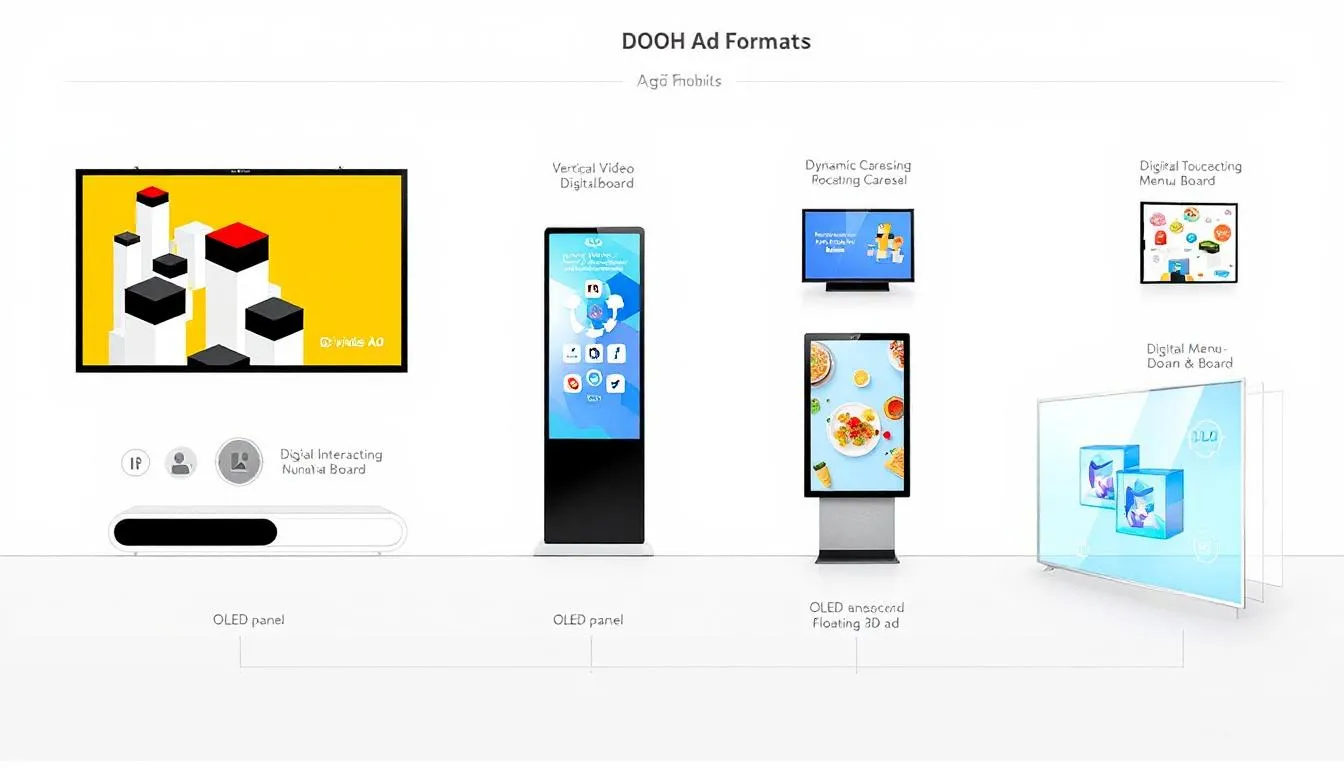
DOOH advertising formats are as diverse as the environments they appear in. Advertisers can choose from:
-
Place-Based DOOH: Digital screens in shopping malls, gyms, grocery stores, and other retail locations.
-
Transit DOOH: Displays in train stations, bus shelters, airports, and other transit hubs.
-
Grand-Format DOOH: Large digital billboards on highways and in city centers.
Within these environments, DOOH ads can include video, imagery, and interactive elements to encourage engagement.
Flexibility That Creates Lasting Impressions
This flexibility allows brands to craft lasting impressions, connecting with consumers through innovative creative that enhances their daily journeys—wherever life may guide them.
Next, we’ll see how programmatic DOOH buying and curated inventory make campaign execution efficient and measurable.
Targeted DOOH Advertising: How Programmatic Buying Works
Be Unmissable Where Your Customers Live and Move
Digital Out-of-Home (DOOH) advertising is a modern form of outdoor advertising that uses digital displays to deliver ads in high-traffic public spaces. Programmatic Digital Out-of-Home (automated, data-driven ad buying) gives you a big-screen presence near stores and on key commuter routes.
Curated Inventory, Fast Launches & Clear Reporting
To maximize impact, we hand-pick panels by postcode and context, curating DOOH inventory in high-traffic retail locations such as gas stations and grocery stores for optimal brand visibility near the point-of-purchase. Programmatic platforms streamline the process that previously required direct negotiation with media owners, making campaign execution more efficient.
We launch fast around openings and promos, with proof-of-play logs and delivery reports so you know exactly what you paid for. Robust digital infrastructure is essential for effective campaign deployment, accurate measurement, and reliable data reporting.
Smart Targeting & Sector Growth
Our advanced targeting strategies help brands reach consumers at key moments when they are most likely to engage or make a purchase. In 2022, DOOH became one of the fastest-growing media sectors in the world, driven by increased investment and interest, according to the Home Advertising Association.
Now, let’s discuss why DOOH should be part of your marketing mix and how it complements other channels.
Why You Need This Service
Why DOOH Belongs in Your Mix
DOOH adds high-impact reach without relying on social feeds or cookies. It complements performance media on Google and Meta—people see the screen, then search or click later. It’s also immune to ad blockers and can’t be skipped, making it a reliable way to reach audiences in the physical world.
Flexible Buying & Precise Targeting
Start small, target precisely, and scale what’s working. Flexible buying lets you activate the most relevant screens and optimise in flight (adjust campaigns while they’re running), so budget goes where performance is strongest.
Omnichannel Synergy
Compared to online ads (highly measurable, advanced audience targeting), DOOH delivers an unavoidable real-world presence that strengthens brand consistency across channels. It integrates seamlessly with social, mobile, and connected TV—enabling cross-channel retargeting and unified measurement.
Measurement & Attribution
Research shows that combining DOOH with other channels significantly increases reach. With advanced attribution (the process of connecting ad exposure to outcomes like site visits or sales), brands can now track DOOH effectiveness across multiple channels, connecting screen exposure to outcomes like site visits, app installs, or store footfall, and apply footfall measurement methods to understand how campaigns influence in-store visits.
Next, discover what makes our DOOH service unique and how we deliver hyper-local, dynamic campaigns.
Our Unique Selling Proposition
Hyper-local screen curation—we don’t “spray & pray.” We hand-pick panels by postcode and context, and can enable dynamic creative rules (time, weather, location), including local weather conditions, so your message stays relevant and impactful throughout the day. The digital nature of DOOH enables dynamic creatives that can be tailored to specific locations and target audiences more effectively than traditional OOH.
Delivering relevant content based on context, such as location, time, and environment, increases ad effectiveness by creating more meaningful and targeted experiences for consumers. Additionally, Digital Out-of-Home advertising allows for cost-effective creative updates by enabling remote changes and offers a wide variety of creative formats to suit different campaign needs.
Let’s break down exactly what’s included in a typical DOOH campaign.
What's Included (Deliverables)
-
Local screen plan: Curated inventory near stores/POIs (retail, transport, gyms, malls) with dayparting (scheduling ads for specific times of day) and pacing, optimizing ad inventory selection for campaign performance.
-
Targeting setup: Geo (postcode radii), contextual/venue targeting, and optional audience overlays (platform-dependent).
-
Creative adaptation: Resizes/crops for common DOOH specs (e.g., portrait 1080×1920 and landscape 1920×1080) and motion/static variants per publisher rules.
-
Dynamic options: Time-of-day and weather/location triggers where supported.
-
Measurement: Proof-of-play (PoP) logs, delivery/frequency summaries, and clean UTMs to attribute downstream actions, with device IDs used for attribution and measurement. DOOH advertising provides measurable metrics such as reach, impressions, and engagement, including ad recall as a key metric for campaign success, allowing advertisers to track the effectiveness of campaigns. Advertisers can optimize their DOOH campaigns using data analytics for better performance.
Next, we’ll discuss how long to run your campaign for maximum impact.
Recommended Campaign Duration
Start with a 10–14 day flight to make an impact. To truly “own” a location, schedule recurring weekly or monthly flights. Shorter bursts work for events or promos, but consistency builds awareness and recall. The use of programmatic technology has led to a growth in investment in DOOH advertising, nearly tripling over two years from 2020 to 2022. Many brands are combining DOOH with mobile marketing to create additional touchpoints for brand engagement.
Now, let’s see who can benefit most from DOOH campaigns.
Who Is This For?
SMEs with a physical location, defined service area, or local event to promote—shops, restaurants, gyms, real estate, healthcare, trades, auto dealers, education, and more—can use DOOH to target high-intent shoppers at critical moments, increasing the likelihood of influencing purchase decisions. If local visibility matters, DOOH makes you the landmark. It is also highly effective at driving foot traffic to physical locations.
Past studies indicate that 76% of U.S. consumers who saw a DOOH ad reported taking action because of it. DOOH campaigns can leverage data analytics to create highly personalized and contextually relevant advertising, encouraging audiences to take action through targeted messaging.
Before you get started, let’s make sure DOOH is the right fit for your business.
Let's Talk Honestly: Are We Right for Each Other?
-
Clear, simple message: Understood in seconds.
-
High-quality visual: Sized for standard DOOH formats.
-
Right expectation: Awareness first; sales lift comes via paired search/social and in-store ops. DOOH advertising allows for personalized messaging based on behavioral data and audience segmentation. Personalization in DOOH is achieved through automation, allowing for numerous creative variations from one ad template.
Calculating Cost per Mille (CPM) for DOOH
What CPM Is & How to Calculate It
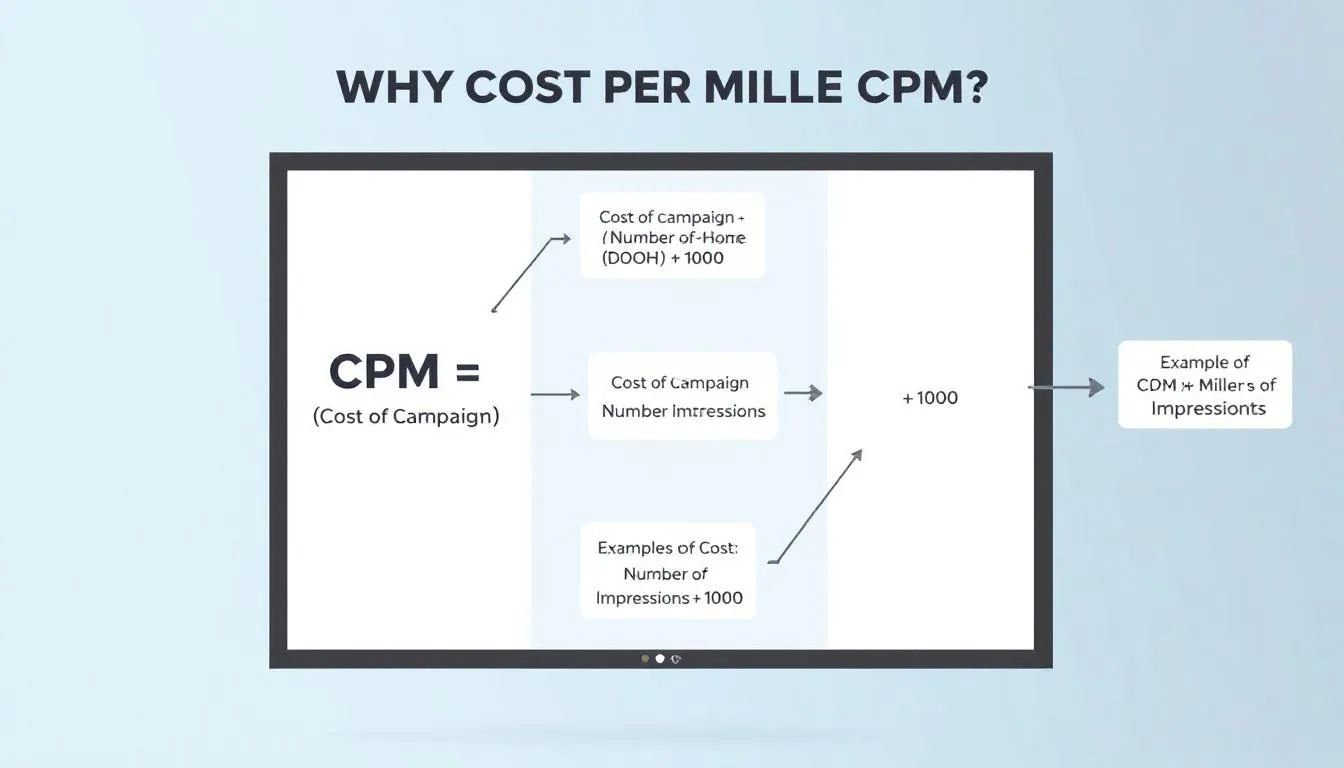
Cost per Mille (CPM) is the cost per thousand impressions—a standard metric in digital advertising, including DOOH. To calculate CPM for a DOOH campaign:
-
Determine your total advertising investment.
-
Estimate the number of impressions your campaign will deliver (in thousands).
-
Divide the total investment by the number of thousands of impressions.
Formula:
CPM = Total Cost / (Total Impressions ÷ 1,000)
What Drives DOOH CPM to Vary
DOOH CPM varies based on several factors:
-
Ad format: Size and type of digital display.
-
Screen size: Larger screens often command higher CPMs.
-
Location: High-traffic or premium locations cost more.
-
Targeting precision: More granular targeting (e.g., by postcode, daypart, or context) can affect CPM.
Optimising Value with Programmatic & RTB
Programmatic technology and real-time bidding (RTB, where ad space is bought and sold in real time) allow advertisers to optimize campaigns for value and measurement accuracy. By leveraging these tools, you can ensure your DOOH campaigns are cost-effective and impactful.
Next, let’s see how to measure the effectiveness of your DOOH campaigns.
Measuring DOOH Campaign Effectiveness
Key Metrics for DOOH
Measuring the performance of your DOOH campaign is essential for understanding ROI and planning future campaigns. Key metrics include:
-
Reach: The number of unique people who see your ad.
-
Impressions: The total number of times your ad is displayed.
-
Engagement: Interactions or responses to your ad (where applicable).
-
Ad recall: How well audiences remember your ad.
Advanced Measurement Tools
Advertisers can use advanced tools such as:
-
Brand lift studies: Assess changes in brand awareness or perception.
-
Foot traffic analysis: Track increases in store visits after ad exposure.
-
Attribution: Connect ad exposure to outcomes like website visits, app installs, or purchases (attribution means linking an ad view to a specific action).
From Precision Targeting to Proven Outcomes
By using mobile location data and sophisticated targeting, advertisers can deliver relevant ads and measure outcomes with precision. DOOH offers advantages over traditional OOH, such as dynamic content, real-time data, and accurate measurement. Incorporating DOOH into your media mix helps you engage consumers, elevate brand awareness, and drive measurable results both online and offline.
Next, let’s summarize the key takeaways and answer common questions about DOOH.
In Summary
Digital out of home advertising offers a powerful evolution of traditional OOH advertising by combining the visual impact of outdoor media with the agility and targeting precision of digital technology. Its key advantages include enhanced flexibility, improved measurement, and the ability to engage consumers in contextually relevant ways across a variety of environments—from large format DOOH billboards to place-based and transit ads—making it an indispensable component of modern advertising strategies.
Frequently Asked Questions about Digital OOH Advertising
What is Digital OOH Advertising and How Does It Work?
Digital OOH advertising refers to the use of digital screens and displays in public spaces to deliver dynamic, targeted advertisements. Unlike traditional out-of-home media, digital OOH allows for real-time content updates and tailored messaging based on audience, location, and context.
How Does DOOH Targeting Help Engage Audience Effectively?
DOOH targeting uses data such as location, time of day, weather, and audience demographics to deliver relevant ads that resonate with viewers. This precision targeting helps brands engage audiences more meaningfully, increasing the likelihood of capturing attention and driving action.
What Types of DOOH Inventory Are Available for Advertisers?
DOOH inventory includes a wide range of digital display formats such as large format billboards, place-based digital signage in retail and transit locations, and point-of-purchase screens in grocery stores and gas stations. Each format offers unique opportunities to reach audiences in different environments.
How Can Digital OOH Advertising Boost Brand Awareness?
By placing vibrant, contextually relevant ads in high-traffic public spaces, digital OOH advertising increases brand visibility and recall. The dynamic nature of digital screens helps create memorable impressions that strengthen brand awareness among target audiences.
What Role Does Home Advertising Play in DOOH Campaigns?
Home advertising refers to digital OOH placements in residential or community areas, such as neighborhood billboards or local retail centers. This helps brands connect with consumers in their everyday environments, reinforcing brand presence close to where people live and shop.
How Can Advertisers Measure the Effectiveness of Their DOOH Campaigns?
Advertisers can track key metrics such as reach, impressions, engagement, and foot traffic attributed to DOOH ads. Advanced measurement tools and attribution capabilities allow for more accurate assessment of campaign impact and return on investment.
Why Should SMEs Consider Using Digital OOH Advertising?
Digital OOH offers SMEs the flexibility to target local audiences precisely, launch campaigns quickly, and optimize in real time. This makes it an efficient advertising channel to increase brand awareness and drive foot traffic without the high costs of traditional media.
How Does DOOH Inventory Integration Support Omnichannel Marketing Strategies?
Integrating DOOH inventory with other digital channels such as mobile and social media enhances campaign reach and consistency. This omnichannel approach ensures a unified brand message, increasing overall marketing effectiveness and audience engagement.

0 comments