

Answering “What is Shift Commerce?” (Quick Overview)
Shift commerce is a strategic approach to ecommerce growth that moves brands away from paid ad dependency toward sustainable, SEO-led acquisition and first-party data ownership. It’s not just a buzzword—it represents a fundamental change in how successful ecommerce businesses build revenue in 2026 and beyond.
This guide is designed for ecommerce professionals, digital marketers, and business owners seeking to understand and implement shift commerce strategies in 2026. It covers the definition, core pillars, SEO fundamentals, and emerging trends that define shift commerce—a transformation in how people shop, driven by technology and changing consumer expectations (Fact 1, Fact 2).
Shift commerce refers to a transformation in how people shop, driven by technology and changing consumer expectations (Fact 1). By 2026, shift commerce is characterized by a transition from traditional retail models to technology-driven ecosystems (Fact 2). This shift offers businesses expanded market reach, reduced operational costs, and enhanced customer experiences (Fact 3).
The “shift” refers to the ongoing transformation since 2018, where rising CPMs, privacy regulations, and platform volatility have forced brands to rethink their entire commerce strategy. Key events accelerated this transition: the COVID-driven ecommerce boom of 2020–2021, Apple’s iOS 14.5 privacy changes in 2021, the GA4 rollout in 2023, and continued advancements through 2025 have fundamentally changed how brands track and acquire customers.
This guide covers both ecommerce SEO fundamentals and how to strategically shift your commerce stack, channels, and mindset to match 2026 realities.
-
More organic traffic: Build sustainable discovery through search engines rather than renting attention through ads
-
Less ad dependency: Reduce vulnerability to rising CPMs and algorithm changes (ads)
-
Better customer experience: Create site architecture and content that serves both users and search engines
-
Higher lifetime value: Use first-party data and owned channels to build lasting customer relationships
What Does “Shift Commerce” Mean in 2026?
Shift commerce isn’t a single technology or platform. It’s a philosophy backed by specific practices that reflect how the best ecommerce brands now operate. Understanding this concept sets the foundation for everything that follows in this guide.
Explicitly, shift commerce refers to the transformation in how people shop, driven by technology and changing consumer expectations. By 2026, this concept is defined by a transition from traditional retail models to technology-driven ecosystems, where businesses leverage digital platforms, automation, and data-driven strategies to reach customers and optimize operations. This shift enables expanded market reach, reduced operational costs, and enhanced customer experiences, fundamentally altering the competitive landscape for ecommerce brands.
At its core, shift commerce encompasses three fundamental transformations happening simultaneously across the industry:
-
From pure transaction to relationship commerce: Instead of treating each sale as an isolated event, brands now build ongoing customer relationships through email, SMS, loyalty programmes, and community. This reduces reliance on constantly acquiring new customers through expensive paid ads.
-
From paid-only to SEO plus owned channels: The shift recognises that organic search, email marketing, and on-site experience drive sustainable growth. Paid advertising becomes a supplement rather than the primary engine.
-
From monolithic platforms to composable architectures: Modern shift commerce stacks combine best-in-class tools—Shopify Plus for commerce, Klaviyo for email, Algolia for on-site search, headless frontends built with Next.js or Nuxt—rather than relying on all-in-one solutions.
Several external forces pushed this model from optional to essential:
-
Customer acquisition costs on Meta and Google have continued to rise dramatically through 2025, with some categories seeing CPMs increase 30–50%
-
Privacy regulations (GDPR, CCPA) and technical changes (iOS 14.5 App Tracking Transparency) broke traditional tracking and attribution models, forcing a focus on first-party data
-
Competition intensified as ecommerce websites proliferated during COVID, making differentiation through experience, ecommerce SEO, and organic discovery critical
The implication is clear: ecommerce SEO, first-party data collection, and on-site experience now sit at the core of sustainable commerce, not as side projects handled when there’s spare budget.
Why Shifting Your Ecommerce Strategy Matters More Than Ever
The shift commerce model isn’t about following trends—it’s about business fundamentals. Brands that have made this transition report better margins, more predictable revenue, and higher valuations when they seek investment or exit.
Consider the landscape: ecommerce share of global retail reached approximately 25% in 2026 and continues climbing. Meanwhile, organic search typically delivers 50% or more of total website traffic for well-optimised ecommerce stores, compared to roughly 10% from paid channels. Yet many brands still allocate the inverse in budget terms.
The risks of remaining ad-dependent are substantial:
-
Rising costs with diminishing returns: Ad platform costs increase year-on-year while targeting precision has declined post-iOS 14.5
-
Revenue volatility: When campaigns pause or underperform, revenue drops immediately with no residual discovery
-
Tracking limitations: Attribution became significantly harder after 2021, making it difficult to optimise spend effectively
-
Platform risk: Algorithm changes can destroy campaign performance overnight with no warning
Strong ecommerce SEO and owned channels create a different dynamic:
-
Revenue continues when ads stop: Organic rankings and email subscribers keep generating online sales during budget pauses
-
Compounding returns: Content and link building create lasting assets that grow value over time
-
Lower blended CAC: Mixing organic with paid brings down overall acquisition costs
-
Higher margins: Less money spent on acquisition means more profit per order
-
Better brand trust: Customers who find you through search or referrals often convert better and stay longer
-
More predictable revenue: Organic website traffic fluctuates less than paid campaign performance
Core Pillars of Shift Commerce
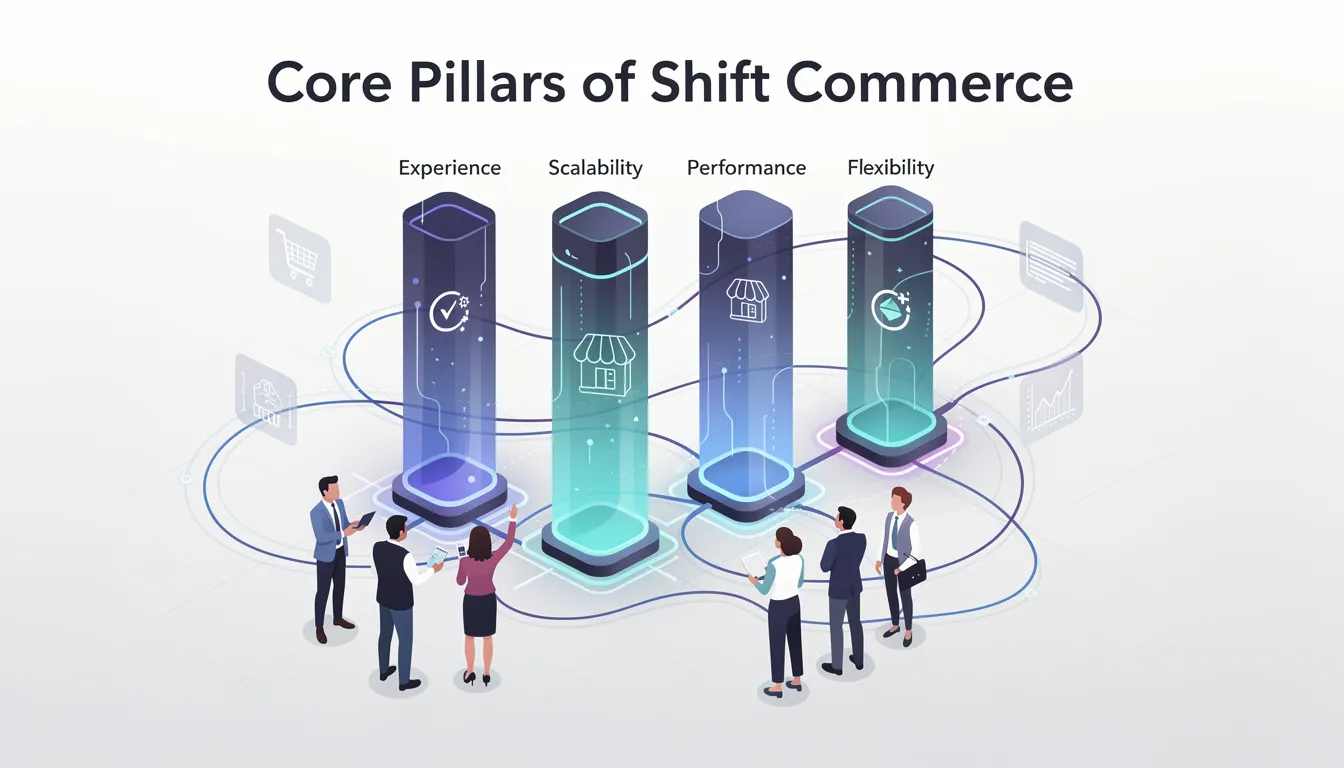
Shift commerce rests on five interconnected pillars. Each supports the others, and weakness in any one limits the potential of the rest. Understanding these pillars helps you prioritise where to focus your efforts.
-
Pillar 1 – Discovery: This encompasses organic search through Google and other search engines, marketplace search on platforms like Amazon, and on-site search within your ecommerce store. Ecommerce SEO forms the backbone here, determining whether potential customers can find your products when they’re actively searching.
-
Pillar 2 – Experience: Site UX, page speed, mobile-first design, personalisation, merchandising, and frictionless checkout all fall under experience. Search engines like Google now factor experience signals into rankings, making this pillar doubly important.
-
Pillar 3 – Trust: Reviews, user-generated content, social proof, secure payments, transparent policies, and authentic brand storytelling build the trust that converts browsers into buyers. Trust signals also influence click-through rates from search engine results pages.
-
Pillar 4 – Data: First-party tracking through tools like Google Analytics (GA4), server-side tagging, customer data platforms, and privacy-compliant segmentation power personalisation and measurement. With third-party cookies deprecated, owning your data is non-negotiable.
-
Pillar 5 – Operations: Inventory visibility, fulfilment speed, returns handling, and delivery reliability aren’t just logistics concerns—they feed directly into SEO through structured data showing stock status and delivery promises in search results.

Ecommerce SEO as the Engine of Shift Commerce
Ecommerce SEO isn’t a tactic within shift commerce—it’s the central mechanism that powers the entire model. When done correctly, SEO integrates with and enhances every other pillar.
Strong SEO work directly shapes site structure, informs content creation, improves user experience, and systematically reduces acquisition costs over time. Unlike paid advertising, SEO investments compound: a well-optimised category page continues driving targeted traffic and revenue for years after the initial work.
The sections that follow break down ecommerce SEO into its component parts, following the logical sequence of a real optimisation project in 2026:
-
Keyword research to understand what your customers actually search for
-
Site architecture to create crawlable, logical structure of web pages
-
On-page optimisation for product pages and category pages
-
Technical SEO to ensure search engines can access and interpret your ecommerce site
-
Content strategy to capture demand at every funnel stage
-
Link building to establish authority through backlinks from relevant third party websites
-
Analytics to measure and improve continuously
Shift Commerce Keyword Research Strategy
Keyword research in 2026 goes beyond traditional SEO tools. The best ecommerce keyword research combines data from Google Keyword Planner with insights from your own site’s internal search, marketplace data from Amazon, and competitive analysis of rival category pages.
Your goal is building a comprehensive keyword universe that maps to your entire product catalogue and the questions customers ask at each buying stage.

-
Start with core categories: Use Google Keyword Planner or tools like Ahrefs and Semrush to identify search volume for your main product categories and subcategories
-
Mine your own data: Export search queries from Google Search Console and internal site search logs to find terms customers actually use
-
Study competitor structure: Analyse how top-ranking ecommerce websites organise their category pages and what product focused keywords they target
-
Tap marketplace intelligence: Amazon autocomplete and bestseller categories reveal high-intent commercial keywords you might miss in traditional tools
-
Distinguish keyword types clearly:
-
Informational keywords like “how to choose running shoes 2026” attract early-stage researchers
-
Commercial research keywords like “best stability running shoes for flat feet” indicate comparison shoppers
-
Transactional keywords like “buy Nike Pegasus 42 mens UK size 10” signal ready-to-purchase intent
-
-
Map keywords to page types: Informational queries belong on blog posts and guides; commercial research fits comparison pages and buying guides; transactional queries target product pages and category pages directly
-
Account for seasonality: Black Friday, back-to-school periods, Singles’ Day (11.11), and other retail events create massive search volume spikes—plan content and optimisation around these windows
Building a Commerce-First Keyword Map
-
Group keywords by user intent (informational, commercial, transactional) before assigning to pages
-
Assign one primary target keyword plus two to three secondary keywords per URL to maintain focus
-
Prevent cannibalisation by ensuring only one core page targets “running shoes for men” while related long tail keywords like “trail running shoes men UK” have dedicated subpages or clearly structured filter pages
-
Document everything in a spreadsheet or dedicated SEO tool with columns for: URL, primary keyword, secondary keywords, search volume, keyword difficulty, and funnel stage
-
Use concrete category examples to test your mapping: “ergonomic office chairs,” “grain-free dog supplements,” or “LED strip lights for kitchens” all have distinct keyword clusters requiring different page structures
Site Architecture for a Shift Commerce Store
Site architecture directly influences both search rankings and conversion rates. A logical structure helps crawlers understand your catalogue while guiding users toward purchase. Get this wrong, and even excellent content and technical SEO won’t reach their potential.
-
Build a shallow hierarchy: Homepage → Main Categories → Subcategories → Product Pages, keeping most products within three clicks of the homepage
-
Create descriptive URLs: Use /mens-running-shoes/stability-shoes/ instead of /category123?id=45—human-readable URLs perform better in organic search results and get more clicks
-
Establish internal linking patterns: Link from blog guides to relevant category pages, from categories to featured product pages, and between related products to distribute authority and guide user journeys
-
Avoid common architecture problems:
-
Orphaned products with no category links pointing to them
-
Overly deep filter paths requiring five or more clicks to reach products
-
Over-reliance on catch-all pages like “/collections/all”
-
Duplicate filtered URLs creating content confusion for crawlers
-
-
Consider modern architectures: Many shift commerce stores combine a headless frontend (Next.js, Nuxt) with a commerce engine (Shopify, BigCommerce)—ensure your navigation and taxonomy remain consistent for SEO regardless of the technology stack
Category and Faceted Navigation in 2026
-
Handle filters (size, colour, price, brand) without creating infinite duplicate URLs—use canonical tags, noindex directives for low-value parameters, or server-side parameter handling
-
Only give SEO-optimised landing pages to high-demand filtered combinations like “black leather office chairs” that have genuine search volume
-
Implement keyword-rich breadcrumb navigation that helps both users and crawlers understand hierarchy (Home > Furniture > Office Chairs > Ergonomic)
-
Study effective faceted navigation on major retailers: ASOS handles colour and size filters while maintaining clean URLs; Wayfair creates dedicated landing pages for popular filter combinations with unique content
On-Page SEO for Product and Category Pages
Your category pages and product pages are the revenue-driving core of ecommerce SEO. These templates get multiplied across hundreds or thousands of URLs, so optimising them correctly creates massive compounding impact.
-
Optimise title tags strategically: Include primary keywords near the beginning, add modifiers like “2026” or “UK” where relevant, and keep under 60 characters to avoid truncation in search results
-
Write unique H1s for each page: Match the primary keyword intent while remaining natural and readable
-
Craft compelling meta descriptions: These don’t directly affect rankings but heavily influence click-through rates—include keywords, a value proposition, and a call to action within 155 characters
-
Create unique product content: Avoid copy-pasting manufacturer descriptions that appear on dozens of other websites. Write original product overviews, specifications, materials, sizing guides, care instructions, and product-specific FAQs
-
Optimise product images properly: Use descriptive file names (red-midi-dress-front-view.jpg not IMG_4521.jpg) and alt text that reflects product variants and helps visually impaired users
-
Implement structured data: Product schema, Offer schema, and Review schema unlock rich results showing price, stock status, and star ratings directly in search engine results pages
-
Handle pagination correctly: Use rel=”next” and rel=”prev” for paginated category listings, and ensure canonical tags point to the correct master URL
Writing Conversion-Focused Ecommerce Copy
-
Answer the key questions every buyer has: Who is this product for? What problem does it solve? How does it compare to alternatives? Why should I buy from this ecommerce store specifically?
-
Integrate social proof naturally: Pull review snippets, mention expert endorsements, or highlight “bestseller since 2022” status within the copy
-
Add urgency and reassurance elements: Delivery cut-off times (“Order by 2pm for next-day delivery”), returns policy highlights (“Free 30-day returns”), and warranty details reduce purchase anxiety
-
Use AI tools like ChatGPT for first drafts of product descriptions, then edit heavily for brand voice, factual accuracy, and regulatory compliance
-
Optimizing content for user experience is crucial, as Google uses user statistics to determine site rankings. Pages that engage users and reduce bounce rates tend to rank higher.
-
High-quality content is vital for a successful long-term SEO strategy, as it is the biggest ranking factor for SEO. Content should be comprehensive, relevant, and regularly updated.
-
Content should be crafted to answer common questions and educate the audience, building trust and supporting broader performance. This approach increases time on site and encourages repeat visits.
-
Regularly refreshing content is crucial for maintaining strong ecommerce SEO performance. Updating product pages, blog posts, and guides ensures your site stays relevant and competitive.
Technical SEO in a Shift Commerce Environment
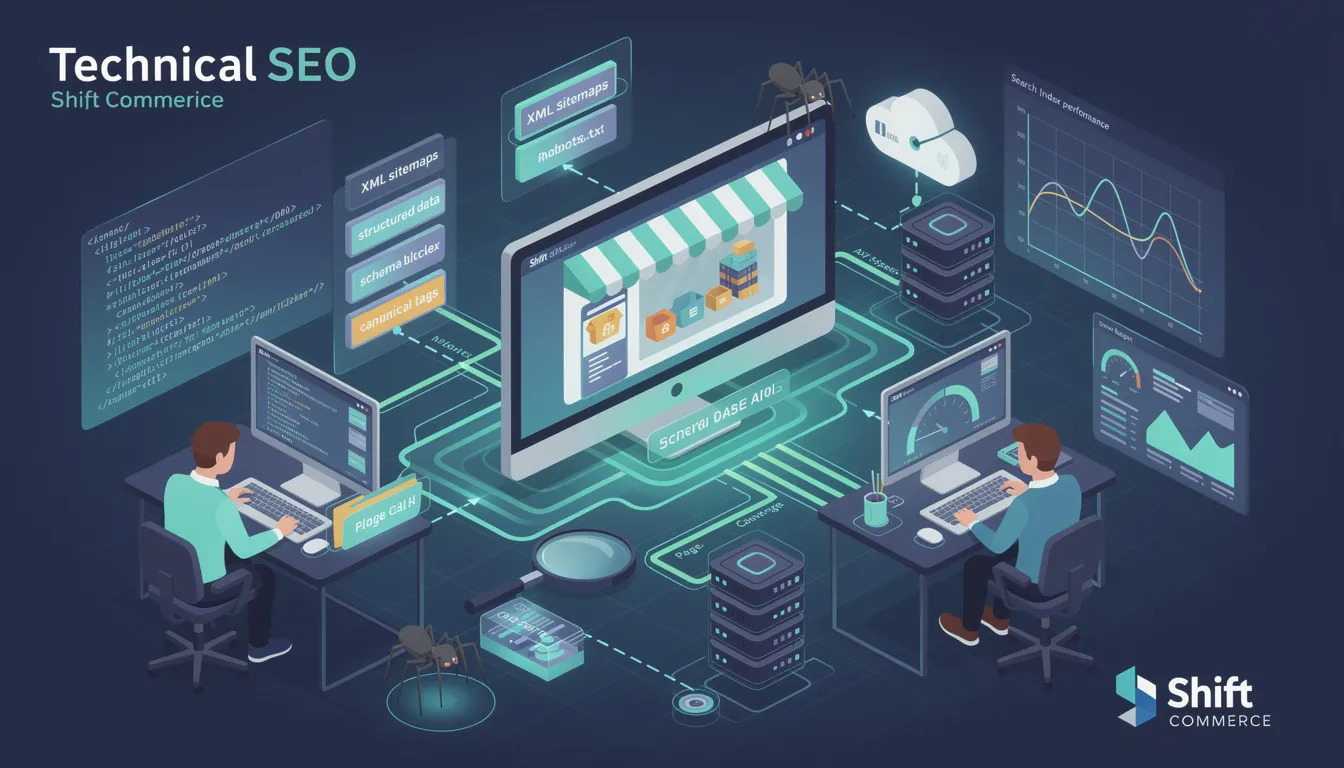
Technical SEO forms the foundation that allows search engines to access, crawl, and correctly interpret your ecommerce site. Without solid technical health, content and link building efforts deliver diminished returns.
-
Ensure crawlability and indexation: Maintain accurate XML sitemaps, configure robots.txt correctly, implement canonical tags consistently, and handle 404 errors and 301 redirects properly during any site changes
-
Prioritise site speed and Core Web Vitals: Google’s page experience signals (LCP, INP, CLS) affect both rankings and user experience. Use CDNs, compress images, lazy-load below-fold content, and minimise JavaScript blocking
-
Design mobile-first: Google’s mobile-first indexing has been the default since around 2020, and mobile devices generate the majority of ecommerce traffic. Ensure responsive layouts, touch-friendly navigation, and fast load times on mobile connections
-
Manage duplicate content systematically: Product variants, faceted navigation, and internal search result pages can create massive duplication issues. Use canonical tags, noindex directives, and parameter handling in Google Search Console to control what gets indexed
-
Audit regularly: Run technical audits using Screaming Frog, Sitebulb, or Ahrefs Site Audit at least quarterly. Schedule deeper audits before major trading periods like Black Friday
Migrating Platforms Without Losing SEO
-
Create complete URL mapping with 301 redirects from every old URL to its new equivalent before migration day
-
Preserve top-performing content, metadata, and internal links from the old ecommerce platform—don’t assume the new platform’s defaults are better
-
Run comprehensive pre-launch and post-launch crawls to catch broken links, missing tags, orphaned pages, and new technical errors
-
Update XML sitemaps immediately, submit them in Google Search Console, and monitor indexation and impressions weekly for at least 90 days post-launch
-
Plan migrations for low-traffic periods—a Q2 2026 migration gives you time to stabilise before the Q4 peak season
Content Strategy to Support Shift Commerce

Content marketing connects ecommerce SEO to every stage of the buyer journey. From initial discovery through evaluation, purchase, and post-purchase loyalty, the right content captures demand and guides customers toward conversion.
-
Map content types to funnel stages:
-
Top-of-funnel: Blog posts, how-to guides, educational articles
-
Middle-of-funnel: Comparison pages, buying guides, gift guides
-
Bottom-of-funnel: Product pages, FAQs, sizing guides
-
Post-purchase: Help centre articles, care instructions, community content
-
-
Choose topics with commercial intent: “Best gifts for Father’s Day 2026,” “how to measure your dog for a harness,” and “LED vs halogen kitchen lighting guide” all have clear paths to product pages
-
Use internal links strategically: Every piece of informational content should link to relevant category pages and product pages, passing authority and creating conversion paths
-
Build topical authority through semantic SEO: Cover related subtopics, entities, and questions thoroughly so search engines understand your expertise in a subject area
-
Align with retail calendar events: Create content well ahead of Valentine’s Day, Prime Day, Black Friday, Cyber Monday, and Christmas—these periods drive massive search volume increases
-
Build a sustainable content calendar: Plan production capacity realistically, aiming for consistent publishing rather than sporadic bursts
Optimising Content for Semantic Search
-
Structure content with clear headings (H1, H2, H3) that outline topics and subtopics for both users and crawlers
-
Incorporate FAQs derived from People Also Ask boxes, search queries in Google Search Console, and common customer service tickets
-
Add schema markup like FAQPage and HowTo where appropriate to gain enhanced visibility and featured snippets
-
Use related entities and synonyms naturally (“sofa,” “couch,” “sectional”) to capture varied search queries without keyword stuffing
Building Authority: Reviews, Links, and Social Proof

Trust signals directly influence click-through rates from search results, on-site conversion rates, and ranking potential. Building authority requires consistent effort across reviews, link building, and social proof.
-
Collect and showcase reviews systematically: Use platforms like Yotpo, Judge.me, or Trustpilot to gather post-purchase reviews and display them prominently on product pages
-
Implement review schema correctly: Product Review structured data enables star ratings to appear in Google’s organic search results, dramatically improving click-through rates
-
Build links ethically and sustainably: Focus on digital PR, genuine partnerships, resource page placements, and creating content that naturally attracts references from relevant websites
-
Prioritise quality over quantity: High-quality links from relevant, authoritative sites (.com, .co.uk, .edu, industry publications) deliver far more value than large volumes of low-quality directory links
-
Display social proof prominently: “As featured in” media logos, influencer collaborations, user-generated content galleries, and trust badges all reinforce credibility and can improve both conversion and SEO
Link Building Campaigns for Ecommerce Brands
-
Create seasonal PR angles: Sustainability reports for Earth Day, gifting trend data before Christmas, or category trend reports based on your own sales data
-
Conduct targeted outreach to niche blogs, industry publications, and comparison sites with genuinely useful data, original research, or comprehensive guides
-
Build linkable assets that provide ongoing value: Sizing calculators, interactive product finders, downloadable checklists, or visual guides that other third party websites want to reference
-
Track every acquired link, monitor referral traffic from each source, and correlate link acquisition with ranking movements to assess campaign ROI accurately
-
Guest posting on relevant websites can be an effective way to build backlinks for your ecommerce site.
-
Earning backlinks from other websites is one of the most powerful ways to boost your ecommerce SEO performance.
Analytics and Measurement in Shift Commerce

Measurement connects your SEO efforts to commerce outcomes, moving beyond vanity metrics like raw traffic to focus on revenue impact and customer value. Without proper measurement, you’re optimising blind.
-
Set up core tools correctly: GA4 with enhanced ecommerce tracking, Google Search Console connected to your ecommerce site, and platform-specific analytics from Shopify or BigCommerce
-
Define meaningful KPIs: Track organic sessions, revenue attributed to organic, conversion rate by landing page type, average order value from organic visitors, assisted conversions, and customer lifetime value for SEO-acquired customers
-
Think in keyword clusters: Rather than obsessing over individual keyword rankings, measure category-level organic traffic and revenue to understand true SEO performance
-
Build unified dashboards: Use Looker Studio or similar tools to combine marketing and operations data, giving you a complete shift commerce view in one place
-
Review and experiment consistently: Monthly performance reviews should identify opportunities and inform structured experiments—test page changes, schema updates, and internal linking improvements with clear hypotheses and measurement plans
Using Data to Drive Continuous Optimisation
-
Identify underperforming pages with high potential: High impressions but low CTR suggests meta tag improvements needed; high traffic but low conversion points to UX or content issues
-
Match actions to problem types:
-
Low CTR: Improve title tags and meta descriptions
-
Low conversion: Enhance page copy, add social proof, improve UX
-
Low impressions: Build internal links, create supporting content, acquire external links
-
-
Use cohort analysis to understand how SEO-acquired customers behave differently from paid-acquired customers—this guides content and merchandising decisions
-
Track real improvements: After rewriting copy and adding comparison content to a “men’s waterproof jackets” category, monitor organic traffic, conversion rate, and revenue over a 90-day period to quantify the impact
-
A well-ranked page will receive more website traffic, so you want your page to rank as high as possible.
-
When your ecommerce site ranks higher for relevant keywords, it is more likely to attract visitors who are already interested in the products or services that your organization offers.
-
Ecommerce SEO allows businesses to capture highly relevant targeted traffic at virtually no cost compared to paid ads.
-
Unlike paid ads, which drive traffic to your web store by making you pay per click, SEO allows you to capture highly relevant traffic at virtually no cost.
-
When your product pages and category pages rank well in search engine results pages, you're attracting people actively looking for what you sell.
-
SEO helps your web store receive more website traffic, which consequently expands your brand's reach.
-
Once you have rolled out your SEO strategy, it continues to work for you with low maintenance compared to other marketing channels.
Emerging Trends and Innovations in Shift Commerce
-
Real-time insights into buyer behavior enable agile planning cycles that are more responsive than traditional quarterly schedules.
-
Automated order processing can reduce manual errors by up to 50%, leading to lower return rates.
-
Businesses can operate 24/7 globally, breaking free from geographical limitations and physical store hours.
-
Shift commerce enables small businesses to compete internationally by providing 24/7 access to markets.
-
AI-driven hyper-personalized experiences can lift revenue by up to 18% and are preferred by 80% of consumers.
-
Social Commerce 2.0 involves the integration of shopping into content on platforms like TikTok Shop.
-
AI assistants are becoming "gatekeepers" that autonomously browse, compare, and purchase items on behalf of consumers.
-
AI is implemented in customer service, logistics, and agentic commerce where AI shops for users.
-
Social commerce features can significantly increase conversion rates and Average Order Value (AOV) by up to 30%.
-
A strong omnichannel presence is crucial for remaining competitive and meeting modern consumer expectations.
-
Early adopters of emerging channels like voice commerce gain competitive advantages over slower competitors.
-
AI agents are expected to handle nearly 20% of e-commerce tasks by 2026, enhancing workflow efficiency.
-
There is a rising demand for e commerce seo experts, e-commerce specialists, data scientists, and digital marketers in retail.
-
The competition in retail is shifting towards providing superior, personalized customer experience across all touchpoints.
-
Using predictive insights for waste reduction aligns businesses with growing sustainability regulations and consumer preferences.
-
Values-based loyalty programs can foster long-term brand advocacy by emphasizing experiences over discounts.
-
Brick-and-mortar stores are evolving to become experience hubs or fulfillment centers.
-
Social commerce platforms like TikTok and Instagram enable product discovery and direct purchases.
-
Predictive analytics can lower inventory carrying costs by 10% and markdown losses by 15–25%.
-
E-commerce and mobile shopping provide convenience, price comparison, and vast selection, driven by smartphones.
-
Shift commerce is characterized by a transition from traditional retail models to technology-driven ecosystems by 2026.
-
Hyper-personalization using advanced analytics allows retailers to significantly tailor pricing and promotions based on consumer intent data.
-
Physical stores are being transformed into experience hubs or fulfillment nodes, utilizing technologies like AR and RFID.
-
Retail media spending is projected to exceed $200 billion by 2026 as retailers monetize data and digital shelf space.
-
Retailers are adopting rolling 4–8 week planning cycles, supported by daily data adjustments to meet digital demand.
-
Digital platforms allow businesses to scale and adapt to demand fluctuations with minimal investment in infrastructure.
-
Brand authenticity and transparency in data practices are critical competitive advantages as AI takes over decision-making processes.
-
Retailers are investing in adaptive supply chains, including micro-fulfillment centers for same-day delivery.
-
An online presence typically incurs lower operational costs than physical stores due to reduced overhead expenses.
-
Automation enhances operational efficiency by minimizing manual errors and improving supply chain processes.
-
Augmented Reality (AR) try-ons and 3D product views can increase engagement by 200% and reduce return rates by approximately 20%.
-
Online platforms enhance customer experience through convenience, self-service options, and personalized recommendations.
-
Marketplace models allow retailers to diversify product ranges rapidly without holding inventory, increasing SKU availability.
Frequently Asked Questions (FAQs)
Why is it important for my ecommerce pages to rank high in search engine results?
A well-ranked page will receive more traffic, so you want your page to rank as high as possible. When your product pages and category pages rank well in search engine results pages (SERPs), you're attracting people actively looking for what you sell. This means visitors arriving at your site are more likely to be interested in your products or services, increasing the chances of conversion and sales.
How does ecommerce SEO compare to paid advertising in terms of cost and traffic?
Ecommerce SEO allows businesses to capture highly relevant traffic at virtually no cost compared to paid ads. Unlike paid ads, which drive traffic to your web store by making you pay per click, SEO enables you to attract organic traffic without ongoing ad spend. This makes SEO a cost-effective marketing strategy targeting users who are already searching for your products online.
What are the key components of a successful ecommerce SEO strategy?
Effective ecommerce SEO starts with thorough keyword research to understand what your customers are searching for. Optimizing product and category pages with relevant keywords, unique content, and structured data is crucial for driving organic traffic. Additionally, building high-quality backlinks through guest posting and link building from reputable websites helps establish authority and trust, boosting your SEO performance.
How often should I update my ecommerce content to maintain SEO performance?
Regularly refreshing content is crucial for maintaining strong ecommerce SEO performance. Updating product descriptions, category pages, and informational content ensures your site stays relevant and competitive in search engine rankings. Fresh content also signals to search engines that your site is active, which can improve visibility.
What role does site structure and technical SEO play in ecommerce SEO?
A clean site structure helps search engines crawl your web pages efficiently and makes it easier for users to find what they need. Technical SEO tasks such as fixing broken links, avoiding duplicate content, implementing XML sitemaps, and improving site speed are foundational for ecommerce SEO success. These elements ensure search engines can access and correctly interpret your ecommerce site, enhancing your rankings and user experience.
How can I measure the success of my ecommerce SEO efforts?
Tracking the success of your SEO channel gets easier when you know what KPIs to look out for. Tools like Google Analytics and Google Search Console help monitor impressions, clicks, search queries, and overall website traffic from organic search. Key metrics include organic sessions, conversion rates, revenue attributed to organic traffic, and keyword rankings. Regular analysis allows you to optimize your SEO strategy continuously.
What are the benefits of link building for ecommerce SEO?
Building trust through link building is one of the most powerful ways to boost ecommerce SEO performance. High-quality backlinks from relevant and authoritative websites signal to search engines that your content is valuable, improving your site's authority and rankings. Guest posting on relevant websites and creating link-worthy content are effective strategies for acquiring backlinks.
How does shift commerce impact ecommerce SEO and business operations?
Shift commerce refers to a transformation in how people shop, driven by technology and changing consumer expectations. It enables businesses to operate 24/7 globally, breaking free from geographical limitations and physical store hours. Shift commerce integrates ecommerce SEO with advanced data analytics, automation, and AI-driven personalization to enhance customer experience, optimize marketing strategies, and increase revenue sustainably.
What are some emerging trends in ecommerce that complement SEO strategies?
Emerging trends include AI-driven hyper-personalized experiences that can lift revenue by up to 18%, social commerce integration on platforms like TikTok Shop, and AI assistants that autonomously browse and purchase items for consumers. Additionally, augmented reality (AR) try-ons and 3D product views can increase engagement by 200% and reduce return rates. These innovations, combined with strong SEO, help ecommerce brands stay competitive and meet modern consumer expectations.
Why is user experience important for ecommerce SEO?
User experience is a key ranking factor for Google, impacting how well an ecommerce site performs in search results. A well-structured site with fast page speed, mobile-friendly design, and easy navigation not only improves rankings but also keeps visitors engaged, reducing bounce rates and increasing the likelihood of purchases. Optimizing content for user experience is essential for a successful and sustainable SEO strategy.
How can ecommerce businesses leverage data and analytics to improve SEO?
Data analytics help businesses understand buyer behavior and optimize marketing strategies. Real-time insights enable agile planning cycles that are more responsive than traditional schedules. By tracking SEO performance metrics and customer interactions, ecommerce brands can refine keyword targeting, content creation, and site architecture to better meet user intent and boost organic traffic.
What is the long-term value of investing in ecommerce SEO?
Ecommerce SEO is a long-term investment that builds your presence in organic search results and delivers sustainable returns. Once you have rolled out your SEO strategy, it continues to work for you with low maintenance compared to other marketing channels. This compounding effect helps reduce reliance on paid ads, lowers customer acquisition costs, and increases brand visibility and trust over time.
How do internal links contribute to ecommerce SEO success?
Internal linking can help keep visitors browsing your content longer, increasing the chances of making a sale. It also distributes link equity across your site, helping search engines understand the relationship between pages and improving the crawlability of your ecommerce site. Strategically placed internal links guide users through the buying journey and support SEO by reinforcing keyword relevance.
What operational improvements support ecommerce SEO in shift commerce?
Robust inventory management, efficient logistics, and automation enhance operational efficiency and customer satisfaction. Automated order processing can reduce manual errors by up to 50%, leading to lower return rates. These operational strengths support SEO by enabling accurate stock status through structured data and ensuring a reliable shopping experience that builds trust and repeat business.
How does sustainability influence ecommerce SEO and consumer expectations?
Sustainability is becoming a baseline expectation for consumers, leading brands to integrate resale and trade-in options into their operations. Values-based loyalty programs that emphasize experiences over discounts foster long-term brand advocacy. Aligning SEO content and marketing strategies with sustainability themes can enhance brand authenticity and appeal to environmentally conscious shoppers.
What skills are in demand for ecommerce SEO and digital marketing in 2026?
There is a rising demand for ecommerce specialists, data scientists, and digital marketers in retail. These professionals help businesses leverage SEO, data analytics, AI, and emerging technologies to create superior, personalized customer experiences across all touchpoints. Staying current with industry trends and technologies is essential for maintaining competitive advantage in shift commerce.

0 comments