

Answering your main question fast: What is artificial intelligence SEO?
Artificial intelligence SEO is the practice of using AI tools to perform SEO work—research, writing, audits—while simultaneously optimizing your content to rank in AI-powered search experiences like Google AI Overviews, ChatGPT, and Perplexity. It represents a fundamental shift from traditional keyword-matching approaches toward understanding and serving user intent across multiple discovery channels.
This guide is designed for SEO professionals, marketers, and business owners who want to stay ahead as AI transforms search. Understanding AI SEO is essential to maintain and grow your online visibility in 2025 and beyond.
AI SEO is the process of making your content discoverable, extractable, and trusted across AI-powered search experiences. It builds on SEO fundamentals but develops them further to align with the way AI systems interpret, summarize, and surface information. AI SEO prioritizes how content is interpreted, extracted, and represented by AI systems, and involves optimizing content for retrieval and citation within AI-generated answers, not just for ranking. This means focusing on semantic search and structured content to improve visibility across AI-generated answers.
In 2025–2026, AI SEO encompasses three interconnected disciplines:
-
Classic SEO for Google and Bing SERPs (the 10 blue links)
-
Generative Engine Optimization (GEO) for AI summaries and overviews
-
Answer Engine Optimization (AEO) for direct answers, chatbots, and voice assistants
Search has become “AI-first.” A substantial share of queries now end in zero-click AI answers, which means visibility inside those generated responses is as critical as ranking in traditional search results. The websites that thrive understand both sides of the equation:
-
AI for SEO tasks: Using machine learning and natural language processing to automate keyword research, content optimization, competitor analysis, and reporting
-
SEO for AI search: Making content discoverable, extractable, and trusted by AI systems that generate answers from multiple sources
This dual approach separates modern search engine optimization efforts from the tactics that worked even two years ago.

Why artificial intelligence matters for SEO in 2025–2026
The search landscape has transformed faster in the past 18 months than in the previous decade. Google rolled out AI Overviews to over 100 countries throughout 2024–2025, fundamentally changing how users interact with search results. Research indicates that more than 58% of US Google searches end without a click—users get their answers directly from AI-generated summaries, featured snippets, and knowledge panels.
Meanwhile, large language models like ChatGPT and Perplexity have become legitimate discovery channels. Millions of users now ask these AI systems for product recommendations, how-to guidance, and research—bypassing traditional search engines entirely.
Key benefits of AI for SEO professionals:
-
Speed and scale: AI tools analyze thousands of pages, keywords, and competitors in minutes
-
Pattern recognition: Machine learning identifies ranking correlations humans would miss
-
Predictive insights: AI forecasts emerging search trends before they peak
-
Automation: Repetitive tasks like meta descriptions, internal links suggestions, and reporting run on autopilot
However, AI-augmented search has raised the quality bar dramatically. Search engine algorithms now filter out thin or generic AI generated content more aggressively than ever. The March 2024 core update specifically targeted sites that published mass-produced, low-value AI content.
E-E-A-T signals—experience, expertise, authoritativeness, and trust—now underpin success in both traditional rankings and AI answer selection. These signals help search engines and AI systems decide which sources deserve visibility.
The teams that combine human expertise with AI efficiency will outperform those who rely on either alone.
How AI has changed the SEO landscape

The gap between 2015-era SEO and 2025-era SEO is enormous. A decade ago, ranking meant optimizing for exact-match keywords, building links at scale, and ensuring basic technical compliance. Today, success requires understanding intent, building entity recognition, and creating content worthy of AI retrieval.
Key shifts that define AI-era search:
-
Machine learning ranking systems: RankBrain (2015), BERT (2019), MUM (2021), and the SGE/AI Overviews rollout (2023–2025) each moved search further from simple keyword matching toward semantic understanding
-
Zero-click and AI summary answers: Informational queries increasingly resolve without users visiting any website
-
LLMs as discovery channels: ChatGPT, Claude, and Gemini now function as parallel search engines for millions of users
-
Quality pressure from AI content explosion: Google became stricter on originality and depth after millions of sites published AI generated content
User behavior has shifted accordingly. Search queries are more conversational, often resembling natural questions. Users ask follow-up questions within AI chat interfaces instead of running new searches. Multi-step research increasingly happens inside a single AI conversation.
|
Traditional SEO (2015–2020) |
AI-Era SEO (2025–2026) |
|---|---|
|
Exact-match keyword focus |
Intent and entity understanding |
|
Link quantity emphasis |
Link quality and relevance |
|
Single-page optimization |
Topic cluster architecture |
|
Rankings as primary KPI |
AI visibility + rankings as KPIs |
|
Manual research and audits |
AI-assisted workflows |
From keyword stuffing to intent and entities
Pre-2012 SEO rewarded keyword density and exact-match anchor text. You could rank for “best running shoes” by repeating that phrase throughout your content and acquiring links with identical anchor text. Search engines matched strings, not meaning.
Modern systems work differently. When someone searches “best running shoes for flat feet 2026,” Google’s AI interprets:
-
Intent: Transactional/informational—user wants recommendations for a specific need
-
Entities: Running shoes (product category), flat feet (physical condition), 2026 (recency requirement)
-
Context: User likely needs arch support, motion control, and current availability
The search engine then serves results that comprehensively address this interpreted need—even if those pages never contain the exact phrase “best running shoes for flat feet 2026.”
This shift demands a different approach to content creation. AI SEO requires:
-
Clear topical focus around specific problems and solutions
-
Consistent entity naming (your brand, products, people)
-
Content structured around user questions rather than keyword variations
-
Depth that demonstrates genuine expertise, not just keyword coverage
Generative Engine Optimization (GEO), AEO, and LLMO
Three related disciplines have emerged as AI search matured:
Generative Engine Optimization (GEO) focuses on making your content appear in AI-generated summaries across Google’s AI Overviews, Bing Copilot, Perplexity, and similar surfaces. The goal is creating extractable, well-structured passages that AI systems want to cite.
A travel website, for example, might optimize a “Best time to visit Portugal” guide with clear monthly breakdowns, specific temperature ranges, and festival dates. When an AI system generates an answer about Portugal travel timing, it pulls directly from these structured, fact-rich passages.
Answer Engine Optimization (AEO) targets direct, snippet-like answers for featured snippets, FAQ rich results, and voice assistants. This means creating concise responses to specific questions.
A financial services site could structure a “What is a Roth IRA?” page with a two-sentence definition at the top, followed by eligibility requirements in a bulleted list. This format wins featured snippets and provides the exact structure Google Assistant or Alexa needs for voice search responses.
Large Language Model Optimization (LLMO) ensures AI models like ChatGPT, Claude, and Gemini can retrieve, cite, and paraphrase your content correctly. When someone asks ChatGPT “What is [Your Brand]?” you want an accurate, current description—not hallucinated information or competitor confusion. For SMEs looking to gain visibility and drive results online, Google Search Marketing for SMEs offers expert strategies to increase leads and sales through targeted advertising.
A B2B software company might strengthen LLMO by maintaining consistent brand descriptions across their website, LinkedIn, Crunchbase, and Wikipedia, while publishing clear product definitions that LLMs can reference.
The rise of zero-click and AI-driven search
Zero-click searches—where users get answers without visiting any website—now dominate informational queries. The 58% figure for US searches is even higher in European markets with stricter GDPR implementations affecting ad tracking.
This reality forces a strategic recalibration. Pure traffic metrics can mislead when your brand appears prominently in AI summaries, knowledge panels, and People Also Ask boxes. That exposure drives later branded searches and direct conversions, even without an immediate click.
Consider a typical 2025 SERP for “how to remove red wine stains”: AI Overview takes the top third of the screen, followed by People Also Ask, then video results, then featured snippets. The traditional first organic result appears below the fold on mobile.
Three strategic consequences:
-
Brand visibility in AI answers matters more than position #1 for some queries
-
Entity clarity determines whether AI systems recognize and cite your brand correctly
-
Conversion optimization becomes critical when you receive fewer but more qualified visits
Core components of an effective artificial intelligence SEO strategy
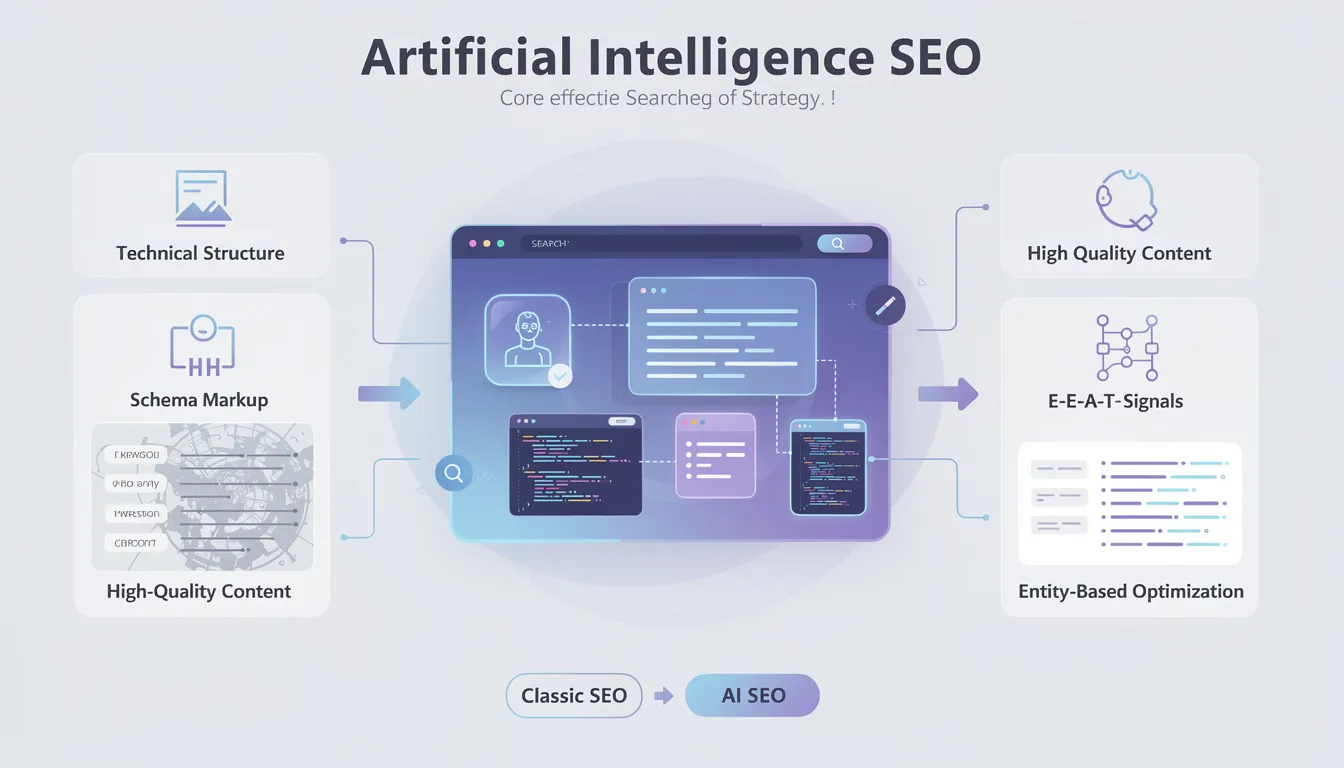
AI SEO builds on classic fundamentals but reprioritizes for clarity, structure, and credibility. The sites winning in AI-powered search experiences share common characteristics—they’re not just optimized for crawlers but designed for extraction by intelligent systems.
Six pillars of effective AI SEO:
-
Semantic structure and topical depth
-
Schema markup and structured data
-
E-E-A-T and real-world proof
-
Technical health and performance
-
Multi-format and multimodal content
-
Continuous measurement across classic SERP and AI surfaces
Each pillar deserves dedicated attention.
Semantic search and structured content
Search engines and LLMs analyze context, synonyms, and intent rather than matching individual keywords. A page about “marathon training plans” ranks for dozens of related queries—“how to train for a marathon,” “26.2 mile preparation,” “first marathon schedule”—because the system understands topical relevance.
Practical on-page tactics: Local Marketing & Footfall | Geo-Fenced Ads & DOOH – SMC
-
Use H1–H3 headings that mirror real user queries
-
Write short paragraphs and bullet lists for easy answer extraction
-
Organize content into topic clusters with clear pillar pages and supporting articles
-
Include definitions near the top of relevant pages
-
Answer the main question in the first 100 words
A fitness site might organize around a “Marathon Training” hub with dedicated subpages for training plans by experience level, nutrition strategies, gear recommendations, injury prevention, and race-day preparation. Each page links to related content, building topical authority the AI can recognize.
Schema markup and structured data for AI
JSON-LD schema helps both search engines and AI models interpret your content correctly. Implementing structured data isn’t optional in 2025—it’s a baseline requirement for rich results and AI citation.
Schema provides explicit signals about what your content represents. An Article schema tells systems this is editorial content with a specific author and publication date. Product schema communicates price, availability, and review ratings. FAQPage schema structures question-answer pairs for direct extraction.
Schemas to prioritize in 2025–2026:
-
Article/BlogPosting: For all editorial content with author attribution
-
FAQPage: For pages answering multiple related questions
-
HowTo: For step-by-step instructional content
-
Product: For ecommerce with price, availability, and ratings
-
Organization/LocalBusiness: For brand entity establishment
-
Person: For author and expert pages building E-E-A-T
Real-world benefits include rich results in SERPs, higher probability of AI Overview citation, and fewer brand misunderstandings by LLMs. A site with proper Organization schema helps ChatGPT answer “What does [Company] do?” accurately.
Building E-E-A-T with AI-era content
E-E-A-T stands for Experience, Expertise, Authoritativeness, and Trustworthiness. Google’s Search Quality Rater Guidelines (last major update in 2022, still actively referenced in 2025 core updates) use these factors to evaluate content quality.
In an era of abundant AI generated content, E-E-A-T signals separate valuable content from generic output. AI can produce grammatically correct text on any topic, but it cannot fabricate real experience, verified credentials, or earned reputation.
Quick E-E-A-T wins:
-
Display author credentials, years of experience, and links to LinkedIn or professional profiles
-
Add case studies with specific results, timelines, and client context
-
Include personal anecdotes and lessons learned that generic AI cannot fake
-
Cite and link to primary sources, studies, and authoritative references
-
Earn citations from reputable sites, industry associations, and news outlets
First-hand data dramatically increases information gain. Share internal benchmarks, customer research, experiments you ran in 2023–2025, and specific tool tests. A blog post that says “we tested 15 AI SEO tools over 6 months and measured ranking changes” outperforms one that summarizes features from vendor websites.
Technical SEO foundations for AI visibility
AI-powered search still depends on clean crawling, indexing, and performance. If pages are slow, blocked, or poorly structured, they won’t be used as AI sources—regardless of content quality.
Technical SEO checklist for 2025:
-
[ ] Core Web Vitals passing on mobile and desktop
-
[ ] Mobile usability verified in Google Search Console
-
[ ] XML sitemaps updated and submitted
-
[ ] Logical URL structure with descriptive slugs
-
[ ] Correct canonical tags preventing duplicate content issues
-
[ ] Proper noindex usage for utility pages
-
[ ] Hreflang implementation for international sites
-
[ ] Site audit completed quarterly using professional SEO tools
Common indexing issues like “Crawled – currently not indexed” require active management. Tools like Search Console, log file analyzers, and indexing monitors help identify pages Google discovers but chooses not to index. Often these pages need stronger internal links, better content differentiation, or technical fixes.
Multi-format and multimodal content
AI systems increasingly combine text, images, and video signals. Google’s MUM model processes multiple content formats simultaneously, understanding that a video demonstration and written tutorial about the same topic should reinforce each other.
Repurposing workflow for a single topic:
-
Create an in-depth article (2,000–4,000 words) as the anchor
-
Produce a long-form video (10–20 minutes) with full transcript
-
Extract 3–5 short-form videos (60–90 seconds) for YouTube Shorts, TikTok, and Reels
-
Design an infographic or comparison table summarizing key points
-
Write social posts linking back to the anchor content
Consistent facts and wording across formats help AI models connect signals. If your website says your product “reduces deployment time by 40%” but your video claims “cuts setup in half,” AI systems may struggle to synthesize accurate information about your offering.
Measurement and analytics for AI SEO
Ranking in the “10 blue links” is no longer the only KPI. Modern SEO teams track visibility across traditional SERPs and AI-generated surfaces.
Metrics to monitor:
-
Organic sessions, conversions, and revenue (classic)
-
Keyword rankings and share of voice (classic)
-
Presence and position within AI Overviews / SGE
-
Citation frequency in AI answer panels
-
Brand mention share in AI responses for target keywords
-
Featured snippet and People Also Ask ownership
-
Branded search volume growth (indirect AI exposure indicator)
Tools have emerged to track AI-specific visibility. Semrush’s AI Visibility reports, SE Ranking’s AI Overview Tracker, and specialized platforms like Rankscale.ai monitor how often your content appears in generated answers.
Track these metrics over time, especially around major Google core and AI system updates. A site might maintain traditional rankings while losing AI Overview presence—or vice versa.

Using artificial intelligence tools to do better SEO work
Since roughly 2019, AI SEO tools have evolved from basic “content spinners” to sophisticated assistants for research, writing, audits, and reporting. The best tools compress manual work from hours to minutes while maintaining quality standards.
Critical distinction: tools don’t replace strategy. They accelerate execution, but humans still decide which topics matter, what positioning differentiates, and where quality thresholds lie. The SEO teams winning with AI treat it as augmentation, not replacement.
Main task categories where AI tools excel:
-
Keyword research and topic discovery
-
Content creation and outlining
-
Content optimization and audits
-
Technical analysis and indexing
-
Reporting and forecasting
AI keyword research and intent analysis
Traditional keyword research tools required hours of manual filtering. AI models can ingest a seed keyword—like “ai seo for ecommerce”—and generate hundreds of related queries, questions, and content angles in minutes.
Recommended workflow:
-
Brainstorm with AI: Use ChatGPT, Gemini, or Claude to explore topic variations, questions users might ask, and related subtopics
-
Validate with data: Cross-reference AI suggestions with keyword research tools like Semrush, Ahrefs, or SE Ranking to verify search volume, keyword difficulty, and SERP intent
-
Analyze intent: Categorize keywords by search intent—informational, navigational, transactional, or commercial investigation
-
Cluster into topics: Group related keywords into content hubs matching buyer journey stages
-
Prioritize by opportunity: Focus on keywords with reasonable keyword difficulty, sufficient search volume, and clear business relevance
Conversational and long-tail queries deserve special attention. These mirror how people ask questions in AI chat: “how do I optimize my Shopify store for google ai overviews” rather than “shopify seo tips.” AI search engines favor content that directly addresses these natural-language patterns.
AI-assisted content creation
AI drafts are starting points, not finished products. Human subject-matter expertise, fact-checking, and brand voice remain mandatory to meet Google’s quality standards in 2025. Sites that publish lightly edited AI content face algorithm penalties and audience trust erosion.
Practical content creation workflow:
-
Define the brief: Document target keyword, search intent, audience, unique angle, word count target, and competitor analysis
-
Generate outline options: Have AI tools like ChatGPT, Koala AI, or Writesonic propose 2–3 outline variations
-
Merge and refine: Manually combine the best elements, add sections competitors miss, ensure logical flow
-
Draft sections strategically: Use AI for definitions, comparisons, and FAQs while writing core arguments, opinions, and case studies yourself
-
Edit aggressively: Fact-check claims, add specific examples, insert original data and screenshots, adjust for brand voice
AI excels at:
-
Definitions and explanations
-
Comparison tables
-
FAQ generation
-
Schema markup drafts
-
Meta description variants
Humans must own:
-
Strategic recommendations
-
Personal experience and opinions
-
Case studies with specific results
-
Quality judgment and fact-checking
-
Brand voice and positioning
Include concrete details—dates, test results, campaign numbers from 2022–2025—to distinguish from generic AI tone. “We tested this approach across 47 client sites in Q2 2024” carries more weight than “this approach can help many businesses.”
On-page optimization and AI SEO content tools
Content optimization tools like Surfer SEO, Clearscope, Frase, and SE Ranking’s Content Editor use AI to compare your draft against current top-ranking pages. They identify gaps in topic coverage, suggest related keywords, and flag potential over-optimization.
These tools typically suggest:
-
Related terms and entities to include
-
Headings and subtopics common among ranking pages
-
Content length benchmarks
-
Internal links to add
-
Image and media recommendations
Optimize-before-publish workflow:
-
Write or import your draft into the optimization tool
-
Review suggested terms—add those that naturally fit, skip those that feel forced
-
Check heading structure against successful competitors
-
Add internal links to related content on your site
-
Verify your target keyword appears in title, H1, first 100 words, and meta description
-
Run final readability check before publishing
Avoid blindly following word count and keyword density recommendations. The goal is comprehensive coverage and clarity, not hitting arbitrary metrics. A 2,000-word article that fully answers the query outperforms a 3,500-word article padded with tangential content.
Technical SEO, crawling, and indexing with AI assistance
Some SEO tools now layer AI on top of crawl data to prioritize issues and predict impact. Search Atlas’s OTTO SEO, Semrush Copilot, and SE Ranking’s site audit features use machine learning to surface what matters most.
Use cases for AI-assisted technical SEO:
-
Automatically grouping crawl errors by estimated traffic impact
-
Predicting which unindexed URLs need content improvements versus technical fixes
-
Monitoring index coverage for new site sections or ecommerce product catalogs
-
Generating developer-friendly task lists from complex audit reports
Tools like Indexly help monitor indexing at scale, alerting when important pages drop from Google’s index. This matters especially for large ecommerce sites where product pages frequently fall into the “Discovered – currently not indexed” limbo.
Technical tasks you can safely automate with AI:
-
Crawl scheduling and error alerting
-
Redirect chain detection
-
Duplicate content identification
-
Internal link opportunity mapping
-
Schema validation reporting
-
Performance-focused paid media campaigns for driving leads and sales
Set up automated crawls with AI-generated summaries that non-technical stakeholders can understand. Instead of sending developers a 500-row spreadsheet, send a prioritized list of 10 issues with estimated impact and recommended fixes.
Reporting, dashboards, and AI summarization
Connect GA4, Google Search Console, and your primary SEO tools into centralized dashboards. Platforms like Whatagraph, Looker Studio with AI connectors, and custom solutions via DataForSEO APIs consolidate data for faster analysis.
AI summarization transforms raw data into actionable insights:
-
Highlight anomalous traffic drops tied to specific algorithm updates
-
Produce executive-friendly summaries from complex charts
-
Suggest hypotheses for why pages improved or declined in AI Overviews
Monthly AI-assisted SEO review checklist:
-
[ ] Compare organic traffic and conversions to previous month and previous year
-
[ ] Review ranking changes for priority keywords
-
[ ] Check AI Overview presence for top 20 target queries
-
[ ] Analyze which content gained or lost visibility
-
[ ] Document hypotheses for significant changes
-
[ ] Plan 2–3 experiments for next month
Remember that AI explanations are suggestions, not conclusions. Analysts must verify patterns, correlate with known algorithm updates, and test potential solutions. The AI surfaces possibilities; humans validate and act.
Optimizing your site for AI-powered search experiences (GEO & AEO in practice)
Now that you can move faster with AI tools, how do you actually win placement inside AI Overviews and answer boxes? This section provides practical GEO and AEO tactics that work across Google, Bing, and LLM-based engines in 2025–2026.
Success comes from three principles: clear answers, strong entities, and information gain versus page-one clones.
Designing content for extractable answers
AI systems prefer content they can easily parse and summarize. Structure your pages for extraction, not just human reading.
Lead with answers. Start important pages with a 2–3 sentence summary that directly responds to the main query. Answer first, explain second. A page targeting “what is artificial intelligence seo” should define the concept in the opening paragraph, then elaborate with context and examples.
Answer patterns AI systems favor:
-
Definition paragraphs (40–60 words, no jargon)
-
Numbered step-by-step lists
-
Pros/cons comparisons
-
FAQ sections with clear question/answer pairs
-
Summary tables with scannable data
A “How to optimize Shopify for AI Overviews” guide might open with a 3-sentence explanation, follow with a 7-step numbered process, include a FAQ section addressing common objections, and close with a comparison table of recommended apps. Each element gives AI systems extractable content for different query variations.
Targeting long-tail and conversational queries
LLM-augmented search handles natural-language questions effectively. Users ask “how do I get my content cited in ChatGPT” rather than “chatgpt seo tips.” Optimizing for these conversational patterns captures valuable traffic that traditional keyword strategies miss.
Research checklist for conversational queries:
To understand how working with an agency for Facebook Ads can boost your campaigns, consider researching the strategies and benefits provided by top marketing professionals.
-
[ ] Mine People Also Ask boxes for your primary keywords
-
[ ] Search Reddit, Quora, and niche forums for recurring questions
-
[ ] Analyze internal site search logs for user language patterns
-
[ ] Use AI tools to expand seed keywords into question variations
-
[ ] Check related keywords and questions from SEO platforms
Map conversational queries to specific, focused pages or sections. Rather than one massive article trying to rank for everything, create dedicated content for distinct questions. A page answering “is AI SEO worth it for small businesses” should focus tightly on that question, not sprawl into general AI SEO strategy.
Strengthening entities and brand signals
Entities—people, organizations, products, locations—feed Google’s Knowledge Graph and the internal understanding of LLMs. Strong entity signals help AI systems recognize your brand, associate it with relevant topics, and cite it accurately.
On-site entity building:
-
Maintain consistent brand name, tagline, and description across all pages
-
Create dedicated pages for core products with comprehensive specifications
-
Build author pages with structured bios, credentials, and social links
-
Use internal links to reinforce relationships: brand → products → case studies → reviews
Off-site entity building tasks:
-
[ ] Sync brand descriptions on LinkedIn, Crunchbase, and major directories
-
[ ] Claim and optimize Google Business Profile
-
[ ] Pursue relevant Wikipedia mentions or references
-
[ ] Earn coverage from industry publications and news sites
-
[ ] Ensure NAP (name, address, phone) consistency across all citations
Test entity understanding periodically. Ask ChatGPT or Perplexity “What is [Your Brand]?” and check for accuracy. Misstatements reveal gaps in your entity signals that need addressing through content and citation improvements.
Keeping content fresh and accurate for AI systems
AI systems are sensitive to outdated statistics, deprecated tools, and stale regulatory information. Hallucinations often start when models synthesize from sources with contradictory or expired data.
Content refresh program:
-
Audit your top 50–100 organic pages every 6–12 months
-
Prioritize YMYL topics (finance, health, legal) and fast-moving areas (AI, technology) for frequent updates
-
Add “Last updated: [Date]” notices to time-sensitive content
-
Clearly distinguish 2023 data from 2024 and 2025 data within articles
-
For local businesses seeking to boost community visibility, consider hyper-local programmatic DOOH digital billboards as part of your marketing strategy.
Use AI tools to scan for outdated references—old years, deprecated tools, retired product names—but let humans update strategic recommendations and analysis. A “Best AI SEO Tools” post should be refreshed annually to add new entrants, retire discontinued products, and update pricing.
Example: An article published in early 2024 might reference ChatGPT-3.5 as the primary model. By late 2025, this signals staleness to both readers and AI systems. Updating to reflect current models (GPT-4, Claude 3, Gemini) maintains relevance and credibility.
Practical workflows: How to use AI for SEO day to day
This section provides playbooks for integrating AI into daily SEO tasks without losing control or triggering quality penalties. Whether you’re a solo marketer or managing a small team, these workflows balance efficiency with strategic oversight.

Workflow 1: Content and keyword research with AI
Step-by-step process:
-
Start with business goals: Define what success looks like. More demos for B2B SaaS? Ecommerce sales in a specific category? Local leads for a service business?
-
Brainstorm with AI: Prompt ChatGPT or Gemini: “I sell [product/service] to [audience]. What content topics would help them discover us and trust our expertise?” Capture 20–30 initial ideas.
-
Validate with data: Import ideas into Semrush, Ahrefs, or SE Ranking. Check search volume, keyword difficulty, and SERP composition. Eliminate topics with no search demand or impossible competition.
-
Analyze search intent: For each validated topic, review current SERPs. What content types rank? What questions do People Also Ask boxes surface? Is the intent informational, transactional, or mixed?
-
Cluster into content hubs: Group related keywords under pillar topics. Map supporting articles to each pillar based on subtopics and questions.
-
Prioritize by opportunity: Score topics by business value, ranking feasibility, and content gap versus competitors. Start with high-value, achievable targets.
Example campaign: An agency targeting “AI SEO tools for agencies” in 2025 might:
-
Seed brainstorm: “AI SEO tools, agency AI tools, SEO automation for agencies”
-
Validate: Discover “best ai seo tools for agencies” has 1,200 monthly searches, medium difficulty
-
Cluster: Create hub with pillar (“Complete Guide to AI SEO Tools for Agencies”) and supporting articles (“AI Content Tools Comparison,” “Automating Client Reporting,” “AI Audit Workflows”)
This workflow cuts research time from 8–10 hours to 2–3 hours while improving strategic focus.
Workflow 2: Drafting and improving articles with AI
Controlled drafting workflow:
-
Create detailed brief: Document target keyword, search intent, reader profile, examples to include, internal links to add, and word count range. Specificity produces better AI output.
-
Generate outline options: Prompt AI to propose 2–3 outline variations based on your brief. Compare approaches—one might lead with theory, another with examples, another with a case study.
-
Merge and improve: Manually combine the strongest elements. Add sections competitors miss. Ensure your unique angle is prominent.
-
Draft strategically: Write introduction and conclusion yourself—these carry your voice. Use AI to generate FAQs, definitions, comparison tables, and supporting sections. Write opinion and strategy sections personally.
-
Add original elements: Insert screenshots from your work, data from your experiments, quotes from clients or team members. These elements cannot be AI-generated and signal authenticity.
-
Edit and fact-check: Verify every claim. Adjust for brand voice. Remove generic phrasing. Add specific dates and numbers from 2022–2025 work.
Sections AI is great at:
-
Definitions and explanations
-
Comparison matrices
-
FAQ generation
-
Schema markup drafts
-
Meta descriptions variants
Sections humans must own:
-
Strategic recommendations
-
Personal opinions and predictions
-
Case studies with real results
-
Quality judgment calls
-
Brand voice and positioning
Workflow 3: Scaling optimization and audits
Quarterly site-wide audit process:
-
Run comprehensive crawl: Use Semrush, SE Ranking, or Search Atlas to crawl your entire site. Export issues in structured format.
-
AI-powered prioritization: Let the tool’s AI assistant group issues by estimated impact. Focus on problems affecting high-value pages first.
-
Generate task lists: Export prioritized issues as developer tickets and content team tasks. Include specific pages, issues, and recommended fixes.
-
Bulk content improvements: Use AI to generate meta descriptions variants for testing, identify thin content needing expansion, and find internal linking opportunities.
-
Human review: Before implementing AI-suggested metadata or content changes, verify accuracy and brand alignment. Prevent keyword stuffing and misleading descriptions.
What you can bulk-process with AI:
-
Meta description and title tag variants for A/B testing
-
Internal link suggestions between related posts
-
Thin content identification with expansion recommendations
-
Duplicate content flagging with merge recommendations
-
Alt text suggestions for images missing descriptions
Workflow 4: Reporting, insights, and experimentation
Monthly routine:
-
Pull consolidated data: Connect GA4, Search Console, and your SEO platform into a unified dashboard.
-
AI-generated summary: Let AI highlight key changes—traffic shifts, ranking movers, new AI Overview inclusions, lost positions.
-
Correlate with updates: Check timing against known Google algorithm updates (core updates, spam updates, AI system changes). Note potential connections.
-
Brainstorm experiments: Based on patterns, identify 2–3 testable hypotheses. “Adding FAQ schema to service pages will increase featured snippet captures.” “Consolidating thin blog posts will improve topical authority.”
-
Document and track: Record hypothesis, changes made, dates, and expected outcomes. Review results next month.
Monthly AI SEO review checklist:
-
[ ] Organic traffic vs. previous month and year-over-year
-
[ ] Conversion rate and revenue from organic
-
[ ] Priority keyword ranking changes
-
[ ] AI Overview visibility for target queries
-
[ ] Content performance (top gainers and losers)
-
[ ] Experiment results from previous month
-
[ ] Next month’s experiment plans
AI summaries make complex data digestible for executives and clients, but keep humans responsible for conclusions and strategic decisions.
Common mistakes in artificial intelligence SEO (and how to avoid them)
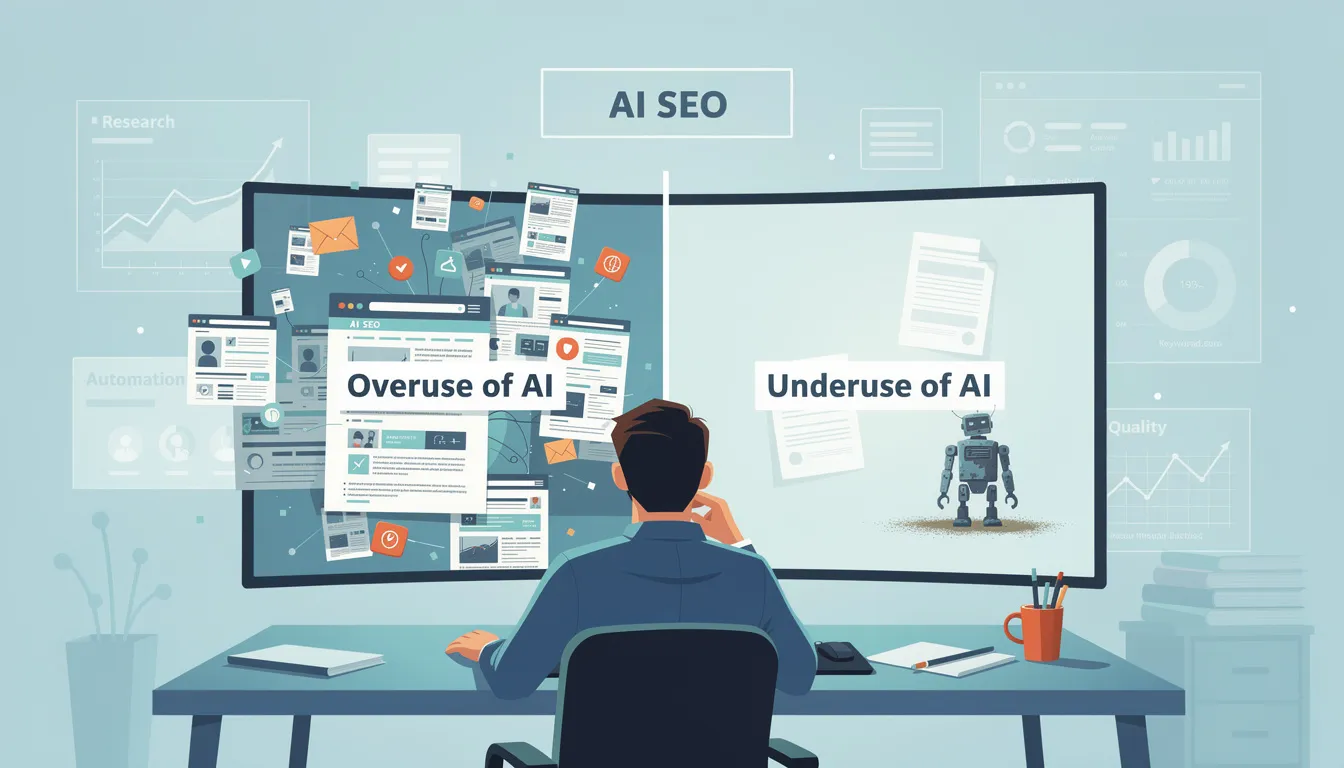
Many teams either overuse AI—publishing thousands of thin articles—or underuse it—ignoring research and automation benefits. Here are the most damaging mistakes and their remedies.
Publishing large volumes of unedited AI content
The September 2023 and March 2024 Helpful Content and core updates devastated sites that flooded their domains with lightly edited AI articles. The pattern was predictable: rapid content scaling, minimal human oversight, and sudden traffic collapse.
Example scenario: An affiliate site publishes 1,000 “best X for Y” articles in three months using AI generation with minimal editing. Traffic grows initially, then drops 70% after a core update. The site never recovers because the content lacks genuine expertise, original research, or user value.
Quality checklist before publishing AI-assisted content:
-
[ ] Does this article contain information unavailable elsewhere?
-
[ ] Have I added personal experience, data, or examples?
-
[ ] Would I be proud to attach my name and face to this?
-
[ ] Does it meaningfully help someone make a decision or complete a task?
Safer approach: Slower publishing, stronger editing, clear expertise signals, and limiting automation to templated sections like FAQs and definitions.
Optimizing only for rankings, not for AI answer inclusion
Some SEOs still chase positions 1–3 while ignoring how their content performs in AI Overviews and answer surfaces. This creates a dangerous blind spot.
AI summaries may cite competitors even when you outrank them in classic results. A page ranking #2 with clear, extractable answers might appear in the AI Overview while the #1 result gets overlooked because its content is harder to parse.
Adjustments for existing top pages:
-
[ ] Check your presence in AI Overviews for core keywords monthly
-
[ ] Tighten answer sections at the top of key pages
-
[ ] Add FAQ schema to pages already answering specific questions
-
[ ] Include unique data or perspectives that make your content more citable
-
[ ] Review structured data implementation for accuracy
Ignoring entity and brand consistency
Inconsistent names, outdated descriptions, and fragmented NAP data confuse AI systems trying to connect mentions to your brand. If your website says “Acme Digital Solutions,” your LinkedIn says “Acme Digital Marketing,” and Crunchbase says “Acme Inc.,” AI models may treat these as separate entities.
Entity consistency checklist:
-
[ ] Unify brand naming in title tags, meta descriptions, and on-page headings
-
[ ] Sync descriptions across LinkedIn, X, Crunchbase, and major directories
-
[ ] Update logos and brand colors consistently across profiles
-
[ ] Ensure NAP information matches exactly for local businesses
-
[ ] Periodically ask AI tools how they describe your company
Chasing “AI hacks” instead of fundamentals
Short-lived prompts, secret tags, and “model exploits” promising instant AI rankings rarely last and often backfire. The SEO industry has seen countless “tricks” come and go—doorway pages, link networks, cloaking—and AI shortcuts will follow the same pattern.
Enduring levers that compound over time:
-
Information gain through original research and expertise
-
Clear structure that AI and humans both appreciate
-
Trust signals built through quality content and earned mentions
-
Technical cleanliness that removes friction from crawling and indexing
Experiment thoughtfully, but anchor your strategy in fundamentals that have driven SEO success for decades. The tactics change; the principles remain.
Neglecting UX and conversion optimization
With more zero-click searches and AI summaries, you’ll receive fewer but more qualified visits. Users who do click through are further along in their decision process. Poor UX wastes these valuable visits.
UX priorities for AI-era traffic: For businesses looking to drive organic growth and boost their online presence, consider leveraging SEO-optimised content strategies and blogs tailored for the AI era.
-
Readability: Clean typography, appropriate contrast, generous spacing
-
Matching CTAs to intent: Don’t push aggressive sales CTAs on informational queries
-
Streamlined conversion paths: Reduce form fields, simplify checkout, remove friction
-
Mobile excellence: Most search happens on phones; design accordingly
AI systems may indirectly consider UX signals when learning which pages satisfy queries. High bounce rates and quick returns to search suggest your content didn’t deliver what the AI promised.
How to measure success in AI-era SEO
Traditional dashboards track rankings and traffic. Modern measurement must include visibility and influence in AI surfaces where brand exposure happens without clicks.
Classic SEO metrics that still matter
These remain essential KPIs, especially for transactional and navigational queries where AI summaries are less dominant:
-
Organic sessions and conversions: Bottom-line impact measurement
-
Keyword rankings and share of voice: Competitive positioning
-
Index coverage and crawl stats: Technical health indicators
-
Backlinks and referring domains: Authority signals
Track these in Google Search Console, GA4, and your primary SEO platform. They provide continuity with historical performance and remain the best indicators for many query types.
New AI visibility and engagement metrics
AI-specific metrics require new tracking approaches:
-
AI Overview presence: Does your content appear in Google’s AI-generated summaries?
-
Source citation frequency: When AI systems generate answers, are you cited?
-
Brand mention share: For core topics, what percentage of AI responses mention your brand versus competitors?
-
Featured snippet ownership: Are you winning the “position zero” result?
Tools tracking these metrics include Semrush One’s AI Visibility reports, SE Ranking AI Overview Tracker, Rankscale.ai, and manual monitoring via periodic searches.
Indirect indicators of AI exposure:
-
Branded search volume growth (people discover you in AI answers, then search your name)
-
Direct traffic increases (recognition from AI exposure drives direct visits)
-
Assisted conversions (first touch from AI exposure, later conversion from another channel)
Qualitative checks: How AI systems describe your brand
Numbers don’t capture everything. Periodically test how AI systems perceive your brand:
Quarterly AI brand review: For a deeper look at how your digital foundation can drive growth, see our web, SEO & data solutions.
-
[ ] Ask ChatGPT: “What is [Your Brand]?” and “Is [Your Brand] trustworthy?”
-
[ ] Ask Perplexity the same questions
-
[ ] Run queries in Google’s generative search for your market
-
[ ] Document inaccuracies, outdated information, or competitor confusion
-
[ ] Update site content, schema, and off-site profiles to correct issues
Misstatements reveal entity signal gaps. If ChatGPT says your company was “founded in 2018” when you launched in 2020, your About page and structured data need attention.
Will AI replace SEO – or just redefine it?

AI is reshaping workflows and search experiences, but core SEO principles remain essential—and arguably more important than ever. Serving user needs, maintaining technical health, communicating with clarity, and building trust will define success regardless of how search interfaces evolve.
Entry-level, task-only roles face automation pressure. Manual keyword tracking, basic copywriting without subject expertise, and routine reporting are increasingly handled by AI tools. However, strategic, cross-functional roles are growing. Someone needs to decide which topics to pursue, what positioning differentiates, how to build brand authority, and where quality thresholds lie.
Skills SEOs should develop for the AI decade:
-
Data literacy: Interpreting patterns, designing tests, validating AI suggestions
-
UX and conversion optimization: Maximizing value from reduced traffic
-
Brand strategy: Building entity recognition across AI systems
-
Content strategy: Orchestrating topic clusters and information architecture
-
Prompt engineering: Getting maximum value from AI tools
-
Cross-channel thinking: Understanding how search, social, and AI discovery interconnect
The next 5–10 years will bring more AI-native search interfaces, heavier personalization, and multimodal results blending text, video, and interactive elements. Teams that blend human judgment with AI efficiency will thrive. Those betting entirely on one or the other will struggle.
Conclusion: Making artificial intelligence SEO work for your business
AI SEO means two things working together: using AI tools to accelerate your work and optimizing your content for AI-driven search experiences. Neither alone is sufficient; both together create compound advantage.
Key takeaways:
-
AI SEO builds on traditional fundamentals (E-E-A-T, structure, technical health) while adding new requirements for extractability and entity clarity
-
Tools compress research, writing, and optimization time but require human strategy and quality control
-
Measurement must expand beyond rankings to include AI visibility, brand mention share, and qualitative perception checks
-
Sustainable advantage comes from original expertise, not AI shortcuts
30–60 day action plan:
|
Week |
Focus |
|---|---|
|
1–2 |
Audit top 20 pages for AI extractability; check entity consistency; set baseline AI visibility KPIs |
|
3–4 |
Build or refine one topic cluster with proper internal linking; implement FAQ and Article schema on priority pages |
|
5–6 |
Establish AI-assisted content workflow; create 3–5 articles using the controlled drafting process |
|
7–8 |
Set up AI visibility tracking; run first qualitative brand check; document baseline and month-one changes |
Start small. Pick one content hub, one reporting dashboard, one set of AI SEO tools. Measure what changes. Iterate based on real results, not theoretical best practices.
The teams that blend genuine expertise with intelligent automation will dominate search through 2026 and beyond. The technology will keep evolving, but the fundamentals—serving users, building trust, creating clarity—remain constant.
Begin today. Audit your top pages. Ask AI systems how they describe your brand. Identify one topic cluster to strengthen. The compound gains start with a single focused step.
FAQ on Artificial Intelligence SEO
What is artificial intelligence SEO?
Artificial intelligence SEO (AI SEO) is the process of making your content discoverable, extractable, and trusted across AI-powered search experiences. It builds on SEO fundamentals but develops them further to align with the way AI systems interpret, summarize, and surface information. AI SEO prioritizes how content is interpreted, extracted, and represented by AI systems, and involves optimizing content for retrieval and citation within AI-generated answers, not just for ranking. This approach blends classic SEO techniques with strategies tailored to AI-driven search environments.
How does AI impact SEO?
AI transforms SEO by improving the efficiency and accuracy of keyword research, content optimization, and technical audits. AI-powered search engines better understand user intent and context, enabling more personalized and relevant search results. AI tools analyze vast datasets to identify emerging search trends and content gaps, helping businesses stay ahead of competitors. However, AI also raises the bar for content quality, emphasizing expertise, authoritativeness, and trustworthiness (E-E-A-T).
Can AI replace SEO professionals?
AI can automate repetitive SEO tasks and assist in content generation, but it cannot replace the strategic thinking, creativity, and expertise of SEO professionals. Successful AI SEO efforts combine AI efficiency with human oversight to ensure content quality, proper tone, and alignment with user intent. SEO professionals guide AI tools to produce optimized, authoritative, and user-focused content.
What are the best AI SEO tools?
Some of the best AI SEO tools include Semrush One, Surfer SEO, SE Ranking, Rankability, Koala AI, and Whatagraph. These tools offer features such as keyword research, content optimization, rank tracking, site audits, and AI visibility monitoring. They help streamline SEO workflows, improve content quality, and track SEO performance across traditional search engine results pages and AI-powered search environments.
How do I optimize content for AI-powered search engines?
To optimize content for AI-powered search engines, focus on semantic structure, clear and concise answers, and entity clarity. Use schema markup to provide structured data that AI systems can easily interpret. Target long-tail and conversational queries that reflect natural language search behavior. Regularly update content to maintain accuracy and relevance. Incorporate E-E-A-T principles by showcasing expertise, experience, and trustworthiness.
What is Generative Engine Optimization (GEO)?
Generative Engine Optimization (GEO) is a subset of AI SEO focused on optimizing content to be selected and cited in AI-generated summaries and answers, such as Google AI Overviews and Bing Copilot. GEO emphasizes creating extractable, well-structured passages that provide unique insights and high information gain, increasing the likelihood of being featured in AI-generated answers.
How do I measure AI SEO success?
Measuring AI SEO success involves tracking traditional SEO metrics like organic traffic, keyword rankings, and conversions, alongside AI-specific visibility indicators. Monitor your presence in AI-generated answers, citation frequency, brand mention share in AI responses, and featured snippet ownership. Tools like Semrush One, SE Ranking AI Overview Tracker, and Rankscale.ai can help track these metrics. Qualitative checks, such as querying AI models about your brand, also provide insights into your AI SEO effectiveness.
Is AI-generated content bad for SEO?
AI-generated content is not inherently bad for SEO but must meet high standards of quality, originality, and user value. Google’s algorithms penalize thin, generic, or low-value AI content. Combining AI-generated drafts with human expertise to add unique insights, verify facts, and align with user intent ensures AI-assisted content performs well in search rankings and AI-powered search results.
How can AI tools improve keyword research?
AI tools enhance keyword research by quickly analyzing large volumes of search data to identify relevant keywords, emerging trends, and user intent. They help discover long-tail keywords and topic clusters that competitors may overlook. AI-powered keyword research tools provide valuable insights into search volume, keyword difficulty, and related queries, enabling more strategic SEO efforts.
What role does E-E-A-T play in AI SEO?
E-E-A-T (Experience, Expertise, Authoritativeness, and Trustworthiness) is critical in AI SEO as AI-powered search engines prioritize content from credible sources. Demonstrating genuine expertise and experience through author bios, case studies, original research, and authoritative references increases the likelihood of your content being selected for AI-generated answers and ranking well in search engine results pages.
How does AI affect link building strategies?
AI assists link building by identifying high-quality backlink opportunities, analyzing competitor backlink profiles, and automating outreach processes. AI-powered SEO tools can suggest relevant sites for link acquisition and track link-building progress. However, human judgment remains essential to build authentic, authoritative backlinks that positively impact SEO performance.
Can AI SEO tools help with technical SEO?
Yes, AI SEO tools can automate technical SEO audits by detecting issues such as broken links, duplicate content, slow page speed, and indexing problems. They prioritize fixes based on potential SEO impact, generate developer-friendly reports, and monitor site health continuously. Tools like Indexly also automate indexing submissions to speed up content discovery by search engines.
How do AI SEO tools support content optimization?
AI SEO tools analyze your content against top-ranking pages to suggest improvements in keyword usage, content length, heading structure, and internal linking. They identify content gaps, recommend related keywords, and help maintain readability and engagement. Using these tools alongside human editing ensures optimized, user-friendly, and search-engine-friendly content.
What are common mistakes to avoid in AI SEO?
Avoid publishing large volumes of unedited AI-generated content, optimizing solely for rankings without considering AI answer inclusion, neglecting entity and brand consistency, chasing quick AI hacks, and ignoring user experience and conversion optimization. Instead, focus on quality, clarity, expertise, and continuous content improvement to succeed in AI-driven search landscapes.
How often should I update content for AI SEO?
Regular content updates are essential, especially for topics where recency matters. Audit your top-performing pages every 6–12 months, prioritize updates for Your Money, Your Life (YMYL) topics, and ensure data and references remain current. Freshness improves your chances of being cited in AI-generated answers and maintaining strong search rankings.
What is the future of SEO with AI?
The future of SEO involves a hybrid approach combining traditional SEO fundamentals with AI-driven strategies. AI will continue to enhance keyword research, content creation, and predictive analytics. Search will become more personalized, multimodal, and conversational. SEO professionals who integrate AI tools with human expertise will achieve the best SEO performance and adapt to evolving search engine algorithms.

0 comments